The Universidade de São Paulo (USP) is separate from INTIAU; Arquitetura e Urbanismo, or Architecture and Urbanism, is USP’s own undergraduate course. This guide concerns FAU in São Paulo. The faculty description connects buildings, urban space, landscape, heritage and environmental considerations within a broad architectural education.
Architecture becomes easier to compare when you move between scales. A window, a room, a building and a street can be studied as parts of one situation, yet each raises different questions. Keep a page of questions at each scale while reading the degree requirements. That is more informative than equating an attractive studio title with a complete professional education.
Use the correct campus and curriculum edition
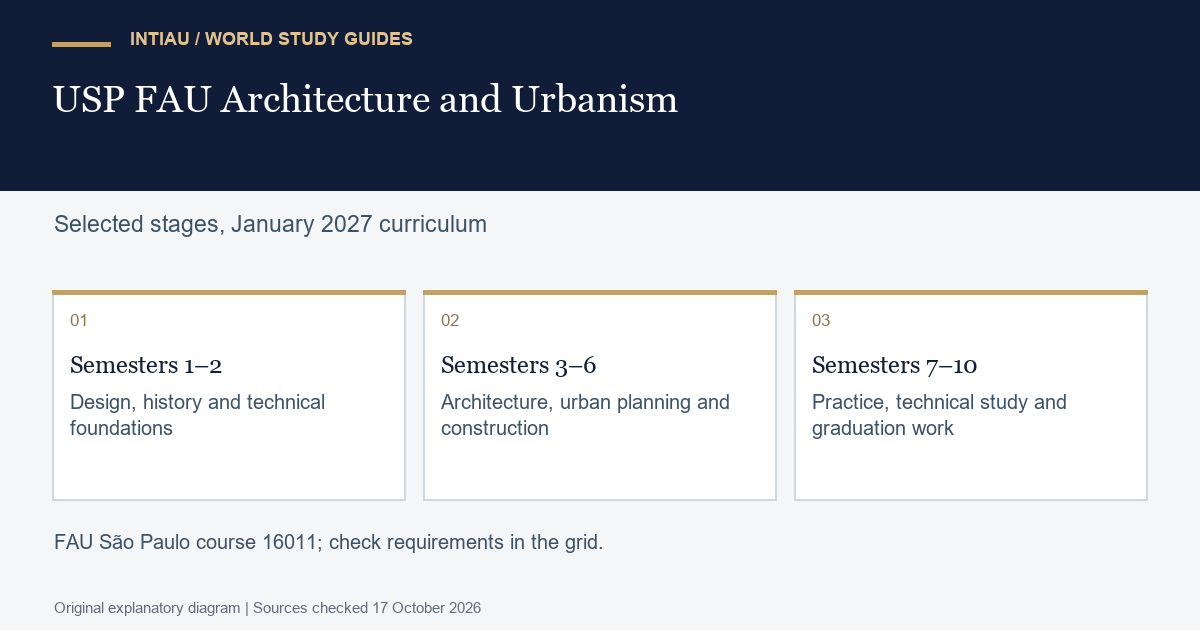
The official JupiterWeb grid for FAU course 16011 has a start date of 1 January 2027 and an ideal duration of ten semesters. The following map groups selected required work. It is not the São Carlos curriculum or a complete timetable.
| Semesters | Examples |
|---|---|
| 1–2 | Design foundations, history, construction, environmental comfort and representation. |
| 3–6 | Architectural projects, urban planning, structures and construction development. |
| 7–8 | Supervised internship, professional practice, costs and foundations. |
| 9–10 | Trabalho Final de Graduação I and II. |
Read this map horizontally and vertically. Horizontally, ask how a design proposal could be tested through history, construction or environmental evidence. Vertically, ask what earlier preparation a later activity needs. Keep the university’s original Portuguese names beside your English notes so that a translated label does not hide a prerequisite or change the meaning of a module.
A real environmental comfort syllabus example
The linked AUT0282 syllabus, activated in January 2026, names Environmental Studies 1 – Fundamentals in English. It connects thermal, acoustic, visual and ergonomic comfort with energy efficiency, field measurements, physical models and solar geometry. Its published evaluation includes work developed through exercises, measurement activities and design practice. This is one selected syllabus; it does not describe every studio’s assessment.
That example gives a useful comparison test: can you identify a method for checking a design claim? “The room feels brighter” is an observation; a labelled comparison of two proposals needs a stated method and consistent conditions. When reading another school’s outline, look for the relationship between a proposal, evidence and revision, rather than assuming that all environmental modules teach identical tasks.
An original room-and-street study exercise
This optional exercise is created for this guide, not assigned by USP. Choose a familiar room that you can observe without disturbing anyone. Draw a rough plan and mark the openings, seating and route through it. Make two alternative furniture arrangements on separate sheets. Use simple dimensions if you can measure safely, and mark estimates clearly.
For each arrangement, write one question about movement, one about daylight and one about sound. Record an observation that could help answer each question. Keep the time and conditions in your notes so that you do not compare a quiet evening with a busy afternoon as if only the furniture had changed. Avoid claims that your sketch proves compliance with a building standard.
Now place the room within a rough street sketch. Where does its entrance meet public movement? What is missing from your evidence about access or neighbouring uses? Finish with a short explanation of one trade-off: an arrangement may help one activity while making another harder. Your output should be a pair of alternatives and an honest evidence list, not a polished rendering that conceals unanswered questions.
FUVEST 2027 is a dated undergraduate route
FUVEST’s 10 August 2026 announcement for the 2027 vestibular gave registration dates of 17 August to 9 October 2026. Registration had therefore closed by this guide’s 17 October check. It listed the first phase for 1 November and the second for 6–7 December 2026. These are dates for that selection cycle, not a recurring annual rule.
Use the official selection materials to check the career, campus, school qualification and applicant category that apply to you. A curriculum link does not submit an application. Keep undergraduate selection separate from similarly named master’s or doctoral notices. For another entry year, locate its own published regulations before transferring any date or document requirement.
Frequently asked questions
Does this guide cover the São Carlos architecture course?
No. Its grid is FAU São Paulo course 16011, with curriculum effective 1 January 2027.
Is the environmental comfort example a real published syllabus?
Yes. AUT0282 has an official JupiterWeb outline, with January 2026 activation, linked from the curriculum.
Was registration for FUVEST 2027 still open on 17 October 2026?
No. The announced registration period ended on 9 October 2026.
For INTIAU’s own information, use Courses or Contact. USP and FUVEST control their respective academic and selection processes.
Related guides
View the curriculum diagram