
The University of Ghana offers the BSc (Agricultural Engineering); this independent university programme is separate from INTIAU.
Checked 17 October 2026. Current undated department curriculum and admission pages checked 17 October 2026; no 2027 timetable inferred.
Look at engineering decisions within agricultural systems
The department connects its degree with machinery, irrigation, storage and engineering problem-solving. Its published teaching methods include lectures, project work and field visits or internships. Programme and entry.
Compare this route through the decisions a learner must explain. A storage system involves the material being stored, the equipment that moves it and the operating environment. A useful preparation notebook should keep those pieces connected instead of reducing the subject to either farming practice or a list of machines.
Trace the department’s level-based course map
The following table selects examples from the current course directory. Its level filters are evidence of progression, not a complete registration schedule or a claim that every displayed course is compulsory. Confirm the applicable curriculum and option choices with the department.
| Level | Published example | Preparation question |
|---|---|---|
| 100 | AREN 114, Introduction to Biosystems Engineering. | What is the system boundary? |
| 200 | AREN 216, Soil Mechanics I. | Which material properties need measurement? |
| 300 | AREN 326, Irrigation Engineering II. | How do component choices affect a whole system? |
| 400 | AREN 400, Project. | How is a proposed solution tested and explained? |
For a syllabus example, AREN 326 covers micro-irrigation components, layout and hydraulic considerations. AREN 400 asks students to apply earlier learning to an engineering project with supervision, an oral presentation and a thesis. These are selected course descriptions. Course directory.
Match entry requirements to the applicant route
The departmental entry example requires core credits in English, Core Mathematics, Integrated Science and Social Studies; elective credits in Physics, Chemistry and Elective Mathematics; and at least B3 in Elective Mathematics. It directs international applicants to central admissions. Entry guidance.
Use the University’s international admission route for the qualification-specific process rather than converting the departmental example into an assumed foreign equivalence.
Record the award title on your school certificate, the examination system and the intended entry year. Make a separate list of any subject-name differences. An unresolved equivalency should remain a question until the published route or the university answers it. This guide does not announce a new application window.
Original exercise: a fictional produce-handling decision
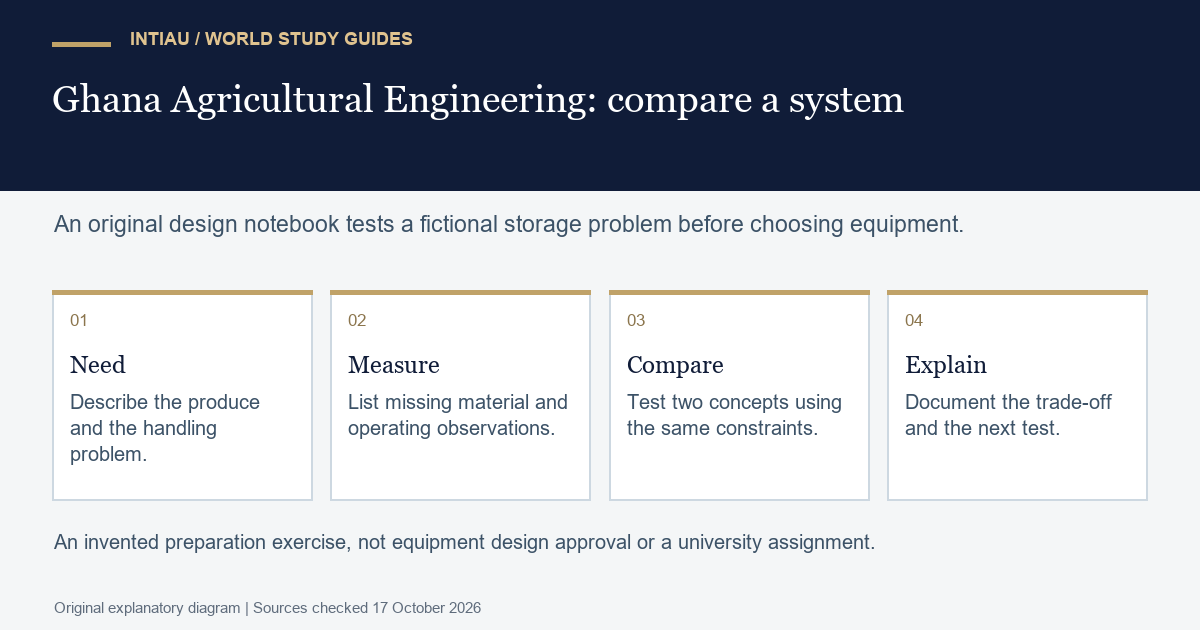
Imagine a small cooperative moving a fictional crop from a collection point to a storage room. Some produce arrives damaged. Write a need statement that describes the problem without choosing a conveyor, container or building alteration. Identify what is known, what is assumed and what has not been measured.
Draw the system boundary around receiving, movement and storage. Then propose two concepts: changing the container and changing the handling sequence. Compare both using damage risk, ease of cleaning, operator effort and compatibility with the space. Keep the criteria identical so that an attractive feature of one option does not quietly replace a missing requirement.
Create a small test plan using empty demonstration containers and invented results. Specify what would be counted as damage, how many repeated trials would be compared and what would stay constant. Label all numbers as illustrative. The aim is to practise fair comparison, not to recommend machinery or claim that a real agricultural product has been tested.
Add one new constraint: the room must also be used for another activity. Revisit both concepts and explain which part of your reasoning changes. A useful engineering argument should show the trade-off rather than conceal it in a single score. Finish with a one-page memo containing a sketch, your assumptions, the preferred next test and one reason to withhold a final decision.
Use the exercise to read course descriptions critically
When comparing another programme, ask which published learning experiences connect measurements, design choices and communication. Do not assume that two courses with “design” in their titles use the same task or assessment. Save one focused question about preparation and one about progression for official academic advising. Keep professional registration and employment decisions outside an undergraduate curriculum comparison.
Frequently asked questions
Is this an INTIAU-delivered engineering degree?
No. The named degree belongs to the University of Ghana; this article is an independent research guide.
Is every directory example a compulsory course?
No. Confirm course status and option requirements with the department.
Should an international applicant copy the local subject rule?
Use the official international route for your qualification and resolve equivalencies with the university.
View the curriculum comparison map
Official sources and further comparison
Continue your independent comparison through the INTIAU Courses directory, or use INTIAU Contact for a general enquiry. The university controls its programme and admissions decisions.