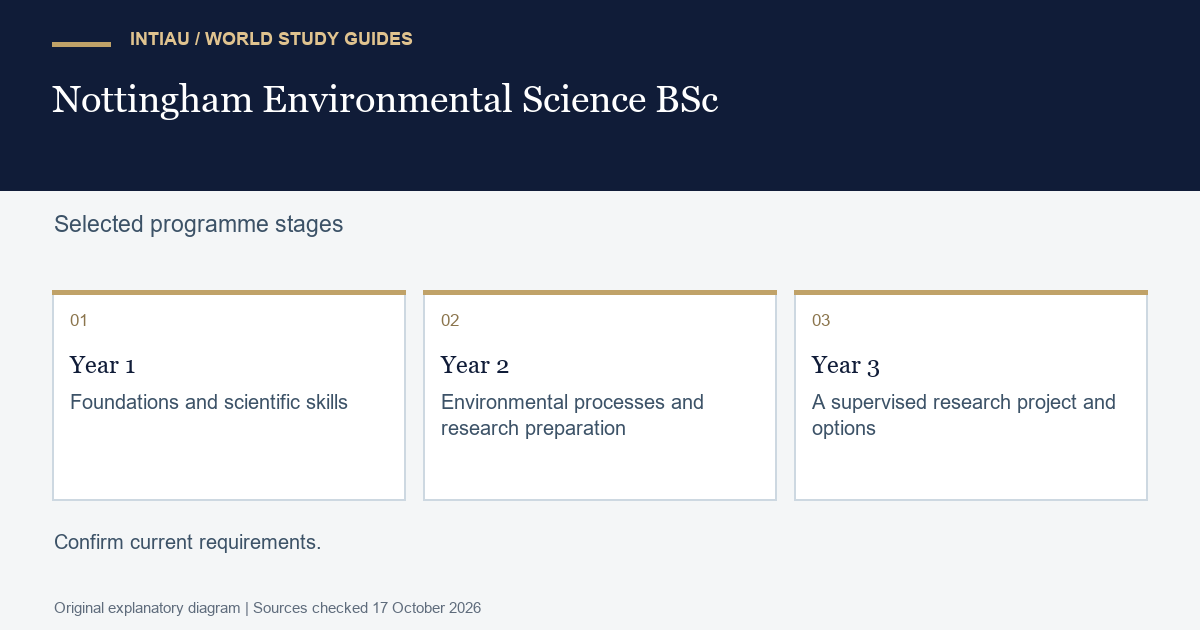
The University of Nottingham is separate from INTIAU; Environmental Science BSc (Hons) is its degree. The 2027 course page lists three years full-time at University Park Campus.
Environmental science comparisons become more useful when a broad concern is turned into an answerable question. “Cleaner water” is a goal. Comparing a defined observation at two sites is an investigation. Explaining what the result means for a decision is another task. Keep those tasks separate while reading a curriculum.
Selected stages and one real module example
| Year | Examples |
|---|---|
| 1 | Ecology, environmental systems and scientific skills. |
| 2 | Climate, geochemistry, surveying and research preparation. |
| 3 | Supervised research project and options. |
The first-year Academic Skills module uses a scientific paper, data analysis, presentation and referencing. This selected map is not the full syllabus.
Use the example to ask what a scientific record should allow another reader to check. A report needs more than a conclusion: it needs a question, an account of how observations were obtained and a clear distinction between results and interpretation. When comparing courses, look for opportunities to practise those connections rather than simply counting environmental topic names.
Original exercise: compare a monitoring question
This exercise is created for this guide, not assigned by Nottingham. Use a fictional dataset rather than entering a real site or collecting samples. Imagine two locations where a team wants to compare a water-quality indicator. Define the indicator and its units before you create any numbers. Write down why that observation might be relevant and what it would leave unanswered.
Create three imaginary readings for each location. Record them individually, then calculate a simple average for each set. Make one set more variable than the other. Explain why comparing only the averages could conceal something important. Do not label a location safe or unsafe from this paper exercise; no real environmental standard has been assessed.
Now introduce a sampling problem. One location was observed in the morning after rainfall and the other on a dry afternoon. Ask whether the apparent difference could be connected to timing or conditions. Write a revised comparison plan that makes its assumptions explicit. The useful output is not a guaranteed answer but a plan that another person could criticise constructively.
Add a communication task: prepare a short note for someone deciding whether further investigation is needed. State the observation, its limitation and the next question. Keep a proposed explanation separate from what the readings actually show. If the note uses the word “because”, identify the evidence supporting that causal link.
Turn the exercise into a programme comparison
Make a four-column worksheet headed question, method, evidence and communication. Put a specific activity from your exercise in each column. Then compare two published module descriptions. Record where each appears to develop that activity and where the description is silent. A gap in a short public summary is a question to ask, not proof that the programme never teaches the skill.
Consider which part of the task you most wanted to improve. You may be drawn to understanding environmental processes, designing observations, handling data or explaining uncertainty to a decision-maker. Those preferences can guide your next reading without turning one exercise into a career prediction. Save a concrete question for each programme you are comparing.
Application route and entry-year checks
Nottingham’s official undergraduate application article says applications are made online through UCAS and discusses choosing the degree and campus. Use the university’s current course information alongside that route. This guide checked the guidance on 17 October 2026 and does not infer an application deadline from an undated article.
Before applying, record the exact award, intended entry year and your qualification route. Keep questions about school subjects or English-language evidence separate from questions about course content. If you are considering a placement, another campus or a different award, locate its own conditions rather than assuming the three-year map covers it.
Read any final offer and later curriculum information against the same planning sheet. A remembered requirement can become outdated even when the subject name stays the same. Keep the date and official link beside each important note, and replace an assumption with the university’s answer when clarification is needed.
Frequently asked questions
Does this map list every module?
No. It selects published stages and one module example.
Can the study exercise replace an application?
No. Nottingham describes a separate UCAS application process.
Does this article verify a 2027 deadline?
No. Check the current entry-year calendar before submitting.
INTIAU’s separate information is available through Courses and Contact. Nottingham controls its programme and admissions decisions.
Related guides
View the curriculum diagram