
The University of Nairobi names this award Bachelor of Arts in Planning, within its Department of Urban and Regional Planning; it is independent of INTIAU.
Checked 17 October 2026. Current undated departmental pages checked 17 October 2026; no new intake deadline or guaranteed future curriculum.
Use the official award name
The programme directory lists Bachelor of Arts in Planning as four years, code B65. Programme directory.
In a comparison notebook, keep the award name, department and subject focus in separate fields. This makes it easier to compare programmes whose titles differ without assuming that their requirements or professional consequences are identical. Preserve the exact university wording when preparing an application or requesting a document.
Follow the scale of planning work
| Stage | Published example | Comparison question |
|---|---|---|
| First year | Introduction to Planning and quantitative preparation. | How is a planning problem defined? |
| Second year | Land economics, transportation and rural planning studio. | Which relationships connect a settlement to services? |
| Third year | GIS and remote sensing, planning law and urban studio. | How do spatial evidence and rules inform a proposal? |
| Fourth year | Planning research and regional studio work. | How does a local choice affect the wider region? |
The outline includes taught work, studios, fieldwork and attachment. Displayed course-code inconsistencies require confirmation. Programme outline.
Read a studio title together with its place in the wider sequence. A map can describe a pattern, while a proposal also needs an argument about priorities and consequences. When the public outline is undated, ask which approved curriculum governs the intended cohort before turning its examples into a fixed registration plan.
Prepare a route-specific admission enquiry
The outline describes KCSE and other qualification routes. Its KCSE example requires an overall C+ plus subject-cluster conditions.
The department’s application page describes a September main-intake pattern and links official application instructions. It does not supply a newly confirmed future closing date for this guide. Application route.
Write down your qualification, completion year and intended intake, then ask which route applies. Separate subject eligibility, document submission and any later academic requirements. Keep an unanswered equivalency question visible rather than converting a familiar grade label into an assumed match.
Original exercise: compare two service locations
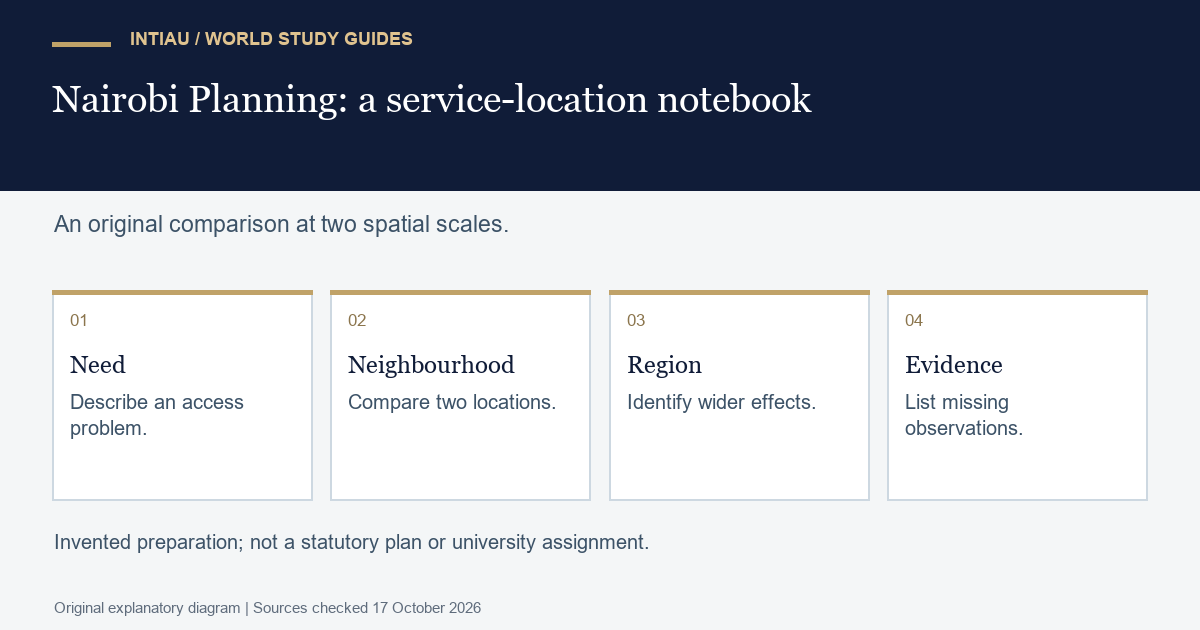
Imagine a fictional settlement choosing a location for a shared reading and internet room. Draw a neighbourhood with two possible sites, a bus route, a market and a river crossing. Assign invented walking distances and label them clearly. Write the service need without choosing a site in the opening sentence.
Compare both sites using access, exposure to disruption, compatibility with nearby uses and effects on different users. Use the same headings for both. If one site lacks evidence, write a question rather than assigning a convenient score. A comparison becomes weaker when unknowns are disguised as favourable assumptions.
Now change the spatial scale. Add two nearby settlements that might also use the service. Identify whether the preferred neighbourhood location still looks suitable when their access is considered. Explain which criterion changed in importance and why. This is an invented reasoning task; it does not establish demand, land rights or the suitability of a real site.
Create a simple evidence plan with one observation needed for each major uncertainty. For access, you might ask for a verified route and travel conditions. For demand, you might need a transparent account of who would use the service. For a proposed building, you would need information beyond the sketch. Keep these different questions separate.
Finish with a short recommendation that remains conditional on the missing evidence. Attach the first and revised maps, with a note explaining how the regional view affected the choice. The aim is to practise accountable reasoning across scales, not to produce a statutory plan or imitate an official university assessment.
Compare curricula without flattening their context
Use the exercise to ask how a programme connects quantitative evidence, studio work and institutional questions. Save the official source date beside your interpretation. A degree comparison can identify useful questions about learning progression while leaving admission, recognition and professional decisions to the responsible institutions.
Frequently asked questions
Is the award called Bachelor of Urban and Regional Planning here?
The department directory uses Bachelor of Arts in Planning. This guide retains that official name.
Is this the full syllabus?
No. Confirm the approved cohort curriculum with the department.
Does a September pattern prove a future application is open?
No. Obtain the actual intake notice and deadline through the university’s official application route.
View the curriculum comparison map
Official sources and further comparison
Continue your independent comparison through the INTIAU Courses directory, or use INTIAU Contact for a general enquiry. The university controls its programme and admissions decisions.