The University of Warwick is separate from INTIAU; Mathematics BSc is a Warwick degree. Its 2027 entry page identifies a three-year programme, UCAS code G100, at the University of Warwick.
To compare mathematics degrees, ask what changes between using a method and explaining why it works. A calculation can be correct without revealing its assumptions. A proof must make those assumptions visible. Keep both kinds of work in your comparison, particularly if your school experience has emphasised a familiar set of techniques.
A broad map during a curriculum revision
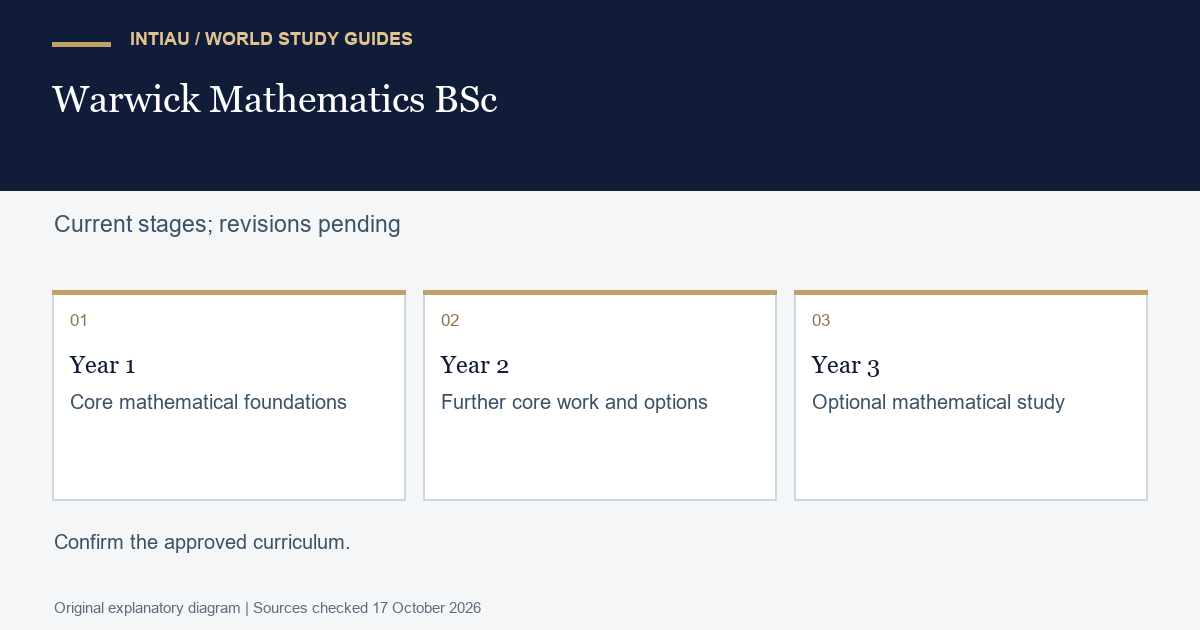
Warwick explicitly flags planned curriculum changes for 2027/28, subject to approval. The page describes core work in years one and two, then optional modules. This broad map is not a settled future module list.
| Year | Structure |
|---|---|
| 1 | Core foundations in algebra, analysis and applied mathematics. |
| 2 | Further core study and options. |
| 3 | Optional modules. |
A useful personal map has arrows as well as boxes. Put a concept you know in one box and a later topic you want to understand in another. Between them, record the preparation you still need. If you cannot explain an arrow, turn it into a question for the department instead of treating the course titles as a guaranteed route.
A genuine analysis module example
The 2026/27 MA141 Analysis 1 entry lists the module as core for the Mathematics BSc first year. Its indicative syllabus includes inequalities, real numbers, sequences, limits, series and continuity. The emphasis is precision and conceptual reasoning beyond school methods. This is a dated selected module, not a claim that the same code or syllabus will be required for 2027 entrants.
When reading that outline, separate the object, the definition and the argument. A sequence is an object; convergence needs a definition; a particular convergence claim needs an argument. This simple distinction helps you compare two descriptions that both use the word “analysis” but may assume different preparation.
Original exercise: test the scope of a claim
This exercise is created for this guide, not assigned by Warwick. Begin with the claim “squaring a number makes it larger”. Write down what “number” and “larger” could mean in this sentence. Try a negative number, zero, a positive fraction and a number greater than one. Make a small table showing the original value, its square and the comparison.
Use your examples to rewrite the claim with a precise domain. Do not stop after finding one counterexample. Ask whether there are separate ranges in which the statement is true, false or an equality. Explain your classification algebraically if you can, and mark any step you have used without justification.
Now compare two explanations: one that gives several examples and another that establishes the whole stated range. Identify what the examples reveal and what they leave unproved. Ask a reader to locate the exact step where your reasoning moves from a few cases to a general statement. If there is no such step, revise the argument rather than adding more examples indefinitely.
Finally, connect this task to study preferences. Did you most enjoy calculating values, identifying the missing assumption or constructing a complete argument? Choose two official module descriptions and record which of those activities each appears to develop. Keep a question where the description is silent. This produces a more useful comparison than simply counting how many familiar topics appear.
Check the entry-year requirements before applying
Warwick’s How to apply guidance explains the UCAS application route and links the relevant application support. Use it alongside the programme’s qualification-specific requirements. The application process and a department’s academic conditions answer different questions; completing one does not establish that the other has been satisfied.
Build an entry checklist with three columns: the requirement as published, your actual evidence and the question still unresolved. Add the intended entry year to every saved note. During a curriculum revision, revisit both the course structure and the conditions before accepting an offer. Leave unverified future module details blank instead of filling them from an older timetable.
Frequently asked questions
Is the 2027/28 module list final?
No. Warwick expressly flags changes undergoing approval.
Is MA141 a real Mathematics BSc example?
Yes. The 2026/27 entry lists it as core for that degree’s first year.
Where should I begin the undergraduate application?
Use Warwick’s official application guidance and its UCAS route.
INTIAU’s own information is available through Courses and Contact. Warwick determines its own academic and admission requirements.
Related guides
View the curriculum diagram