
McMaster University’s Honours Bachelor of Arts in Economics is an independent university degree, not an INTIAU programme or partnership.
Checked 17 October 2026. Current official routes checked 17 October 2026; sample course levels, not a complete 2027 calendar.
Separate first-year entry from upper-year choice
The current Honours Economics I page describes direct first-year entry. Students in that route continue automatically into standard Honours BA Economics without a new Level II application; specialized, combined, accelerated and co-op choices require selection applications. First-year route.
The practical distinction is between the programme you apply to from school and a later option you may wish to enter. Record both names. Someone beginning through a different Level I route should obtain advice about that route’s requirements, rather than assume the direct-entry continuation rule applies to them.
For Ontario applicants, the current page lists six 4U/M courses including English, Advanced Functions, and Calculus and Vectors. It identifies three core first-year Economics courses: ECON 1B03, ECON 1BB3 and ECON 1ME3. Entry and foundation.
Use course levels as a comparison scaffold
The department labels its course list “not all required.” Its examples span introductory theory, applied policy, econometrics and advanced research methods. The table below preserves that distinction. Degree overview.
| Level | Example | Question for a course outline |
|---|---|---|
| I | ECON 1B03: Introductory Microeconomics. | How are choices represented in a model? |
| II | ECON 2N03: Public Policy Toward Business. | Which market problem is a policy intended to address? |
| III | ECON 3EE3: Econometrics I. | How are estimates interpreted and challenged? |
| IV | ECON 4FF3: Research Methods in Economics. | What makes a research question answerable? |
Do not read a higher course number as proof that a course is compulsory, currently available or accessible without prerequisites. Build a prospective sequence only after identifying the award requirements and the restrictions on each choice. That prevents an appealing seminar from becoming an unsupported assumption in a degree comparison.
McMaster links current and archived term-specific outlines separately. The calendar supplies descriptions and prerequisites. Outline directory.
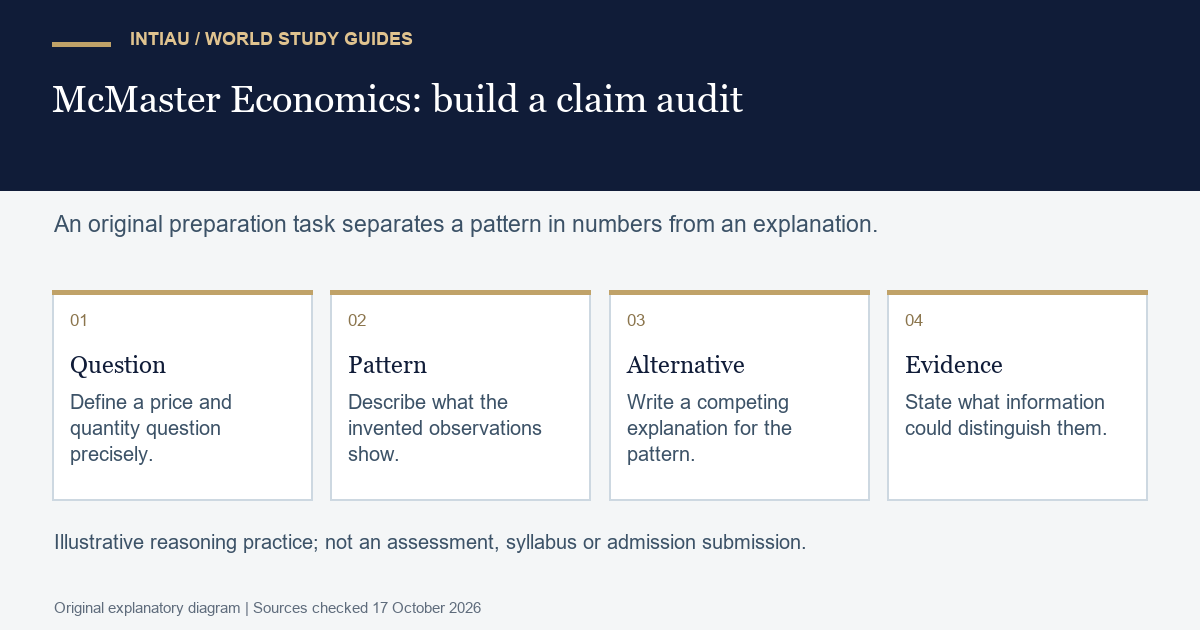
Original exercise: audit a demand claim
Invent a small dataset for four weeks at a fictional campus café. Record a sandwich price, sandwiches sold and whether a large event took place. Use prices of 5, 6, 6 and 7 units of fictional currency, and sales of 100, 85, 130 and 80. Mark the third week as the event week. State explicitly that these numbers are made up.
Write two descriptions. The first should summarize the pattern without explaining it. The second should propose an explanation involving price. Now identify why the third week complicates that explanation. It may contain a change in the number of potential customers, so a simple comparison of price and sales cannot settle the question by itself.
Add a competing explanation and request two additional observations that would help test it. For example, you might want a comparable week without an event or a record of how many people passed the café. Explain why each observation matters. Avoid treating a longer spreadsheet as automatically stronger evidence; relevance and comparability matter more than row count.
Finish with a one-paragraph memo divided into claim, evidence and limitation. Keep any calculation separate from the interpretation it is meant to support. If you draw a graph, label the axes and units and retain the event annotation. A reader should be able to reconstruct your reasoning without trusting a decorative trend line.
Build a route-specific application notebook
Keep school admission requirements, first-year course choices and later option requirements on different pages. Record the exact official source and date beside each. This guide checks current pages on 17 October 2026; it does not assign them an unannounced future deadline or turn an anticipated average into an offer. Resolve your school-system equivalencies through McMaster’s official admissions route.
For academic comparison, ask how mathematical reasoning, writing and evidence analysis connect across levels. Select one outline to inspect closely rather than collecting a long list of titles. Record the learning task, the prerequisite and the assessment information only when the applicable outline actually supplies them.
Frequently asked questions
Must every first-year student reapply for standard Honours Economics?
No. Current guidance distinguishes automatic standard-route continuation from Honours Economics I and applications for other upper-year options.
Are all table examples compulsory?
No. The department explicitly labels its sample list as not all required.
Does this reproduce the syllabus?
No. Use the relevant term’s official outline and calendar for detailed assessment and prerequisite information.
View the curriculum comparison map
Official sources and further comparison
Continue your independent comparison through the INTIAU Courses directory, or use INTIAU Contact for a general enquiry. The university controls its programme and admissions decisions.