Massey University is a separate institution; its Bachelor of Food Technology with Honours is not an INTIAU programme or partnership. The degree normally requires four full-time years and 480 credits. This guide focuses on the Food Product Technology major, not a separate food-science bachelor’s award.
The major is offered at Manawatū campus in Palmerston North and is open to international students studying on campus in New Zealand.
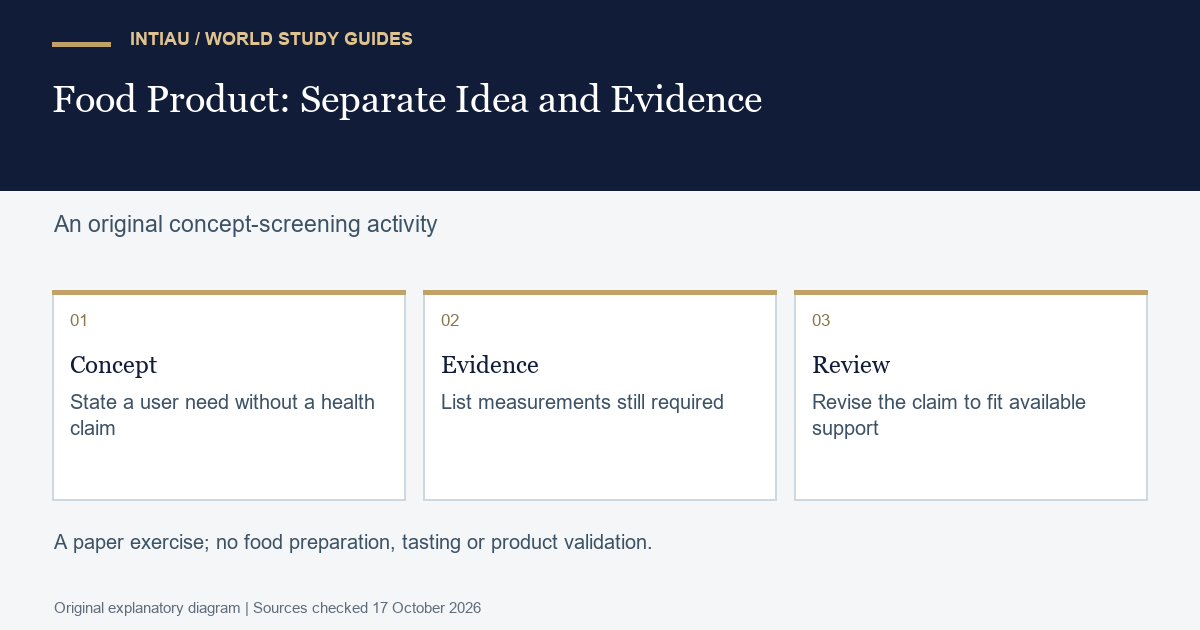
A useful food-product question contains both a desired change and a way to investigate it. “Make it better” is too vague. Ask what property should change, for whom and under which conditions. Keep a product concept separate from a health statement or an established safety conclusion. This makes curriculum comparisons more precise and keeps an imaginative idea from being mistaken for evidence.
Read the four-part structure
| Part | Examples, alongside other requirements |
|---|---|
| One | Chemistry, physics, mathematics and technology foundations. |
| Two | 141211 Food Product Development Principles; 280201 Industrial Microbiology. |
| Three | 141311 Food Microbiology and Safety; 141312 Food Characterisation; 141358 Nutrition and Food Choice. |
| Four | 141727 Innovative Food Design and Development I; 141733 and 141734 Food Technology Project I and II. |
The regulations also require 800 hours of practical work. Part-based progression and major requirements must be read together; this selected table is not the complete qualification schedule.
Look for connections between scientific explanation, measurement and product decisions. A course on characterisation and a course on development address different questions even when they examine a similar ingredient. In your reading record, keep one column for the confirmed requirement and another for the question you want to investigate. Do not replace a prerequisite check with a plausible learning sequence of your own.
Inspect a real nutrition-related course
The 141358 course page covers nutrient recommendations, diet and disease, food choice and ethical or legal issues surrounding nutrition claims. Use its current description to identify questions about evidence, rather than assuming it authorises any particular product claim.
Read a course description at the level it actually supports. A topic list is useful evidence of scope, but it is not a full weekly syllabus or a promise about the next assessment. When comparing programmes, ask what kinds of data students learn to interpret and how uncertainty is communicated. Keep commercial appeal, nutritional interpretation and food-safety evidence as separate headings.
Worked exercise: a fictional snack concept
Invent a packaged snack for people who want a less crumbly food to carry in a bag. Keep the brief about convenience; do not add a disease-prevention or nutritional benefit claim. On paper, compare concept A, a firm bar, with concept B, a small cluster format. Give each a hypothetical score for crumbling and a fictional user preference result, clearly labelled as simulated.
Suppose A has less simulated breakage but B is preferred by six of ten fictional respondents. Write two possible decisions and the assumptions behind them. One might prioritise carrying convenience, while another might require a revised cluster before proceeding. Explain why ten invented responses cannot establish a market preference, and why reduced crumbling says nothing by itself about shelf life or safety.
Make an evidence-request sheet with rows for texture, packaging, storage, user needs and claims. For each, state what you know, what remains unknown and who would need appropriate expertise to investigate it. No cooking, tasting or storage trial is required. Your output is a concept brief, an explicitly simulated comparison and a revised statement that does not outrun the evidence.
Finish by deleting one unsupported adjective from a mock product description. Replace “healthier and longer-lasting” with a narrower statement about the design goal, or leave the claim unresolved. This editorial step reveals why food development draws on several kinds of knowledge. It also gives you a concrete question to take back to the published course descriptions.
Keep application dates in their category
Checked on 17 October 2026, Massey lists 31 October 2026 for new international applications to standard Semester One 2027 qualifications, with later applications considered if space remains. Selected-entry qualifications have separate dates. Verify that the category and programme route apply before using the deadline.
Record academic and language evidence separately from the calendar. A deadline does not establish eligibility, and admission does not settle every later course choice. If your previous study is being assessed, obtain the university’s decision rather than treating similar course names as approved credit.
Three evidence questions
Does a product idea establish a health benefit?
No. A design goal and evidence supporting a public claim are different things.
Is the table a complete enrolment schedule?
No. It selects dated examples; the full regulations and progression rules remain necessary.
What should the exercise produce?
A concept brief, a transparent comparison and an evidence request, without claiming a validated food product.
Official source trail
- Food Technology honours degree
- Food Product Technology major
- 2026 university calendar
- 141358 Nutrition and Food Choice
- 2027 admission dates
For INTIAU information, visit INTIAU Courses or INTIAU Contact. These links do not apply to the separate institution discussed above.
Related guides
View the study diagram