The University of Tokyo is a separate institution; its Civil Engineering department within the Faculty of Engineering is not an INTIAU programme or partnership. The faculty lists the Bachelor of Engineering award. This guide concerns the traditional undergraduate route, not an English-only first-year civil degree.
The traditional-programme guidance identifies Japanese as the teaching language and describes Special Screening for applicants educated at high schools overseas. Eligibility and selection must be checked through that route’s current instructions.
Civil engineering study can connect a physical system with public decisions about resources and risk. Begin your comparison with a question that crosses that boundary. What evidence would justify repairing an existing asset before expanding another? A useful curriculum reading asks where technical reasoning, representation and decision-making meet, rather than assuming that a department title explains every stage of entry.
Distinguish common study and departmental progression
The Civil Engineering department is based at Hongo; common early study is a separate campus-stage question.
Tokyo’s undergraduate framework places the first two years in the Junior Division at Komaba before Senior Division study. That common framework should not be presented as guaranteed direct admission to a particular department from high school.
| Stage | What the department describes |
|---|---|
| Second-year A1/A2 | Introductory lectures. |
| Third-year S1/S2 | Foundational lectures, including structural and fluid mechanics, materials, planning and spatial information. |
| Third-year A1/A2 | Applied lectures and project-oriented exercises. |
| Fourth year | Research-group affiliation and graduation thesis. |
Read that table as an educational progression rather than a full prerequisite or graduation checklist. Make separate notes for common university requirements, departmental choices and research allocation. A diagram showing learning order does not settle every administrative rule. Keep the current official source beside your interpretation so another reader can tell which connections you have added.
Inspect a real early course example
The department’s Komaba page lists first-year science seminars from 2024 onward, including engineering for international projects and exploring Shibuya’s nature and history. These are selected early-course examples, not a complete 2027 syllabus or an admissions preparation requirement.
A seminar title gives you a starting question, not enough information to invent weekly activities. Ask what is observed, how a problem is framed and how a conclusion is communicated. When comparing a course from another university, compare the published outcome and evidence expected, rather than treating similar place names or project words as proof of equivalent study.
Worked exercise: which fictional asset needs attention?
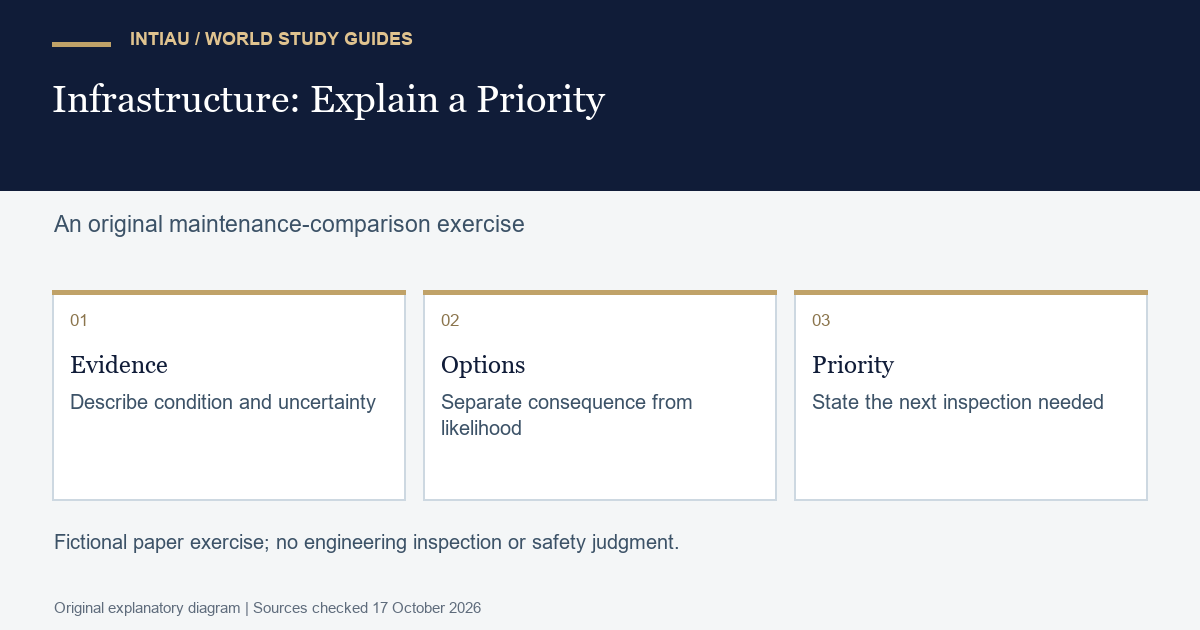
Create a paper inventory of three invented pedestrian-route assets: a small bridge, a stairway and a surfaced path. Give each a simulated condition label, an uncertainty level and a description of who would be affected by closure. Do not assign real load limits or safety ratings. The task is to examine a decision structure, not to judge an actual structure.
Suppose the bridge has an uncertain condition but a long alternative route, the stairway has a known minor defect with a nearby alternative, and the path has a frequent drainage complaint with unclear cause. Write two rankings: one prioritising better information and another prioritising possible disruption. Explain why the rankings can differ without either being a calculation error.
Choose one asset for a hypothetical next investigation. State which uncertainty the investigation would reduce and how its result could change the priority. Add a counterexample: what new information would make another asset more urgent? Your output should include the fictional inventory, both rankings and a short decision note. Ask a peer to identify any hidden assumption about users or alternative access.
Finish by separating likelihood, consequence and confidence in the evidence. Avoid collapsing all three into one unsupported number. A neat score can conceal a weak observation. This original exercise requires no field inspection, testing, records about real people or contact with an asset owner, and it is not an official Tokyo assignment.
Keep the route and date visible
Checked on 17 October 2026, this guide uses the linked traditional entry framework and current departmental information. It does not supply an unverified future application deadline. Record the exact applicant category and published admission edition before building a timeline, and distinguish eligibility for university screening from later departmental progression.
Three route questions
Is this an English-only high-school entry route?
No. The traditional route described here is Japanese-taught.
Does the stage table guarantee department entry?
No. It explains selected learning stages after the relevant progression decisions.
What should the priority exercise reveal?
The difference between a decision based on consequences and a decision about where better evidence is needed.
Official source trail
- Engineering departments and degrees
- Traditional undergraduate route
- Undergraduate common framework
- Civil curriculum overview
- Komaba course examples
For INTIAU information, visit INTIAU Courses or INTIAU Contact. These links do not apply to the separate institution discussed above.
Related guides
View the study diagram