The University of Western Australia is a separate institution; its Bachelor of Marine Science is not an INTIAU programme or partnership. The 2026 handbook lists BP023 at UWA Perth, comprising 144 points, normally 24 six-point units. This is the standalone bachelor’s route.
A marine curriculum is easier to compare when you begin with a question about a system. Are you most interested in organisms, water movement, interactions between them or evidence for a management decision? Write two questions before reading unit names. This prevents an attractive fieldwork photograph from standing in for an understanding of what you would actually learn.
Trace biological and physical preparation
| Level | Examples, not a complete personal plan |
|---|---|
| 1 | BIOL1130 Frontiers in Biology; EART1105 Dynamic Planet; SCOM1101 Communicating Science. |
| 2 | SCIE2204 Marine Systems; BIOL2204 Marine Biology; EART2204 Coastal Processes. |
| 3 | ENVT3307 Oceanography; SCIE3304 Field Techniques in Marine Science. |
The extended-major page separately identifies bridging requirements. Mathematics and chemistry preparation can affect first-year choices; check your equivalent qualifications rather than assuming every student starts with the same timetable.
Draw arrows between a foundation, an analytical method and an application. Label each arrow as either an official prerequisite or your own interpretation. Those categories matter: a connection that makes intellectual sense is not necessarily an enrolment rule. Keep the entire degree’s requirements beside the major, particularly when considering electives or additional study interests.
Inspect a real field-methods unit
The SCIE3304 description connects marine research with sampling design, statistical analysis, scientific communication and teamwork. Its indicative assessments include critical analysis, a group project and a project report. The detailed outline remains the authority for the applicable offering.
Use that example to ask how observation becomes a defensible conclusion. A useful course comparison records what students measure, how variation is handled and how findings are communicated. Also note practical arrangements that require current confirmation. Do not infer access arrangements, residential dates or a weekly timetable from a short catalogue description.
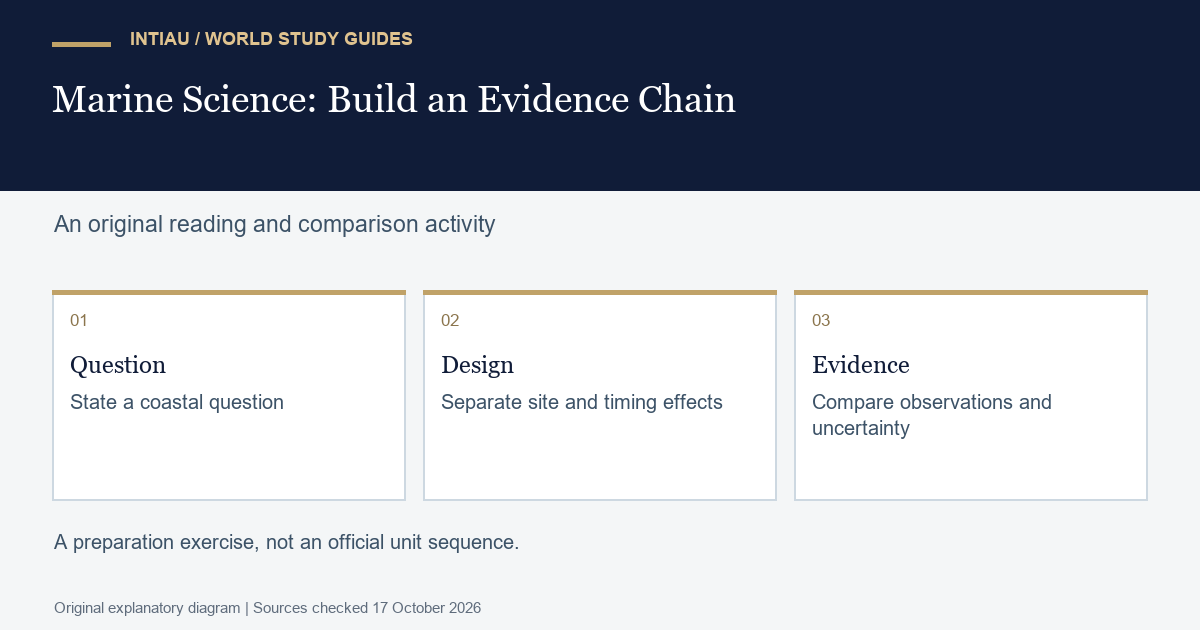
Worked exercise: distinguish place from timing
Imagine two fictional coastal sites, A and B. A simulated observation sheet gives counts of a harmless imaginary organism: A has 8 and 12 in two samples, while B has 14 and 18. Calculate a mean of 10 for A and 16 for B. Write the limited observation first: these four invented samples differ. Do not immediately conclude that the sites cause the difference.
Now add a complication: all A samples were recorded in the morning and all B samples in the afternoon. Time and place have changed together. Sketch a revised sampling grid that includes both sites at both times, with repeated observations. Explain which comparison the revised design would permit and what it would still leave unresolved. Keep this a paper exercise; no collecting or access to a real coastal site is necessary.
Create a one-page output containing the fictional dataset, the two means, the revised grid and a paragraph separating observation from explanation. Add one missing variable, such as a simulated difference in exposure, and explain how you would record it. Ask a peer to find the strongest unsupported inference in your first draft. Revise that sentence rather than hiding the uncertainty in a footnote.
Separate admission from curriculum planning
Checked on 17 October 2026, UWA’s international application guidance allows direct online application or an agent route and asks applicants to meet academic and English requirements. This guide does not infer a 2027 closing date from the 2026 handbook.
UWA states that English is its language of instruction and assessment. Accepted evidence and any higher course requirements must be checked against its current language policy.
Prepare two separate records: evidence that you meet entry conditions, and questions about the curriculum for your eventual cohort. Record the handbook year on every saved note. If an adviser answers a bridging question, retain the precise qualification context so you can distinguish individual advice from a general rule.
Three planning questions
Is this the combined bachelor’s and master’s course?
No. This guide concerns BP023, the standalone bachelor’s degree.
Does the table establish a 2027 timetable?
No. It is a selected 2026 catalogue map, requiring a fresh cohort and offering check.
What should the sampling exercise produce?
A transparent comparison, a revised design and a clear statement of what the invented observations cannot establish.
Official source trail
- 2026 degree rules
- 2026 Marine Science major
- SCIE3304 field techniques
- International application route
- English language requirements
For INTIAU information, visit INTIAU Courses or INTIAU Contact. These links do not apply to the separate institution discussed above.
Related guides
View the study diagram