EPFL is a Swiss institution separate from INTIAU; its Computer Science bachelor is an EPFL programme. This guide concerns the undergraduate route described on the official programme page, rather than a master’s specialisation.
A useful comparison begins with the kind of thinking a programme asks you to practise. Programming can produce an answer; computer science also asks whether the answer is correct, how the method scales, and which assumptions the machine model makes. Keep those questions separate when evaluating a course list. A familiar programming language does not by itself tell you how much mathematical reasoning or systems work a degree contains.
Read the two curriculum stages separately
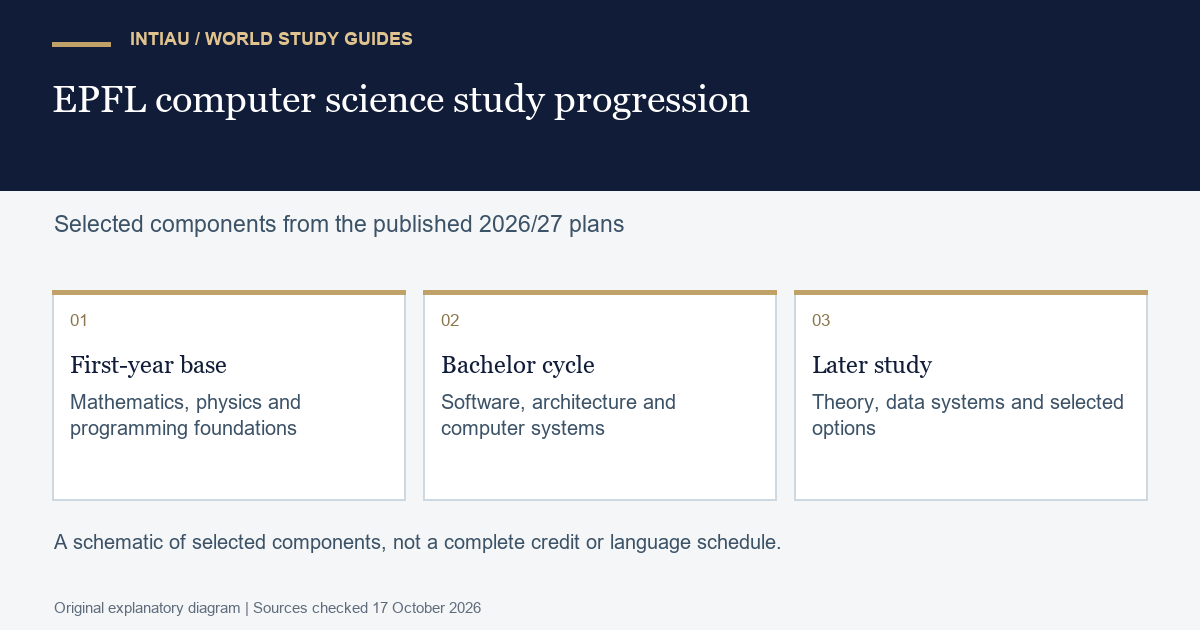
The 2026/27 first-year plan lists mathematics, physics and programming foundations. Its language column matters: an English version of the website does not make every first-year class English-taught.
| Stage | Examples of published components |
|---|---|
| Semesters 3–4 | Software Construction, Computer Architecture and Computer Systems |
| Semesters 5–6 | Theory of Computation, Data-Intensive Systems and options |
The official bachelor-cycle catalogue identifies credits, semesters and teaching languages. This short selection is not the complete degree plan or a promise of an unchanged future timetable.
Read across the plan as well as down it. A software subject and a hardware subject may illuminate the same problem from different directions. In a comparison notebook, record the question each component helps answer: how to express an algorithm, what resources it consumes, or how execution changes when several activities interact. This produces a more informative comparison than counting subjects with fashionable names.
A real course example
Software Construction, CS-214, covers building reliable modular software, including abstraction, types, specification and testing. The published outline connects programming practice with reasoning about behaviour. It is an example course, not a reproduction of its syllabus.
Worked exercise: specify before testing
This original exercise is independent of EPFL coursework. Design a function that removes repeated integers while preserving their first appearance. For input [4, 2, 4, 3, 2], the required output is [4, 2, 3]. An implementation returning [2, 3, 4] has removed duplicates but failed the ordering requirement. Sorting first therefore changes the problem, even if the result looks tidy.
Write three properties before choosing an implementation. Every output item must occur in the input. No output item may appear twice. If two distinct items first occur in a particular order, the output must preserve that order. Add the empty list and a list containing only one repeated value to your tests. These examples probe different boundaries; five ordinary lists with no duplicates would reveal much less.
Now trace a simple approach: scan left to right, keeping a set of values already seen and a separate output list. After reading [4, 2, 4], the set contains 4 and 2, while the output is [4, 2]. The next unseen value, 3, is appended; the final 2 is ignored. Explain why this preserves the first occurrence rather than merely stating that the example works.
Finally, distinguish a correctness claim from a performance claim. A repeated search through the growing output list can still give the right answer while doing more work than a suitable membership structure. Describe the input size and operations being counted before using words such as “efficient”. This miniature comparison tests whether you enjoy precise requirements, counterexamples and explanations as well as writing code.
For your comparison notes, draw two columns headed “evidence of correctness” and “evidence of cost”. Put a counterexample in the first and an operation count in the second. If one column remains empty, identify the missing work before declaring a solution finished. This makes your learning preferences visible without pretending that a small exercise represents an entire degree.
Application and language scope
Use EPFL’s qualification-specific bachelor admission guidance. French at B2 is required and C1 is recommended. The institution warns that criteria are updated annually; guidance checked on 17 October 2026 should not be treated as a final 2027-entry calendar. Follow the applicable qualification category and official application instructions.
Questions about this route
Does an English catalogue remove the French requirement?
No. EPFL’s bachelor admission guidance requires French proficiency.
Is the table the full curriculum?
No. The linked study plan contains the complete course and credit information.
Is the worked exercise an EPFL assessment?
No. It is an original comparison exercise for prospective readers.
For INTIAU’s own information, use Courses or Contact.
Related guides
View the study diagram