
The Federal University of Rio Grande do Sul identifies its Bacharelado em Ciência da Computação through the Instituto de Informática; this independent guide concerns UFRGS study, not an INTIAU programme or partnership. Programme resolution.
A useful computing comparison separates a course’s intellectual content from the curriculum version in which it appeared. Database design, formal reasoning and mathematical tools can be examined through published examples without pretending that an older teaching plan is the current registration checklist. Retain Portuguese names so the evidence remains traceable.
What the available sources establish
Resolution 02/2022 changes the curriculum from 2023/1 to include university extension practice. It is not an admission notice.
The formal-languages teaching plan used here is explicitly 2021/2. Dated teaching plan.
The database teaching plan is also labelled 2021/2. Its historical status is preserved. Database plan.
Checked on 17 October 2026, official indexed text supplied these records while direct retrieval was restricted. This is therefore a versioned course-reading guide, not a complete 2026 or 2027 matrix. Confirm the current applicable programme and undergraduate selection instructions with UFRGS before deciding an application or registration action.
Selected published course sequence
| Recorded stage | Original example | Selected English explanation |
|---|---|---|
| Second stage, 2020/2 plan | MAT01354 Cálculo e Geometria Analítica II-A | Calculus and analytical geometry |
| Third stage, 2021/2 plan | INF05005 Linguagens Formais e Autômatos N | Languages, grammars and automata |
| Fourth stage, 2021/2 plan | INF01145 Fundamentos de Banco de Dados | Relational data, integrity and database design |
| Curriculum reform from 2023/1 | Prática Extensionista | Extension practice added through the resolution |
The database plan includes entity-relationship modelling and normalisation. Those topics make a useful starting point for comparing how information is organised.
The last row records a reform rather than inventing a final-semester course. Different evidence types are labelled deliberately. A reader should be able to see which statements concern a historical teaching plan and which concern a later structural change.
Worked exercise: repair a fictional record design
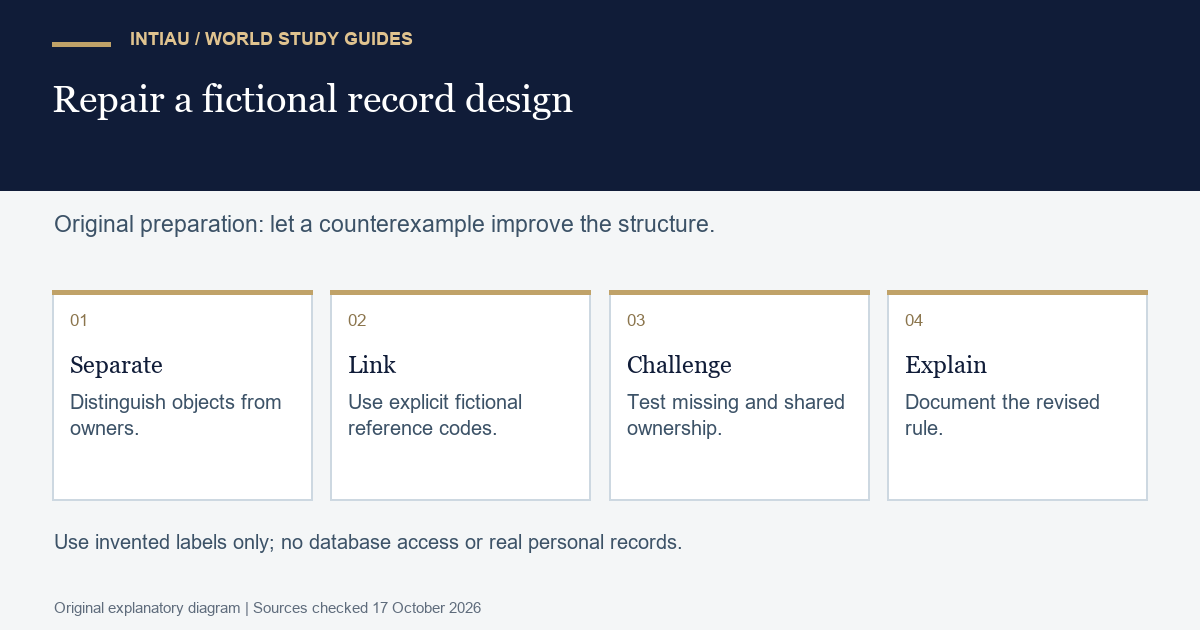
Imagine a paper catalogue for three invented objects. Each row contains an object code, title, owner code and owner contact label. Two objects share owner A. If A’s contact label changes, both rows need editing. Write out the two changes and identify what could happen if one row retained the old label.
Now separate the design into an Objects sheet and an Owners sheet. The first holds object code, title and owner code. The second holds one row for each owner code and its invented contact label. Update A once on the second sheet. Explain how the connection between the sheets would let a reader recover the owner label for either object.
Introduce a counterexample: an object row refers to owner Z, but no Z row exists. Your design now needs a rule about valid references. Write that rule in ordinary language, then decide whether an object may temporarily have no owner. Either decision is possible in this invented case, but the choice must be explicit and consistent.
Next, imagine that an object can have two owners. A single owner-code cell no longer represents the relationship cleanly. Draw a third sheet connecting object codes to owner codes. Record two links for the shared object rather than hiding a comma-separated list inside one cell. Show how a reader can count owners without interpreting free-form text.
Keep every example fictional. Use letters and object labels, never actual personal contacts, student identifiers or borrowed records. No software, database access or website interaction is necessary. The learning product is the explanation of a design decision and the counterexample that forced you to revise it.
Build a precise comparison question
Annotate the exercise with the assumptions that changed: one owner per object, valid owner references, and possible shared ownership. Then choose one rule and describe how you would test it. This makes an interest in computing concrete without claiming that a paper exercise demonstrates full database competence.
When comparing previous study, collect the teaching period, course description, assessment method and practical work separately. Ask the receiving institution about equivalence rather than inferring it from a translated title. For admission, locate the current undergraduate route; neither an extension resolution nor a postgraduate notice supplies that decision.
Frequently asked questions
Is this a complete current curriculum?
No. It combines clearly dated official examples with a later reform record and preserves the access limitation.
Is database design an actual published example?
Yes. The 2021/2 Fundamentos de Banco de Dados plan includes modelling, integrity and normalisation.
Can the record exercise use real personal information?
Use invented objects and labels only. Real records are unnecessary for explaining relationships and checking consistency.
View the study diagram
Official sources
For other independent study comparisons, see INTIAU Courses; general enquiries can use Contact. The named university decides its own admissions and academic requirements.