University College Dublin is an Irish institution separate from INTIAU. Its Computer Science common entry, DN201, leads towards a four-year BSc. The common-entry catalogue places the degree-subject choice at the end of second year; this guide focuses on the Computer Science subject.
That distinction matters when comparing courses. An application label can describe an entry route, while a later subject page describes the curriculum you eventually follow. Record both labels. Otherwise, an attractive specialist option can accidentally become an assumption about what every entrant studies. Start with the route’s shared foundations, then investigate when and how later choices become available.
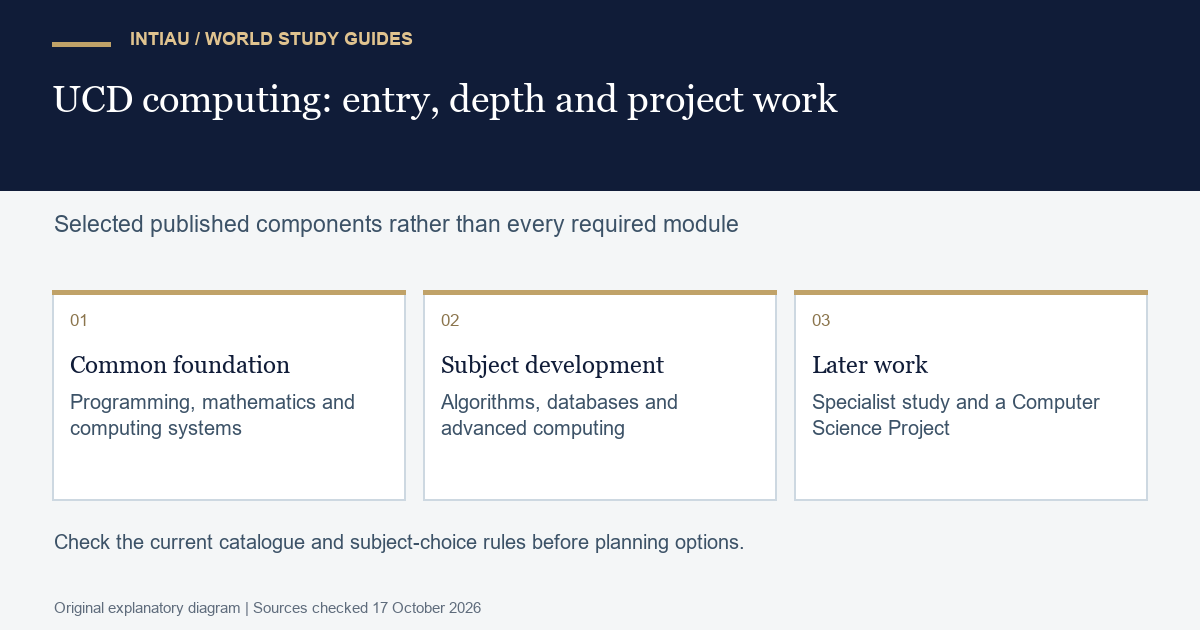
Selected curriculum progression
| Stage | Selected study components |
|---|---|
| Early study | Programming, architecture, mathematics and software projects |
| Developing core | Databases, object-oriented programming, networks and algorithms |
| Later study | Advanced computing, specialist choices and a Computer Science Project |
The official subject catalogue gives the detailed module list. This table is a selection, not a complete credit schedule or a guarantee of an internship.
For comparison, ask what each layer lets you explain. Programming describes operations; architecture provides a model of the machine performing them; databases organise persistent information; algorithms make procedures explicit enough to analyse. A programme can involve all four without treating them as interchangeable. Keep one example question for each layer so that your course comparison reflects intellectual content as well as course names.
A real module: Graph Algorithms
COMP30870 Graph Algorithms is a five-credit level-three module. Its outline includes graph modelling, traversal, shortest paths and connectivity, with mathematical analysis of algorithms. The live catalogue warns that curricular information can change; its URL’s year code is not a promised future timetable.
Worked exercise: a graph is a choice of model
This original exercise uses a fictional delivery network. Four locations are connected as follows: A–B takes two minutes, B–D takes seven, A–C takes five, and C–D takes one. Assume travel works in both directions and those are the only links. The route A–B–D uses two links and takes nine minutes. A–C–D also uses two links but takes six minutes.
A procedure minimising the number of links cannot distinguish these routes by travel time. Representing every connection as an identical step has discarded relevant information. Give each edge a weight in minutes instead, then write the objective as “minimise the sum of travel times”. The route through C now has the smaller total. The calculation is simple; identifying the information the model needs is the important step.
Change one assumption: A–C is temporarily closed. The best route in the original graph is no longer a feasible route in the updated graph. Do not describe the earlier calculation as mathematically wrong; it solved a different input. Next, suppose a carrier charges by distance rather than time. You need new weights. A number attached to an edge is not meaningful until its unit and purpose are stated.
Draw the graph and annotate three things: what a vertex represents, what an edge permits, and what its weight measures. Then invent a counterexample to the rule “always take the cheapest next edge”. From A, the two-minute edge looks attractive but leads to the slower complete route here. Explain the difference between a local choice and a complete-path objective.
Use this exercise to assess whether you enjoy moving between a practical description and a precise model. Being able to write a short program is useful, but so is noticing that a program answers the wrong question because its input representation omitted a constraint. The exercise is independent of UCD assessment.
Application route and date boundary
The linked course pages distinguish CAO applications from the non-EU direct route and carry 2027-entry application statements. Follow UCD’s applicant-category instructions and English-language requirements; nationality alone should not replace the official classification. The curriculum selection here was checked on 17 October 2026, separately from the entry cycle.
Questions about UCD Computer Science
Is DN201 already one specialist degree subject?
No. It is the common-entry route with a later subject choice.
Is Graph Algorithms a real catalogue module?
Yes. COMP30870 has its own published module outline.
Does the worked network describe a real transport system?
No. Its locations and travel times are fictional.
INTIAU’s own information is separate: visit Courses or Contact.
Related guides
View the study diagram