
The University of KwaZulu-Natal offers the Bachelor of Science in Computer Science and Information Technology; this independent guide describes UKZN study, not an INTIAU programme or partnership. Official programme page.
Computing preparation can begin with a small rule that behaves correctly even when inputs arrive in an inconvenient order. A useful curriculum comparison asks how students move from writing instructions to choosing data structures and reasoning about systems. Keep the exact degree title and campus beside that comparison, rather than treating every computing route as identical.
Campus and admission boundaries
The programme page identifies Pietermaritzburg and Westville and shows different third-year choices by campus. Its entry table is framed around the NSC and gives an undated 30 September closing date.
Checked on 17 October 2026, an undated day and month cannot establish that a future cycle is open. Match the applicant qualification, intended entry year and campus with current official instructions. Do not turn an eligibility threshold into an offer, or assume a recommended elective is compulsory for everyone.
The 2026 college handbook supplies the dated degree context; the selected module examples below follow the current programme page. 2026 handbook.
Selected progression and actual modules
| Stage | Selected published example | Preparation question |
|---|---|---|
| Level 1 | COMP100 Introduction to Computer Science; COMP102 Computer Programming | Can I state a rule precisely? |
| Level 2 | COMP200 Object-Oriented Programming; COMP201 Data Structures | Which representation supports the required operations? |
| Level 3 examples | COMP315 Advanced Programming; COMP314 Theory of Computation | How can I justify a result or limitation? |
The current page’s campus split should be retained when reading the later-level map. A listed example is not a guarantee of an individual class place.
The table is intentionally condensed. It does not reproduce the full degree, second-major requirements, elective conditions or every prerequisite. For a personal plan, place the dated handbook next to the current offering information and ask the university to resolve any difference.
Worked exercise: a fictional queue with a rule
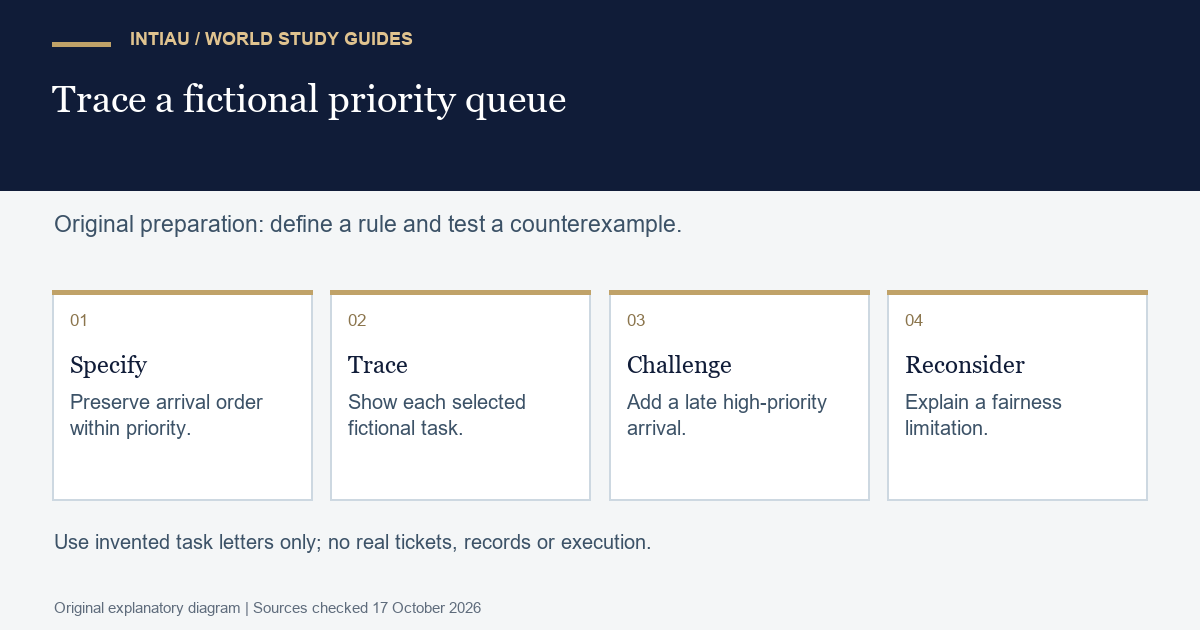
Imagine four fictional tasks arriving in order A, B, C and D. Tasks A and C have ordinary priority; B and D have high priority. Define a rule that high-priority tasks are processed first, while tasks with equal priority retain their arrival order. Write the expected sequence before designing a representation: B, D, A, C.
Now record each task as a pair containing priority and arrival position. Explain why sorting on priority alone might leave equal-priority order unspecified unless the method preserves it or the arrival position is also used. Your explanation should name the requirement rather than relying on the phrase that the system simply knows what to do.
Introduce a new high-priority task E after the first task B has already been processed. Decide whether E should go before or after D under your stated rule. If you preserve arrival order within a priority, D remains ahead of E. Show the remaining sequence and explain how it follows from the rule rather than from a new preference.
Add a fairness question. If high-priority tasks keep arriving, ordinary tasks may wait indefinitely under this simplified policy. Identify that limitation without claiming the original sequence was incorrect. Propose a different fictional rule, such as processing one ordinary task after two high-priority tasks when both groups are waiting. Explain how the objective has changed.
Make a small trace table containing arrival, waiting groups, selected task and reason. Use letters only, not real support tickets, account records or student data. No software installation, website access or code execution is needed. The learning product is an inspectable sequence and a clear statement of the invariant you tried to preserve.
Turn the trace into a study question
Review the step that felt least obvious: representing arrival order, choosing an operation, checking equal-priority behaviour or recognising an undesirable consequence. Choose one skill to practise with a second invented sequence. Keep the failed trace if you find an error and explain the correction; hiding it removes useful evidence of learning.
When comparing courses, distinguish writing a working example from understanding why it behaves correctly. Collect descriptions, assessments and practical work for any previous-study enquiry rather than assuming that matching course names establish credit. Keep applicant eligibility, major selection and module registration in separate rows.
A focused university enquiry should identify the exact degree, campus, entry year and qualification system. Attach the source label behind an unresolved question, but avoid sending private records through an unrelated general contact. The university decides admissions and academic applicability.
Frequently asked questions
Are later choices identical at both campuses?
The current programme page separates Pietermaritzburg and Westville third-year choices. Preserve that distinction.
Is Data Structures an actual example?
Yes. COMP201 appears in the programme’s Level 2 curriculum evidence.
Does the queue exercise demonstrate complete programming ability?
No. It tests a small rule and its consequences in an invented case. It provides no qualification, assessment credit or prediction of success.
View the study diagram
Official sources
For other independent study comparisons, see INTIAU Courses; general enquiries can use Contact. The named university decides its own admissions and academic requirements.