The University of Freiburg is a German institution separate from INTIAU. Its Liberal Arts and Sciences programme at University College Freiburg is English-taught, normally four years and 240 ECTS, leading to a BA or BSc according to the major.
A useful comparison asks how breadth becomes a coherent course of study. Write down one problem you would like to investigate and the kinds of evidence it requires. Then distinguish learning another discipline’s vocabulary from acquiring enough methodological knowledge to assess an argument made within it. An interdisciplinary title alone does not answer that question.
Read the core and major together
The curriculum page identifies regulations effective from 1 October 2026. Its framework combines a core, a major and electives.
| Component | Published emphasis |
|---|---|
| Core | Academic methods, reflection on knowledge, responsibility and leadership |
| Major | Culture and History; Governance; Life Sciences; Environmental and Sustainability Sciences |
| Electives | Further individual study within the programme framework |
Dealing with Numerical Information is a real foundational module named in the programme overview. This identifies a selected component, rather than a complete syllabus or future elective guarantee.
For your own comparison, put a methods component beside a substantive theme. Ask what you could calculate, explain or question after studying them together. A major selection should follow the applicable regulations and advising process rather than a personally invented combination of attractive module titles. Record unresolved sequencing questions before comparing this programme with a shorter degree elsewhere.
Worked exercise: an outcome changes with its denominator
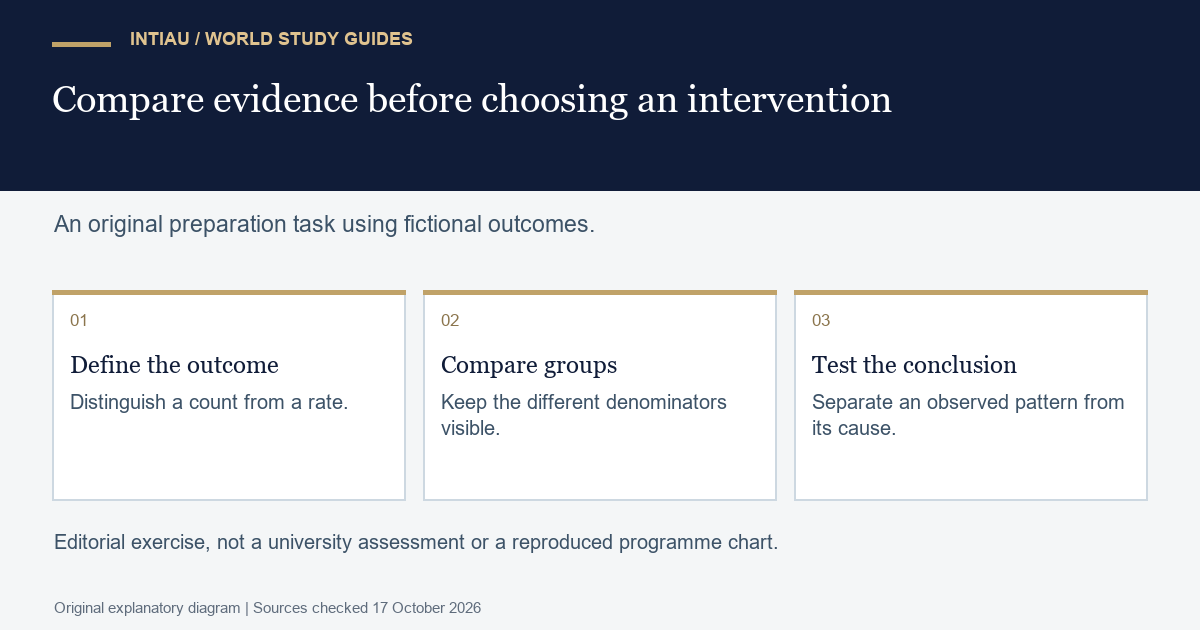
This original task concerns two fictional information sessions. Session A reaches 40 people, of whom 12 correctly answer a later question. Session B reaches 100 people, of whom 25 answer correctly. Decide what the evidence supports before choosing which session seems more successful. There are no real participants, and the exercise does not evaluate Freiburg teaching.
First compare counts: B has 25 correct answers against A’s 12, a difference of 13. Next compare proportions: A has 12 divided by 40, or 30%; B has 25 divided by 100, or 25%. The order reverses because the questions differ. B produces more correct answers in total, while A has the higher observed correct-answer share.
Now imagine that the aim is to maximise correct answers with a fixed outreach budget. Neither comparison settles the decision, because the session costs are absent. If A costs 80 fictional units and B costs 250, A costs about 6.67 per correct answer and B costs 10. Those calculations depend entirely on the invented cost figures; they do not transform the observations into a causal experiment.
Write three separate conclusions. The count conclusion concerns total correct answers. The rate conclusion concerns the share of people reached. The cost conclusion concerns the assumed expenditure per correct answer. Label each denominator explicitly. A sentence such as “A is better” hides the choice of outcome and leaves a reader unable to reproduce the judgement.
Finally, consider the missing comparison. Without an initial knowledge measure or an appropriate comparison group, you cannot say how many correct answers either session caused. People may have arrived with different knowledge. Changing the reported metric cannot remove that uncertainty. A sound short report can contain a clear numerical finding and an equally clear limit on its interpretation.
Produce one page with the three calculations, the question each answers and one additional piece of evidence you would seek. This is a way to examine your interest in combining quantitative reasoning with social or environmental questions. It is not an application essay template or a substitute for the university’s assessment process.
Application cycle and preparation
The official application page marks the 2026 period as over and says its guidance will be amended for 2027. On 17 October 2026 it lists an entrance qualification, English evidence at B2 and application materials including written work. Use the university’s instructions for the next actual cycle and your qualification category.
Keep language evidence, qualification recognition and curriculum preferences on separate lines in your planning sheet. A strong interest in a major does not answer an administrative eligibility question. Check the eventual cycle-specific instructions before preparing final documents, particularly where a retained previous-cycle example appears beside current general guidance.
Three programme questions
Does every student receive the same bachelor award?
No. The programme leads to a BA or BSc according to the major.
Is the framework tied to a published regulation date?
Yes. The page identifies regulations effective from 1 October 2026.
Can the closed 2026 application period be used as a 2027 deadline?
No. The page says the guidance will be amended for 2027.
For INTIAU information, use Courses or Contact.
Related guides
View the study diagram