
The University of Bologna offers the Laurea in Economics of Tourism and Cities at Rimini; this independent guide concerns that university programme, not an INTIAU award or partnership. The 2026/27 record identifies a three-year, English-taught course, code 6645, in class L-33 R. Official programme record.
A tourism comparison needs more than enthusiasm for travel. Ask whether you enjoy explaining the decisions of a business, the use of a destination’s resources, or the interaction between visitors and a city. These questions overlap, but they need different measurements. A busy attraction, for example, can be commercially successful while creating costs outside the operator’s accounts.
Follow the entrant-specific curriculum
The published diagram is specifically for students enrolling in 2026/27. It separates first-year foundations from two later tracks, Tourism and Leisure Industries and Smart Cities and Urban Economy; the second-year track choice continues into third year. Entrant curriculum.
| Stage | Selected published example | Question for comparison |
|---|---|---|
| First-year foundations | Economics I – Foundations; Mathematics; Statistics | What does a model leave out? |
| Second-year direction | Tourism and Leisure Industries or Smart Cities and Urban Economy | Which decision interests me? |
| Third-year continuity | The same selected track | How does the later work deepen it? |
| Named first-year example | C 8391 Accounting, eight credits | Can I explain a result through its assumptions? |
The 2026/27 Accounting outline includes financial statements, management accounting and sustainability reporting. These are selected learning themes, not a reproduced syllabus or a promised future assessment schedule. Actual course outline.
In your notes, distinguish an accounting measure from a wider judgement. A calculation can answer whether a fictional transaction covers an assumed cost without answering whether an entire destination benefits. Keep the scope visible before using a word such as successful. This will also help you compare an economics course with a management or planning course.
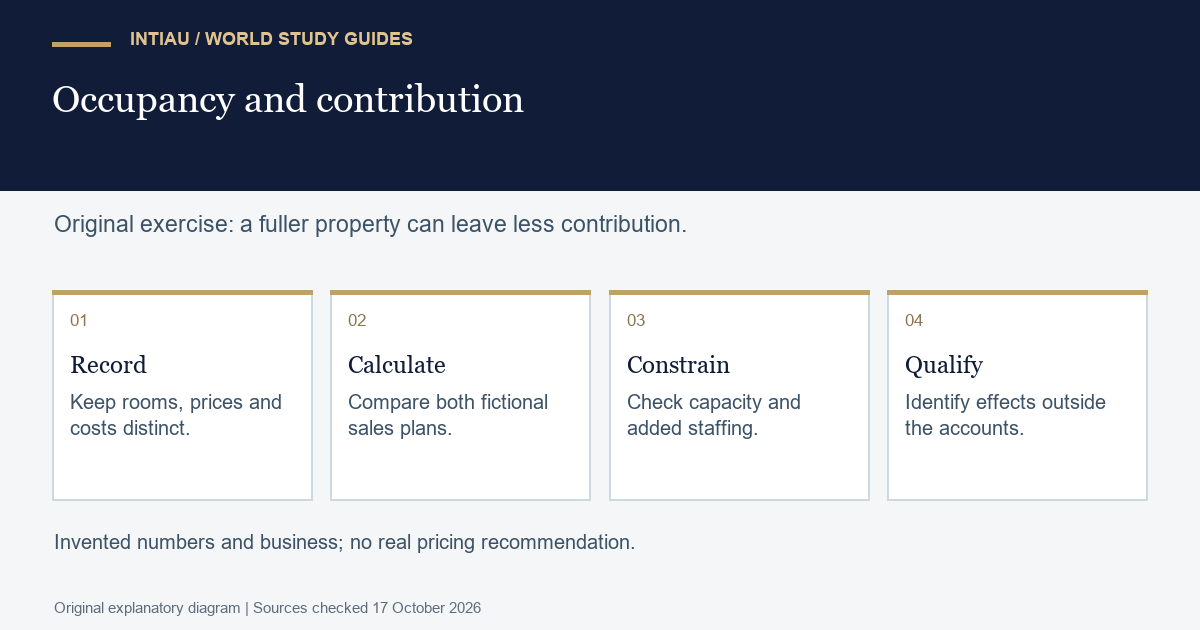
Original worked exercise: occupancy is not contribution
This paper exercise is invented for this guide and is not a Bologna assignment. Imagine a small fictional accommodation provider with twenty rooms available for one night. Plan A sells fifteen rooms at eighty units each. Plan B sells eighteen at seventy units each. Occupancy rises from seventy-five to ninety percent, while revenue rises from 1,200 to 1,260 units.
Now introduce an assumed variable cost of thirty units for every occupied room. Plan A leaves 750 units after these variable costs: fifteen multiplied by fifty. Plan B leaves 720: eighteen multiplied by forty. The plan with higher occupancy and revenue leaves a smaller contribution under this particular invented cost model. State that qualification beside the result.
Add an assumed fixed nightly cost of 700 units. The resulting balances are fifty for A and twenty for B. These are not real business profits: the exercise has deliberately specified only two cost categories. List two omitted items that could matter, then say what information would be required before including them. Do not silently treat an absent cost as zero.
Test a third proposal: an extra four rooms at a price of sixty units, available only if the existing fifteen bookings retain their original price. Those additional rooms contribute thirty units each under the stated variable-cost assumption, adding 120 units. The proposed fifteen plus four bookings give nineteen occupied rooms, leaving one of the twenty rooms unused. Write why this is a different proposal from lowering every room’s price to sixty.
Finally, make an alternative scenario in which the extra bookings require an additional fixed staffing cost of 150 units. The added contribution of 120 no longer covers that extra cost. The change in conclusion comes from a changed assumption, not a correction to the earlier multiplication. Keep both scenarios so another reader can inspect the reasoning.
Produce a one-page comparison with columns for rooms sold, price, revenue, variable cost, fixed cost and unresolved effects. Add a sentence about a possible neighbourhood impact that the accounts do not measure. Your completed answer should separate arithmetic, a model-dependent recommendation and a wider question requiring evidence. It is neither a pricing recommendation nor a claim about an actual destination.
Keep selection separate from study planning
The programme’s admissions page directs applicants through the applicable selection call and Studenti Online. Its listed 2026/27 calls are marked expired; they should not be presented as a newly open 2027 application window. Current programme application route.
Sources were checked on 17 October 2026. Record your intended entry year and qualification before following a checklist. Keep the curriculum choice, the selection procedure and any evaluation of previous study as separate questions. A preferred track is useful preparation for an enquiry, but it is not an admission decision.
Frequently asked questions
Does this guide concern the Rimini course?
Yes. The official programme record identifies Campus Rimini and English teaching.
May I combine the two tracks without checking?
The published entrant diagram specifies a track choice and its continuation. Consult the complete requirements before proposing a combination.
Is the accommodation exercise an official assessment?
No. Its business, prices and costs are fictional. It is an original preparation exercise with fully stated assumptions.
View the study diagram
Official sources
For INTIAU’s separate information, see Courses and Contact. Bologna determines its own academic and admission requirements.