Pompeu Fabra University offers the four-year, 240-credit Grau en Ciències Polítiques i de l’Administració at its Ciutadella campus. This independent Political and Administration Sciences programme is not an INTIAU qualification or partnership. Teaching uses Catalan, Spanish and English. Official programme record.
A political-science comparison should ask how an institutional rule connects preferences, decisions and outcomes. Keep a descriptive claim separate from a judgement about which rule is preferable. A carefully specified example makes that distinction visible without pretending to describe an actual election or public institution.
Selected curriculum and the edition boundary
The faculty links a 2026/27 teaching-plan document covering foundational subjects, methods, later political analysis and final work. These selected translations retain the original names where useful; they are not a complete module syllabus. Official annual plan.
| Stage | Selected component | Question for comparison |
|---|---|---|
| Year one | Introducción a la ciencia política; introduction to social research | What question is being investigated? |
| Year two | Qualitative methods; comparative politics | Which comparisons support an explanation? |
| Year three | Political behaviour and public opinion; public management | How are preferences and institutions connected? |
| Year four | Treball Fi d’Estudis; external practice | How will I communicate a sustained investigation? |
For a separately dated example, the accessible 2024/25 Introduction to Political Science guide identifies a six-credit first-year course and introductory study of political power, the state and democracy. It is historical teaching evidence, not an unseen 2026/27 outline. Dated course example.
Use the distinction between the annual plan and a dated guide in your own comparison. Write what each source establishes, then identify any detail that still requires the current individual guide. An unchanged code does not guarantee unchanged assessment. Retaining an edition is more useful than combining details from several years into an apparently current description.
Match the application route to the qualification
UPF’s official admission page distinguishes EU education systems, including the International Baccalaureate, from education outside the EU. Start with the category matching your qualification; no future application opening or allocation is established here. Official admission routes.
Prepare an applicant sheet with the exact award, intended entry cycle, governing route and unresolved language questions. Separate access eligibility, requesting a place and enrolment after allocation. Keep a deadline attached to a specific action. This source check is dated 17 October 2026, while the course evidence carries the editions explicitly stated above.
When asking about teaching language, name the actual course and group rather than only the degree. A multilingual programme listing does not tell you that every component is available in your preferred language. Keep the university’s answer with the correct course edition.
Original worked exercise: one electorate, different rules
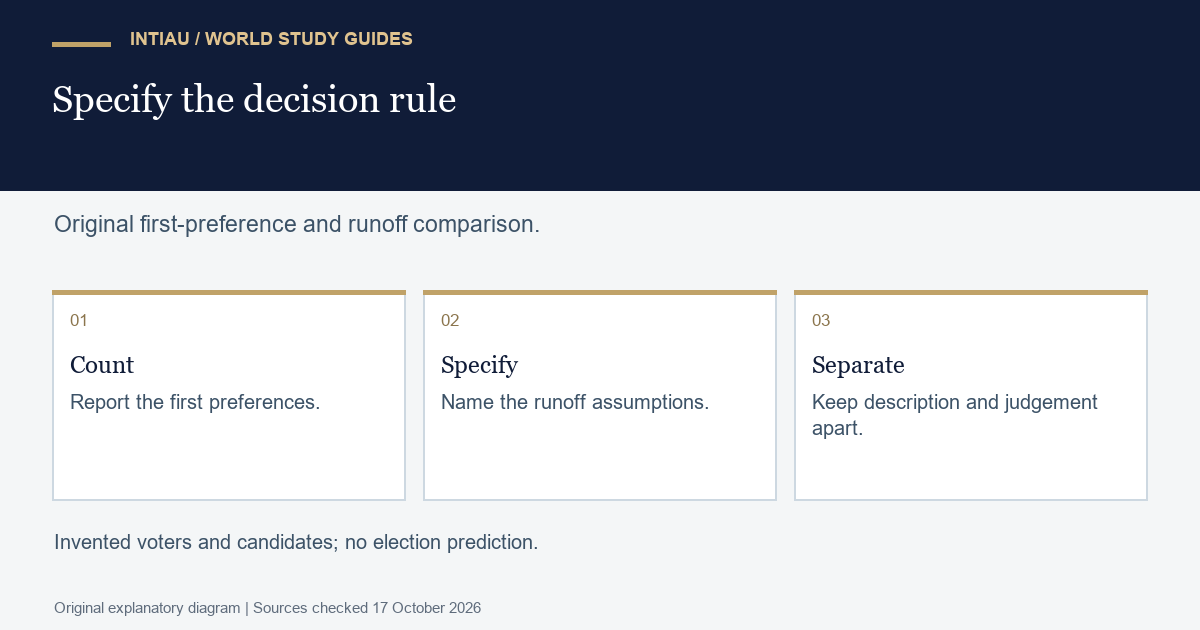
Consider a fictional hundred-voter election with three invented candidates. First preferences are A 40, B 35 and C 25. Under the stipulated rule that the largest first-preference count wins, A wins with forty votes. No claim about an actual electoral system is being made.
Now stipulate a different rule: the two leading candidates enter a runoff, all voters participate again and all original A and B voters retain their preference. Suppose twenty C voters then choose B and five choose A. The runoff result is B 55, A 45. B wins under the second rule.
The first-preference counts alone did not establish that result. If instead twenty C voters choose A and five choose B, the runoff becomes A 60, B 40. Both hypothetical runoff scenarios are consistent with the original first-preference totals because those totals contained no information about the C voters’ later choices.
Write a compact result statement for each rule. Include the rule, supplied preferences and assumptions about participation. Then identify the missing information needed to predict the runoff from the first count. Do not call the outcome a contradiction: the decision procedure and information supplied have changed.
Finish with a separate normative question, such as which feature of a rule you would want to evaluate. Keep it separate from the arithmetic. This invented exercise illustrates institutional specification and evidence limits; it is not an election forecast, a university assessment or an endorsement of a political position.
Practical questions
Can the first count predict the stipulated runoff?
Not without further assumptions about later choices and participation. The exercise supplies two different scenarios.
Why include a historical course guide?
It provides a clearly dated actual teaching example. It is not presented as a current detailed syllabus.
Does a different winner establish which rule is better?
No. That requires an explicitly stated evaluative question, not just the invented vote totals.
For INTIAU’s own services, see course information and the contact page.
Official source index
- Programme: identity and language.
- Plan: selected progression.
- Guide: dated teaching example.
- Admission: applicant categories.
Related guides
View the study diagram