Fudan University’s History undergraduate programme is an independent university offering, not an INTIAU programme or partnership. Its departmental programme list identifies full-time, four-year undergraduate History study.
Identify the specialised route first
This guide focuses on the History Strong Foundation Plan, 强基计划. The 2026 admissions notice addresses school-leavers eligible for that year’s national college entrance examination in provinces where Fudan offers the plan. It is a specialised gaokao-linked route, not a generic international application route. Its A and B applicant categories distinguish general academic excellence from specified national Olympiad awards.
The published 2026 application deadlines were 30 April for A applicants and 26 April for B applicants. Both are past on 17 October 2026. The notice requires participation in the gaokao and sets out university assessment stages; it also prohibits concurrent applications to another university’s Strong Foundation Plan. No 2027 opening is confirmed here.
Read the actual History curriculum
The 20 April 2026 History plan requires at least 133 credits for the 历史学学士 award. This table selects components.
| Published component | Selected requirement |
|---|---|
| General education | 38 credits |
| Professional education | 69 credits, including humanities foundations and professional core |
| Named foundation | 史学原典导读, guided reading of historical classics |
| Further pathway | At least 20 credits through the specified honours, interdisciplinary or advanced-study route |
The plan also identifies practical courses, annual papers and a graduation thesis. Strong Foundation students are separately grouped and subject to academic review; progression into later study is conditional.
Read requirements at two scales. First identify the overall graduation rule; then locate each selected block within it. A table of a few blocks should never be used to invent a missing-credit balance. For a reading-intensive course, ask for the assigned text, expected preparation and written-work brief, rather than judging its intellectual workload from the course title alone.
Distinguish a course listing from its syllabus
A current departmental teaching profile lists 史学原典导读 as an undergraduate foundation course and 西方史学史, Western Historiography, in undergraduate required and honours forms. It also identifies research themes in ancient Greek history, Western historical writing, comparative study and historical narrative. These provide a concrete view of the department’s intellectual setting; they do not establish the weekly content of every listed class.
The same profile records work on Herodotus and the interpretation of historical texts. A useful preparation question is therefore how a historian’s narrative, context and evidence relate. Obtain the applicable course guide before assuming particular authors, assessments or texts are required in your cohort. A staff research theme is not automatically a prescribed reading list.
The programme list separately labels Chinese History and Culture as an English-taught master’s route. That designation should not be transferred to undergraduate History. The Chinese-language undergraduate plan reviewed here does not establish an English-only bachelor’s pathway.
An original comparison of two records
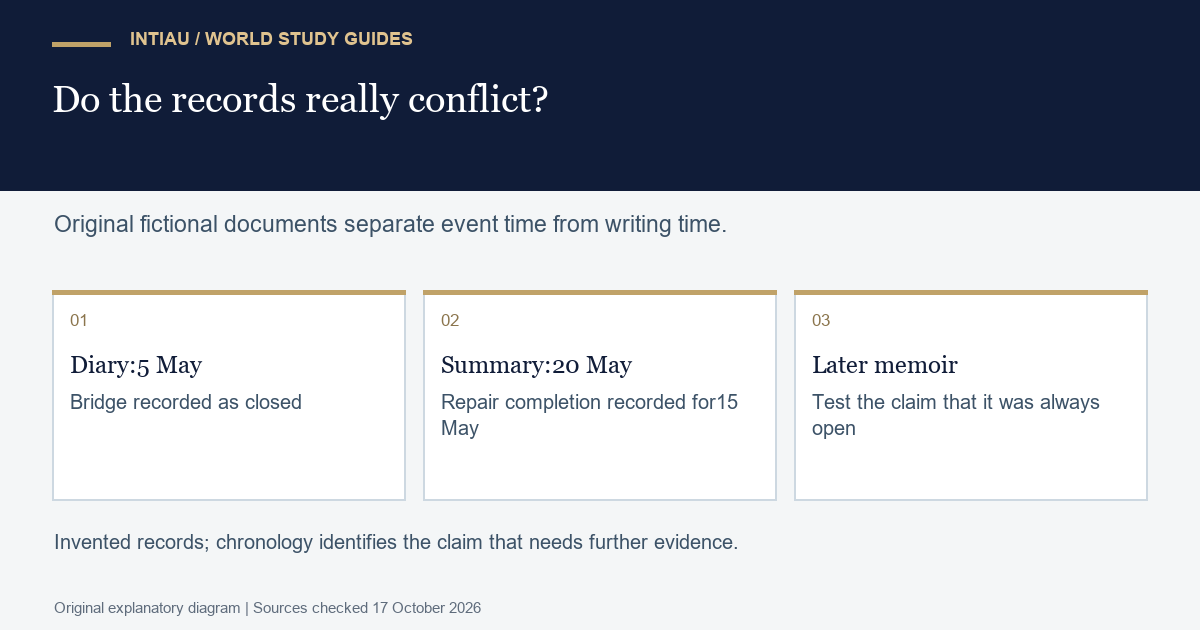
Use these invented records of one bridge: a diary dated 5 May says it was closed, while a council summary dated 20 May says repairs were completed on 15 May. There is no necessary contradiction: the statements concern different dates. Write a timeline containing the observation date, document date and claimed completion date.
Now add a later memoir saying the bridge was always open that spring. Identify which part conflicts with the diary, but do not automatically declare one author dishonest. List two possibilities to investigate, such as a different bridge entrance or a different meaning of open. Separate those possibilities from established information.
Your answer should contain the timeline, the exact disputed claim and one additional source you would seek. This original preparation task uses no real document or participant and is not a Fudan assessment.
Three pathway questions
Is the 2026 Strong Foundation notice an international admissions guide?
No. Its eligibility is tied to the specified provincial gaokao applicant conditions.
Does meeting the undergraduate course map guarantee postgraduate progression?
No. The plan describes review and conditional transition arrangements, not an unconditional later place.
Must the two dated bridge records disagree?
No. Closure on 5 May and completion on 15 May can both be true.
Use INTIAU’s Courses and Contact for general enquiries.
Related guides
View the study diagram