The Indian Institute of Technology Madras offers a Bachelor of Technology in Naval Architecture and Ocean Engineering through its Department of Ocean Engineering in Chennai. This independent university programme is not an INTIAU degree or partnership.
Read naval architecture within its ocean context
The departmental overview connects marine vehicles with hydrodynamics, structural mechanics, materials, ship geometry and drawing. Its undergraduate scope also includes important ocean-engineering elements, rather than treating a ship separately from waves, currents and the surrounding environment.
IIT Madras’s undergraduate programmes page describes the BTech as four years. It distinguishes this from the five-year BTech–MTech dual-degree route. The award route matters when reading a departmental page that lists several programmes together.
Selected progression in the departmental course map
The official course map separates the eight-semester BTech from the longer dual-degree programme. These selections are from the BTech section. The page does not identify a cohort edition, so confirm its applicability before using it as a personal registration checklist.
| Published stage | Selected BTech subjects |
|---|---|
| Semesters I–II | Introduction to Naval Architecture and Ocean Engineering; Ship Hydrostatics and Stability |
| Semesters III–IV | Ship Hydrodynamics; Ship Drawing and Calculations; Ship Resistance and Propulsion |
| Semester V and later summer | Motion of Ships and Floating Systems; subsequent Shipyard Training |
| Semesters VII–VIII | Ship Design; Ship Structural Design; project/professional-elective choices |
A useful comparison follows how a geometric description becomes a calculation and then informs a design decision. Keep the project and elective choices visible; a selected map should not turn options into a claim that every student completes the same project.
Actual syllabus examples beyond the course titles
The linked OE 1101 outline begins with physical oceanography: seawater properties, waves, tides, currents and air–sea interaction. It introduces marine vehicle types, propulsion, ship terminology and general arrangement, onboard systems, and fixed and floating offshore structures. Its practical description includes identifying ship spaces and sketching general arrangements.
The OE 1012 Ship Hydrostatics and Stability outline develops hull geometry, numerical ship calculations, weight estimation, centres of gravity and buoyancy, equilibrium and stability. It considers weight shifts, free-surface effects, longitudinal stability, subdivision and damaged stability. Practical outputs include lines plans, hydrostatic data, stability calculations and righting-arm curves.
These published themes show why matching a displaced mass is only one part of the subject. The outline also asks students to examine changes in equilibrium and the response to different conditions. The individual PDFs are undated and are used here for selected learning content, not as verified weekly schedules or complete current assessment rules.
Original exercise: a stipulated displacement model
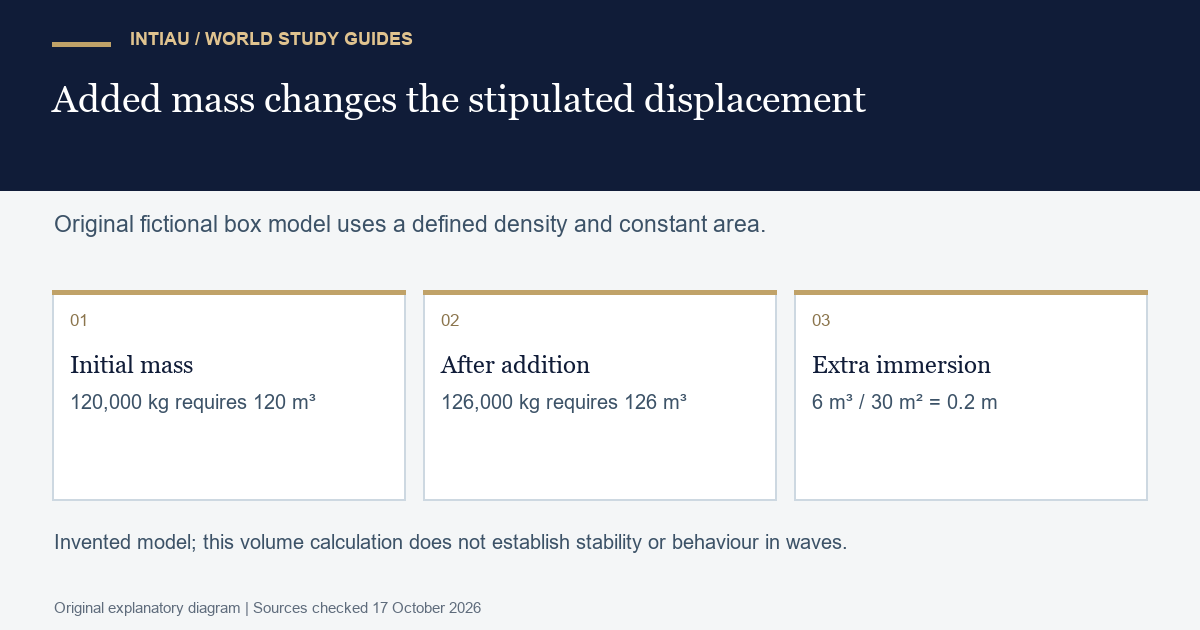
Use an invented rectangular-box model in which each cubic metre of displaced fluid supports 1,000 kilograms. A mass of 120,000 kilograms therefore requires 120 cubic metres. Add 6,000 kilograms and the stipulated required volume becomes 126 cubic metres, a change of 6.
Assume, only for this task, a constant horizontal area of 30 square metres. The added volume corresponds to 6/30=0.2 metres of additional immersion. Write the density rule, constant-area assumption and units beside the answer. Then state what the calculation does not establish: the box’s stability or its behaviour in waves. Changing a geometric assumption would change the model. This is a paper exercise with invented values, not an assessment of a real vessel or an IIT Madras assignment.
Applicant route and source dates
The institute’s undergraduate page describes BTech entry through JEE Main and JEE Advanced, with branch admission determined through the stated admission process. Consult the current examination and allocation rules for the applicant’s category. The undated overview does not establish a 2027 registration window, deadline or seat entitlement.
Keep the applicant cycle separate from the curriculum page’s edition and the individual course outlines. Explore broader subjects through INTIAU’s Courses or use Contact for general enquiries.
Three curriculum questions
Is the BTech the same as the dual degree?
No. The institute describes four-year BTech and five-year BTech–MTech routes separately.
Are the listed learning themes actual course content?
Yes. They are selected from the department-linked OE 1101 outline.
Does the map verify a cohort-specific full plan?
No. Its cohort applicability needs confirmation.
Official sources checked 17 October 2026 are linked beside the relevant claims.
Related guides
View the study diagram