Seoul National University’s Landscape Architecture undergraduate major is in its College of Agriculture and Life Sciences at Gwanak, Seoul. It is an independent university programme, not an INTIAU offering or partnership.
A programme connecting ecology, design and construction
The official major overview covers planning, design, construction and management from gardens to urban plazas and larger developments. Students connect natural and social sciences, engineering and aesthetics, with plant ecology, arboretum work, CAD and GIS among its teaching examples.
Read that breadth as a reason to compare the kinds of work involved. A design representation, a plant observation and an engineering calculation answer different questions. Keep their purpose visible when looking through a course list; the presence of all three does not make their methods interchangeable.
Selected actual courses and their edition
SNU’s official 2022 undergraduate course descriptions, printed pages 540–542, provide the selected examples below. These are descriptions from that edition, not a verified 2027 semester schedule or complete graduation plan.
| Selected course | Learning focus in the description |
|---|---|
| Landscape Drawing and Media | Drawing, diagrams, mapping, collage and montage |
| Landscape Plant Materials | Identification, ecological roles and environmental adaptability |
| Practice of GIS and Quantitative Analysis | Terrain, suitability and statistical analysis |
| Landscape Architectural Design Studio 2 | Builds on prior study through public, residential and campus design |
A useful reading sequence moves from representing a site to understanding its living and spatial conditions, then to explaining a design proposal. This is an editorial way to read the selections, not a claim that the table specifies compulsory semester order.
A closer look at Landscape Engineering
The university’s Green Infrastructure Engineering Lab teaching page describes undergraduate Landscape Engineering,5271.224 A. It connects soil mechanics, site layout, grading, roads, drainage, statics, structures, irrigation, foundations and water features with design and construction. It also includes structural-analysis tools and CAD.
The same page labels Landscape Engineering as first-semester English teaching, while Landscape Cost Estimation and Economic Analysis is labelled Korean. These are course-specific language descriptions, not evidence of an entirely English-taught major. The page is undated, so a current section still needs confirmation.
Original exercise: apply a stated slope constraint
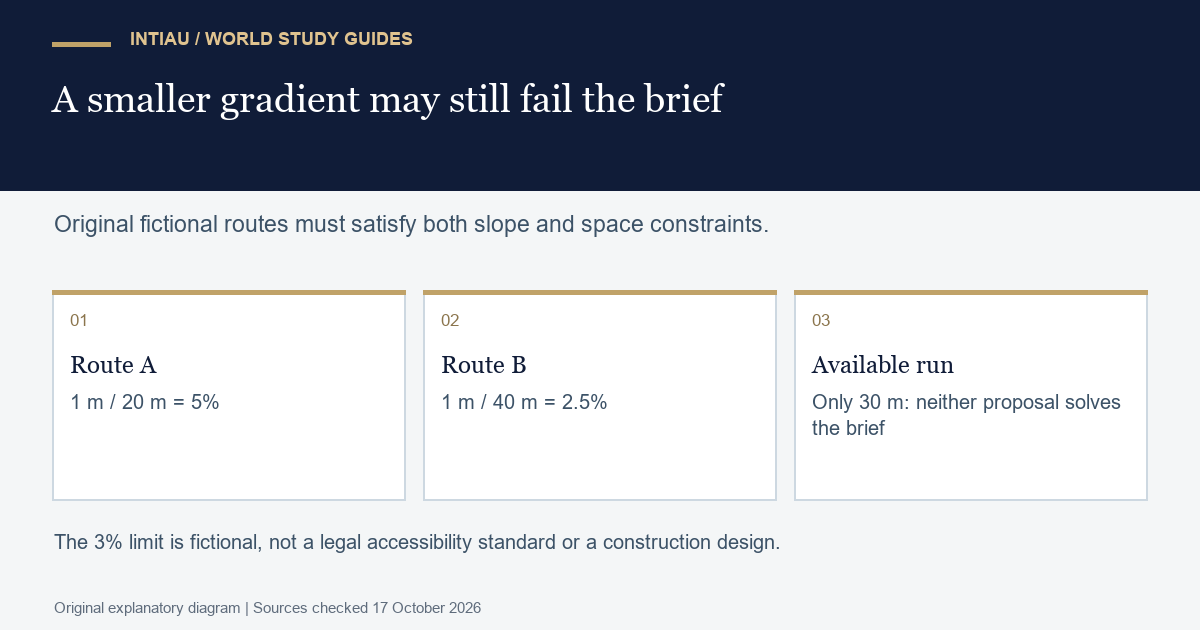
Imagine a fictional brief with a one-metre vertical rise. Route A has 20 metres of horizontal run; B has 40. Their gradients are 1/20=5% and 1/40=2.5%. If this paper brief stipulates a maximum of 3%, B satisfies that fictional constraint and A does not. The 3% value is invented for the task, not a legal accessibility standard.
Now add the condition that only 30 metres of run are available. Neither of the two proposed routes solves the whole brief: A is too steep and B does not fit. Write a short unresolved-design note instead of selecting B just because its gradient is smaller. This task uses no real site or construction work and is not an SNU assessment.
Graduation and applicant documents answer different questions
SNU’s general undergraduate graduation page states a minimum of 130 credits, including general and major study, alongside department-specific requirements, grade requirements and approved completion work. That university-wide minimum does not establish the Landscape Architecture major’s individual credit audit or the precise award wording for an applicant.
The Spring 2027 international undergraduate notice set online applications for 6–9 July 2026, with recommendations due on 10 July. These dates are past on 17 October 2026, even though entry is in 2027. Use the relevant admissions guide for eligibility and required evidence; do not treat the entry year as an open application window.
Explore subjects through INTIAU’s Courses or use Contact for general enquiries.
Three practical questions
Is the selected table the current full curriculum?
No. It uses the dated 2022 course-description volume.
Does an English course label cover every class?
No. The teaching page gives different languages for individual courses.
Are Spring 2027 applications still open in October?
No. The cited application period ended in July 2026.
Official sources checked 17 October 2026 are linked beside the relevant claims.
Related guides
View the study diagram