Wuhan University’s Remote Sensing Science and Technology undergraduate route belongs to its School of Remote Sensing and Information Engineering, independently of INTIAU. The school’s undergraduate education index is the starting point for programme notices.
What this review could actually establish
The index carries a training-plan entry dated 1 September 2026, but its contents required permission during review. Consequently, the accessible course evidence below is explicitly from the 2018-version outline category, posted in 2021; it is not presented as the full current plan.
The distinction matters when a student is comparing subjects. Detailed older outlines can reveal the intellectual and practical work behind a title, while still leaving current graduation credits, award wording, teaching language and applicant eligibility to be confirmed. Record those unanswered questions instead of filling them with assumptions from another university’s similarly named major.
Two actual courses show a practical progression
| Documented course | Place or scale in its outline | Selected work |
|---|---|---|
| Digital Image Processing Course Design | 1 credit;24 practical hours | Image operations, feature extraction and algorithm implementation |
| Digital Photogrammetry Course Design | Third-year elective;2 credits;48 hours | After theory: positioning, reconstruction and implementation |
These two entries describe designed practical work, rather than just a collection of software names. Read the theoretical preparation, technical task and report requirements together. A result should be explainable: which operation produced it, which assumptions were used and what evidence supports the interpretation?
Image processing and photogrammetry ask different questions
The official Digital Image Processing Course Design outline, code 3140540011094, includes preprocessing and transformations, edge, shape and texture features, colour fusion and template matching. Students implement algorithms and explain their methods and results in a reasoned report. This is a selected translation of the published Chinese outline, not a claim about a current English-taught section.
The Digital Photogrammetry Course Design outline,3350540011103, follows theoretical study. Its selected themes include projection geometry, positioning and reconstruction from multiple views. Programming, debugging, data reporting and teamwork are part of the practical learning. It therefore gives evidence of how geometric reasoning is connected with a working implementation.
Both outlines were posted on 11 November 2021 under the 2018-version category. Their stated hours and study stage belong to that evidence, rather than a verified 2026 timetable.
Original exercise: inspect a tiny classification result
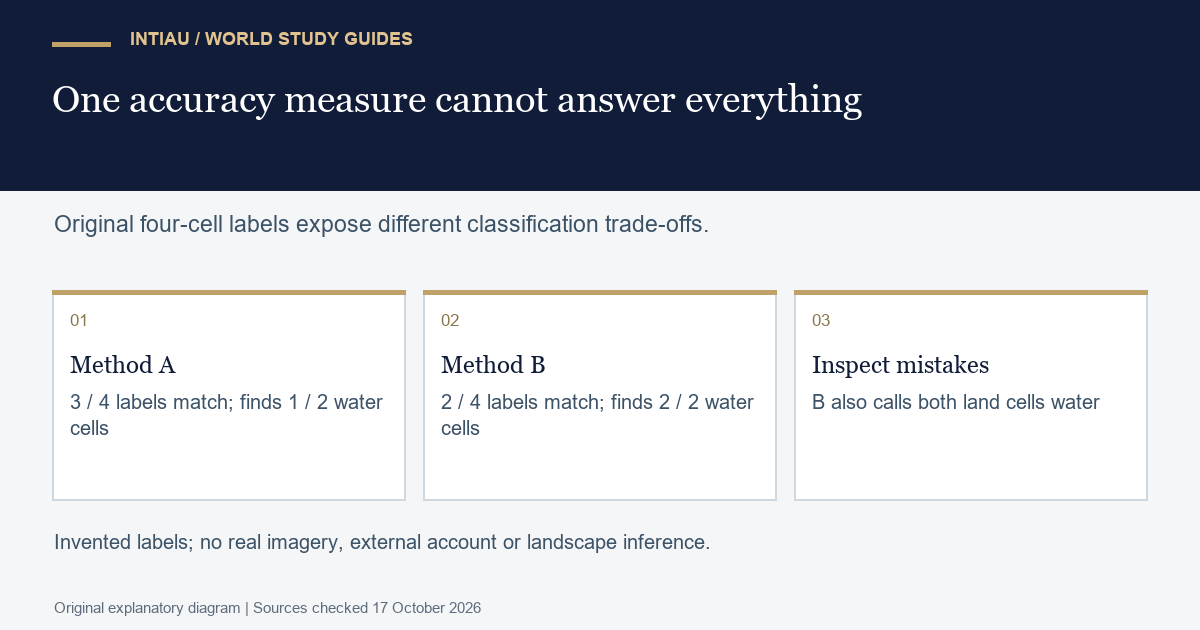
Use a fictional four-cell map whose stipulated reference labels are water, water, land and land. Method A predicts water, land, land and land; B predicts water in every cell. A matches three of four labels, or 75%. B matches two, or 50%. For the two reference-water cells, A finds one and B finds both.
Explain why finding every water cell does not by itself make B the better overall classifier: it also labels both land cells as water. List the four comparisons explicitly rather than reporting only one percentage. Then add a boundary statement: four invented cells cannot establish performance on a real landscape. No imagery, location data or external service is needed for this original paper exercise, which is not a Wuhan University assignment.
Do not merge separate admission routes
A May 2025 university announcement describes a separate Remote Sensing Science and Technology plus Economics double-bachelor project, associated with a low-altitude economy experimental class and direct 2025 gaokao recruitment. That specialised combination should not be substituted for the ordinary remote-sensing curriculum or treated as a general international applicant route.
Before applying, obtain the exact current programme catalogue and applicant notice, then match its entry route to the plan the school confirms. No future application window is verified here. Explore broader subjects through INTIAU’s Courses or use Contact for general enquiries.
Three evidence questions
Was the 2026 full plan read?
No. The current entry required permission.
Are the practical-course details actual published examples?
Yes. They come from a dated official undergraduate outline.
Is the Economics combination the same route?
No. The 2025 announcement identifies a separate double-bachelor project.
Official sources checked 17 October 2026 are linked beside the relevant material.
Related guides
View the study diagram