The University of Science and Technology of China’s Astronomy undergraduate programme is an independent university route, not an INTIAU qualification or partnership. Astronomy appears in the International College’s current schools and programmes list.
Keep the current route separate from the legacy plan
The International College’s undergraduate introduction describes four-year full-time programmes delivered in Chinese, with completion of required coursework and a thesis defence before graduation and degree award. An English description of the university does not establish English instruction.
The older public catalogue’s introduction explains its 2012 planning work and revisions through 2014. Consequently, its Astronomy requirements below are legacy curriculum evidence, not a verified 2026 cohort plan.
The 2025 undergraduate study guide directs readers to cohort-specific execution plans. That current-plan route led to university sign-in during this review; its Astronomy contents were not publicly verified.
A selected map of the older requirements
The legacy School of Physical Sciences plan identifies Astronomy and the 理学学士 award category. Its 160-credit structure distributes study as follows; it should not be substituted for a present student’s own academic audit.
| Legacy component | Credits |
|---|---|
| General courses | 80 |
| Disciplinary foundations | 39.5 |
| Professional core and direction courses | 11 and 13 |
| Other electives and thesis | At least 8.5 and 8 |
Use this map to distinguish broad foundations, specialist study and independent work. Do not add a course to a personal plan simply because its title looks relevant. The governing edition and its classification determine how it counts; an older catalogue can illustrate a structure without settling today’s graduation requirements.
Two real teaching descriptions illuminate the subject
The official legacy course-outline volume, printed page 80, describes General Astronomy, AY 03302. Its themes range from celestial coordinates, time measurement and observational instruments to the Solar System, stellar structure and evolution, galaxies and cosmology. The same page’s Galactic Astronomy outline examines galaxy classification, the Milky Way, spiral and elliptical systems, active galaxies and large-scale structure.
Galactic examples include stellar orbits, rotation curves and the mass distribution of the Milky Way. These are actual published learning themes from an old document. They are not a claim that the named codes, credit values or weekly teaching arrangements remain unchanged.
A separate USTC Introduction to Astronomy MOOC connects observed phenomena with their physical explanations, from planets and stars to galaxies and cosmic evolution. Its indexed official course description calls for some general physics knowledge. It offers another way to understand the subject’s questions; this review does not establish degree credit, current enrolment availability or a complete current university syllabus from it.
Original exercise: what does a ratio establish?
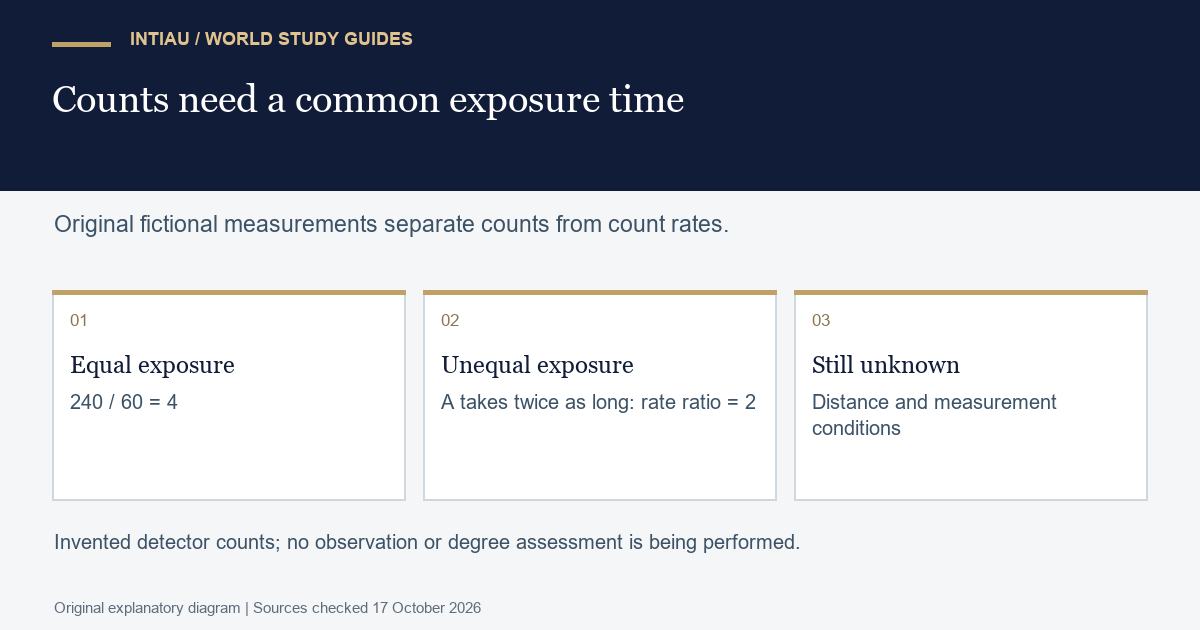
Imagine two fictional sources measured with the same detector settings. After the stipulated background correction, A gives 240 counts and B gives 60 over equal exposure times. A’s recorded signal is four times B’s. Now suppose A’s exposure was twice as long: the count rates become 120 and 60 per common time unit, a ratio of two.
Write the exposure and correction assumptions beside both answers. Counts alone cannot establish an intrinsic luminosity difference without additional information. In this paper task, list distance and the measurement conditions as unanswered questions rather than inventing them. Your output is two ratios and a short statement of what remains unknown, not an observing proposal or an assignment from USTC.
Plan the next enquiry
Request the applicable cohort plan, the instruction language of the intended route and its current applicant notice together. Keep a current admissions document separate from these historical course examples; no future application deadline has been verified here. INTIAU’s Courses and Contact provide broader subject information and general enquiries.
Questions about the evidence
Is 160 credits verified for a new entrant?
No. That total belongs to the legacy plan.
Were the current execution-plan contents read?
No. The current-plan route required university sign-in.
Does the MOOC establish university degree credit?
No. It is used for its published subject description only.
Official sources checked 17 October 2026 are linked at the point of use.
Related guides
View the study diagram