The University of Basel in Switzerland is independent of INTIAU. Its Bachelor of Science in Biology takes six semesters and 180 credit points. The Biozentrum describes a common scientific beginning followed by specialisation, with substantial practical work in the Molecular Biology major. German predominates in the first two years; the third-year block courses are in English. biology degree overview
Choose a major with its practical structure in view
The department identifies Molecular, Organismal and Integrative Biology as the three major directions. The first year is shared. Differentiation develops during the second year, while the third uses intensive theory-and-practice blocks. The programme starts in the autumn semester. Its linked regulations and study guide distinguish requirements for students beginning from August 2022 onwards; use the edition applicable to your own start date. structure and regulations
A useful comparison asks what kind of evidence you would like to explain. A question about molecular interactions and a question about population change may both be biological, but they demand different tools. Do not decide from the word laboratory alone. Compare the questions, the scale of observation and the amount of sustained practical time in each route.
Selected stages from the published structure
| Stage | Published components | Preparation question |
|---|---|---|
| Year 1 | Biology with mathematics, physics and general chemistry; electives | Can you explain a biological result using the supporting science? |
| Year 2 | Further biology and organic chemistry; major-related study and bioethics | Which level of biological organisation interests you? |
| Year 3 | Major-specific practical blocks; Molecular Biology includes a thesis | Can you sustain and document one investigation? |
Molecular Biology has three six-week, full-day blocks: Structural Biology and Biophysics, Microbiology and Immunology, and Cell Biology and Neurobiology. Its eight-week thesis applies from 2025. Molecular Biology pathway
Translate “full-day block” into a question about your weekly commitments before comparing it with a programme built around several parallel courses. This table selects the progression and does not reproduce the complete module catalogue, every elective or a personal registration plan.
A current example: Structural Biology and Biophysics
The autumn 2026 catalogue lists 15920-01, Structural Biology and Biophysics, as a 15-credit English-language block. It combines protein structure, prediction and design with biophysical investigation, including research projects. Selected methods include cryo-electron microscopy and nuclear magnetic resonance. Its entry requirements specify completed first- and second-year study, a qualifying Molecular Biology result and appropriate structural-biology knowledge. Places are limited and attendance is compulsory. This is a demanding later-stage course rather than a first-year introduction. The themes illustrate how a structural question can be approached through different measurements; the linked record is the source for the complete content and assessment conditions. autumn 2026 course record
Application and language checks
Applicants with foreign qualifications use Basel’s online application route and must meet the requirements for their specific educational certificate. The application guidance allows a pending final certificate to be supplied later under the applicable rules. Documents outside German, French, Italian or English require the prescribed certified translation into German or English. The university expects the language ability needed for study, with German generally central to bachelor teaching. A later English practical block does not remove that earlier preparation need. Check the current country-specific admission conditions and document instructions; this guide does not project an undated annual deadline into a confirmed 2027 application window. foreign-qualification application guidance
Original exercise: signal or measurement change?
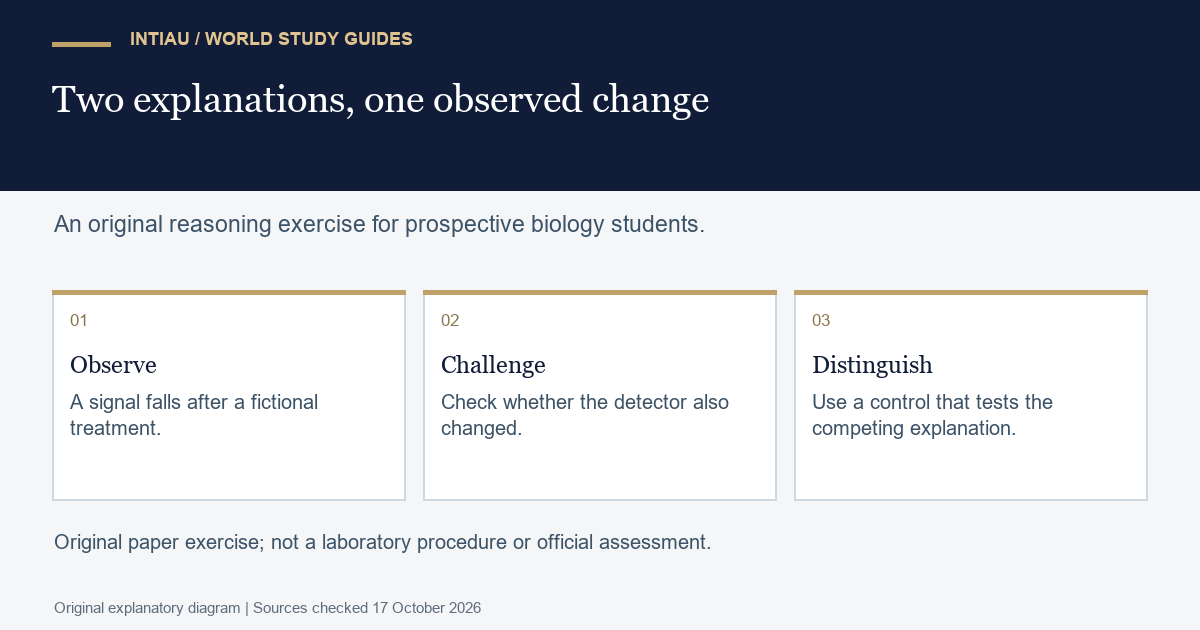
A fictional assay gives a signal of 100 units before a treatment and 60 afterwards. One explanation is that the measured biological quantity fell. Another is that the treatment interfered with the detector while the quantity stayed unchanged. State why the two readings alone cannot distinguish these explanations. Now add a reference sample known to contain the same fixed quantity on both occasions: its signal also falls from 100 to 60. That supports a measurement problem, but it still does not establish what happened in the original sample. Propose a comparison using a different measurement principle and explain its purpose. The strongest answer links the proposed observation to the competing explanations rather than merely asking for repetition. These stipulated numbers are a reasoning exercise, not instructions for conducting an experiment.
Three practical questions
Is the whole degree taught in English?
Earlier teaching is predominantly German; the third-year blocks use English.
Are all majors represented by the same three blocks?
No. Check the requirements for the chosen major in the linked structure.
Does the reference sample prove the biological quantity was constant?
No. It challenges the measurement interpretation without resolving the original sample’s biological change.
For INTIAU’s own information, see Courses and Contact.
Related guides
View the study diagram