The Indian Institute of Science in Bangalore, India, is independent of INTIAU. Its four-year Bachelor of Science (Research) begins broadly before specialisation in Physics, Chemistry, Mathematics, Biology, or Earth and Environmental Science. The 2026/27 international programme description also identifies a substantial research project. dated programme overview
Broad foundations before a major
The shared curriculum covers the first three semesters. Its overview brings together physics, chemistry, mathematics, biology, engineering and Earth/environmental science. The displayed first-semester map names Analysis and Linear Algebra I, Introductory Biology I, Introductory Chemistry I, Introductory Physics I and Humanities. It provides an actual foundation sequence rather than a promise that students begin immediately in one narrow specialism. shared curriculum
For a prospective student, the useful comparison is not simply how soon a favourite subject appears. Ask whether you want several sciences to inform the question you eventually investigate. Record one question that could change when viewed through a second discipline, then identify which foundation would help you recognise that change.
One pathway through the published structure
The current Chemistry page specifies a minimum of 131 credits. Its framework separates basic courses, engineering, humanities, major/project study and an optional minor. Students not taking a minor fulfil the stated assortment-course requirement instead. The table below selects the shared beginning and a chemistry example; it is not the complete plan for every major. Chemistry framework and full map
| Stage | Selected published component | Comparison question |
|---|---|---|
| Semesters 1–3 | Shared scientific foundations, with humanities | Which other discipline could challenge your initial explanation? |
| Chemistry example, semester 4 | Thermodynamics and Electrochemistry; chemistry of elements; organic reactions; instrumental analysis | Which method supplies evidence for a chemical claim? |
| Later specialisation | Major study with research-project participation | How would you turn a broad interest into a tractable question? |
A February 2026 notice discontinued the Materials major for entrants from 2026/27, while protecting already enrolled students. An older six-major description should therefore not be used for the new-entry choice. The same news record extended the 2026/27 application deadline to 7 June 2026, which is past as of this guide’s 17 October 2026 check. dated changes and admission notices
A selected analytical course and its access boundary
The current Chemistry map names Instrumental Methods of Chemical Analysis, UC207, with a 2:1 course pattern. The public course buttons did not yield a verified full modal outline in this check. current named-course map
An undated official Chemistry Curriculum PDF has readable indexed text describing an instrumental-analysis course. Selected themes include measurement uncertainty, statistical treatment, separation methods and spectroscopic identification. Its direct PDF screenshot request returned404, so no PDF pixels or current edition were verified. This indexed outline is an illustrative published theme record, not proof of the exact 2026 UC207 syllabus, assessment or credit allocation. The current HTML map, rather than the undated PDF, is used for the named-course placement above. official indexed outline reference
Admission routes are cycle- and status-specific
For 2026/27, the selection page requires Physics, Chemistry and Mathematics as main qualifying subjects, with the stated school-result threshold and category relaxation. Indian-national/OCI(I) selection uses JEE Advanced2026 or IAT2026. Foreign-national/OCI(F) routes distinguish SAT/ACT shortlisting followed by interview from selection through IAT/JEE Advanced ranks. OCI status depends on the published card-date and category rules, so applicants should not choose a portal simply from an informal “international” label. Read the actual status, qualification and document conditions together. These are dated 2026 rules, not an announced 2027 application route. 2026 selection conditions
Before planning a later application, obtain the newly published cycle’s instructions and confirm the language expectations for teaching and assessment. The programme’s English-language web presentation is not used here as independent proof of every class’s language.
Original exercise: does the second reading add information?
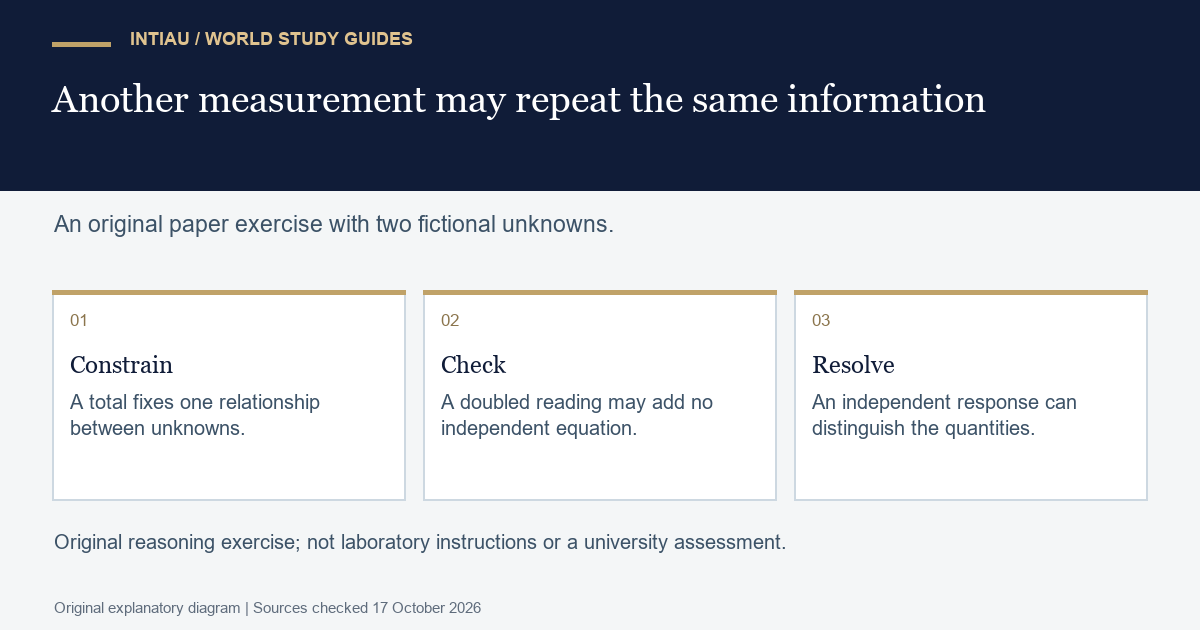
Two fictional quantities x and y total10. A stipulated instrument reads 2x + y =14. Subtracting the total gives x =4 and y =6. Now imagine a second instrument reading 4x +2y =28. That reading merely doubles the first response; by itself it adds no independent relationship. Compare it with an instrument reading 3x + y =18, which gives an independent equation when combined with the first reading, even without the known total. State which conclusions rely on knowing the response rules exactly. Then explain why obtaining several consistent numbers would still not prove that an actual unknown material followed those rules. The exercise illustrates independence of information, not real instrumentation, chemical behaviour or a laboratory procedure.
Three practical questions
Can an older six-major list guide a new entrant?
No. Use the dated change notice and the major choices applicable to the intended admission cycle.
Is the indexed outline a verified current full syllabus?
No. Its edition and direct access remain unverified; the distinction is explicit above.
Does doubling a response create independent information?
No. In the stipulated exercise, it repeats an existing relationship.
For INTIAU’s own information, see Courses and Contact.
Related guides
View the study diagram