The University of Gothenburg in Sweden is independent of INTIAU. Its three-year, 180-credit Software Engineering and Management programme is taught in English on campus in Göteborg. Graduates receive a Bachelor of Science with a major in Software Engineering. The advertised autumn 2027 first-round window is 16 October 2026–15 January 2027. programme details
Read the programme as a sequence of team problems
The July 2026 curriculum organises learning around term themes, with projects alongside disciplinary courses. Term five permits electives or study abroad; the other term courses are mandatory. The final term combines leadership, research methods and a 15-credit thesis. This selected map is a route into the full curriculum and linked syllabus, not a complete assessment calendar. curriculum map
| Terms | Selected curriculum | Comparison focus |
|---|---|---|
| 1–2 | Programming, discrete mathematics, agile project management; data management, requirements and systems development | From a requirement to a working component |
| 3–4 | Architecture, distributed systems and HCI; embedded/real-time systems, quality and testing | How system boundaries change the problem |
| 5–6 | Electives; management and leadership; research methods; bachelor thesis | Choice, explanation and independent investigation |
For a programme comparison, choose one hypothetical feature and follow it through the table. A feature needs a reason to exist, a representation, an implementation and evidence that it behaves as required. The management question concerns how people organise that work and revise their decisions. Counting programming languages alone would miss much of this distinction between producing code and engineering a software system.
A real project syllabus makes the management component concrete
DIT099, Project: Agile Software Project Management, is a 7.5-credit compulsory programme course with a syllabus effective from autumn 2024. It introduces agile methods, estimation, risk management and project evaluation. Students create a software prototype and documentation from an idea and specification, organising work as a team. Published outcomes include allocating tasks, monitoring a project, communicating results and taking individual responsibility. Assessment considers project artefacts, an oral presentation, a group report, individual assignments and individual contribution. The published entry requirement includes 7.5 credits in programming: admission to the degree and eligibility for a later course are separate matters. course syllabus
The practical comparison is whether you want your development work to be accompanied by explicit planning and reflection on a team’s process. When reading any project course, identify which result is shared and which understanding each participant must demonstrate. A finished prototype does not, by itself, establish that every team member can explain the design or reproduce a decision.
Applicant route and evidence
The university directs bachelor’s applications through University Admissions. Its guidance separates general eligibility, programme-specific requirements, documentation, selection and registration. Academic merits are assessed after an application rather than through a promised advance decision. It also distinguishes the first and second admission rounds and their reply arrangements, and says admitted students must follow departmental registration instructions. Use the programme’s dated offering when choosing the relevant round. application guide
Entry requires general eligibility, English 6/level 2 and Mathematics 3b/3c or their published newer equivalents. SweSAT is optional. programme details
Original worked task: effort and duration
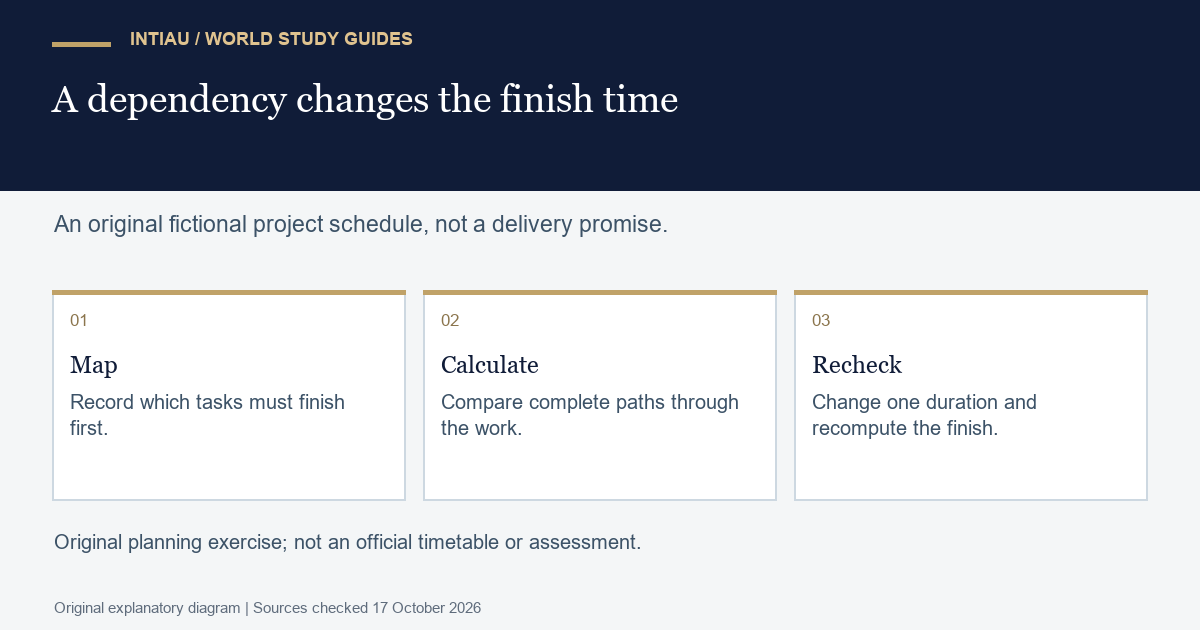
A fictional team has four tasks: A takes three hours; B takes two and waits for A; C takes four and also waits for A; D takes two and waits for both B and C. Assume B and C can run in parallel with sufficient people. Total effort is eleven hours, but the earliest finish is nine: A ends at three, B at five, C at seven and D at nine. If C grows to six hours, the finish moves to eleven. Reducing B to one hour does not restore the earlier finish because D still waits for C. Draw the dependency graph and name the assumption that permits parallel work. Then explain why adding the task durations answers an effort question while the longest necessary path answers this model’s elapsed-time question. No real project schedule or delivery outcome is implied.
Three practical questions
Can every term be replaced by electives?
No. The curriculum identifies term five as elective; the other term courses are mandatory. curriculum map
Is the selected project syllabus the entire degree?
No. It is one actual course specification, with its own effective date and entry requirements.
Does less total effort always shorten the finish?
No. In the original task, the unchanged dependency through C still determines when D can begin.
For INTIAU’s own information, see Courses and Contact.
Related guides
View the study diagram