Linköping University in Sweden is independent of INTIAU. Experimental and Industrial Biomedicine is a 180-credit, full-time, English-taught campus programme in Linköping. The advertised autumn 2027 international round has an application period 16 October–15 January and directs applicants to University Admissions. programme details
Biomedical science alongside project development
The programme’s main field is medical biology, and its named award is the Degree of Bachelor of Science in Medical Biology. The syllabus revised in August 2026 is valid from autumn 2027. It combines scientific courses with recurring projects; its future semester tables explicitly label courses preliminary. The selected map below follows that published framework without claiming that every future course or offering is final. programme syllabus
| Stage | Selected published study | What to compare |
|---|---|---|
| Year 1 | Cell biology, chemistry, physiology and genetics; biomedical product development and bioentrepreneurship | Connections between a mechanism and a project question |
| Year 2 | Analytical chemistry, immunology, bioinformatics, pharmacology and systems biology | Methods used to interpret complex biological information |
| Year 3 | 30-credit degree project; later disease-model, imaging and clinical-trial project study | Independent investigation and its limits |
The separately published 2025-cohort plan places its first year in 2025/26 and later semesters in subsequent years, with preliminary labels retained. That older cohort record is not a timetable for a new 2027 entrant. Its distinction between taught scientific work, projects and independent research helps identify which version a prospective student is reading. cohort plan
For comparison, identify three different kinds of evidence: understanding a biological process, carrying out and interpreting a method, and organising work to answer a defined question. A programme may integrate them, but a short description of laboratory experience does not establish what scientific claim a student must defend. Use actual outcomes and project descriptions to make that distinction visible.
An actual biomedical product-development course
8BKG16, Project Course: Biomedical Product Development, is a six-credit programme course with an autumn 2026 offering; the displayed syllabus is valid from spring 2020. It introduces development and validation of diagnostic-testing methods, quality documentation, regulatory considerations and project management through time, cost and quality. Outcomes include planning work, assessing laboratory data and communicating a method to nonspecialists. Teaching uses lectures, seminars, laboratories and project groups. Assessment includes a written report and oral presentation, with individual assessment within group work. These are selected course themes, not evidence that any resulting product has regulatory approval. course syllabus
The practical question is whether you want to study a scientific technique in isolation or also examine how its evidence, documentation and intended use fit together. Before comparing two courses, write down what would count as an adequate result for each. An elegant presentation and a technically complete set of observations still need a justified connection to the question being asked.
Applicant requirements and progression
The programme requires general undergraduate eligibility plus its stated English, chemistry, biology and mathematics equivalents. It exempts students from the Swedish requirement. The main programme’s English-language statement should be read alongside actual course-offering information rather than treated as a substitute for checking every group. programme details
The revised syllabus specifies progressive study and a threshold of at least 90 credits from semesters 1–4, including named foundational courses, before the degree project and specified later study. These progression conditions are different from initial admission. programme syllabus
Original paper calculation: a fictional quality screen
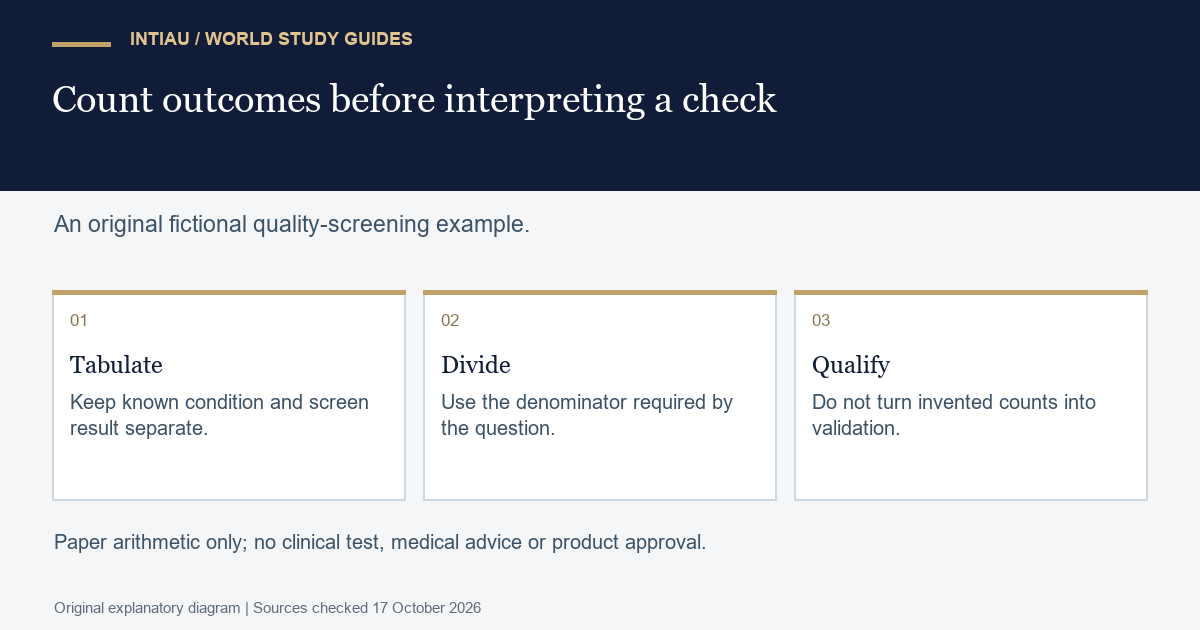
Consider 100 invented manufactured units: 20 have a known flaw and 80 do not. A fictional screen flags 18 flawed units and eight unflawed units. It flags 26 in total, so 18/26, about 69.2%, of flagged units have the stipulated flaw. It detects 18/20=90% of flawed units, a different denominator and question. Now keep those rates but imagine only ten flawed units among 100: nine are detected and nine unflawed units are flagged, giving nine genuine flaws among 18 flags, or 50%. Explain why the same detection rate can coexist with a different composition of flagged results. The counts are invented and establish no clinical performance, real manufacturing capability or validated product claim.
Three questions
Is the 2025 cohort plan the 2027 entrant’s timetable?
No. Keep the intake year attached to the record and use the revised framework applicable to the intended cohort.
Does a product-development course establish product approval?
No. A teaching specification describes learning, not the regulatory status of an actual product.
Are flagged units and flawed units the same denominator?
No. The original calculation distinguishes the composition of flagged results from the fraction of flaws detected.
For INTIAU’s own information, see Courses and Contact.
Related guides
View the study diagram