Umeå University in Sweden is independent of INTIAU. Life Science combines chemistry and molecular biology in a three-year, 180-credit campus route. The autumn 2027 offering is in Umeå with English teaching. It lists general eligibility plus Biology 2, Chemistry 2 and Mathematics 3c, or the stated newer-level equivalents. programme details
Which scientific foundation and degree?
The syllabus valid from 31 August 2026 leads to a Bachelor of Science in Chemistry or Molecular Biology. The first year is chemistry-focused, the second molecular-biology-focused, and the third includes choices and an independent project. The syllabus describes English as the normal teaching language, while allowing some Swedish support for Swedish students. The selected map preserves that qualification rather than treating a language label as a description of every interaction. programme syllabus
| Stage | Selected syllabus components | Preparation question |
|---|---|---|
| Year 1 | Biological Chemistry; Fundamentals of Chemistry; Organic Chemistry; Biochemistry | Can you connect a chemical representation with an explanation? |
| Year 2 | Microbiology; molecular genetics; cell biology; animal and plant physiology | How does a mechanism connect levels of organisation? |
| Year 3 | 45 credits of elective/free study and a 15-credit degree project, subject to degree conditions | Which choices deepen the intended main field? |
Rather than treating chemistry and biology as two unrelated lists, select one process and identify the kinds of explanation it requires. A molecular structure, a reaction, a cellular response and an organism-level observation can concern the same broad question while demanding different methods. Your comparison notes should say which level is being explained and what observation would support the explanation.
Two actual course examples
Biological Chemistry, 5KE111, is a 15-credit introductory course with a syllabus valid from 30 May 2022 onwards. It connects chemical processes with biological applications through themes concerning future medicines, forensic science, and nutrition, sport and health. Students encounter experimental planning, analysis and presentation alongside introductory chemistry, statistics, report writing and scientific reasoning. Its outcomes include planning a practical study and reporting results orally and in writing. Laboratories and safety briefings are compulsory. These are selected syllabus themes; this page supplies no laboratory procedure to carry out independently. course syllabus
The 15-credit Cell Biology course, 5MO100, offers a different example of how scientific explanation and communication connect. Its published description divides work into theory, professional presentation practice and laboratory study. The laboratory component includes scientific-report preparation, independent planning of experiments and analyses, and an individual record of protocols and results. Reports use the form of a scientific article. The course page links the legal syllabus, which should be consulted for its applicable version and full requirements. course description
That comparison suggests a practical reading method: separate what you must understand, what you must perform and what you must explain to someone else. A laboratory title alone cannot show all three. For each candidate programme, find one actual course specification and mark where it asks for interpretation, documentation or a justified choice, rather than simply recording the technique’s name.
Application and later choices
For autumn 2027, use the application link and eligibility wording attached to that offering. A programme-syllabus effective date is not an applicant deadline. programme details
Original worked comparison: unequal amounts
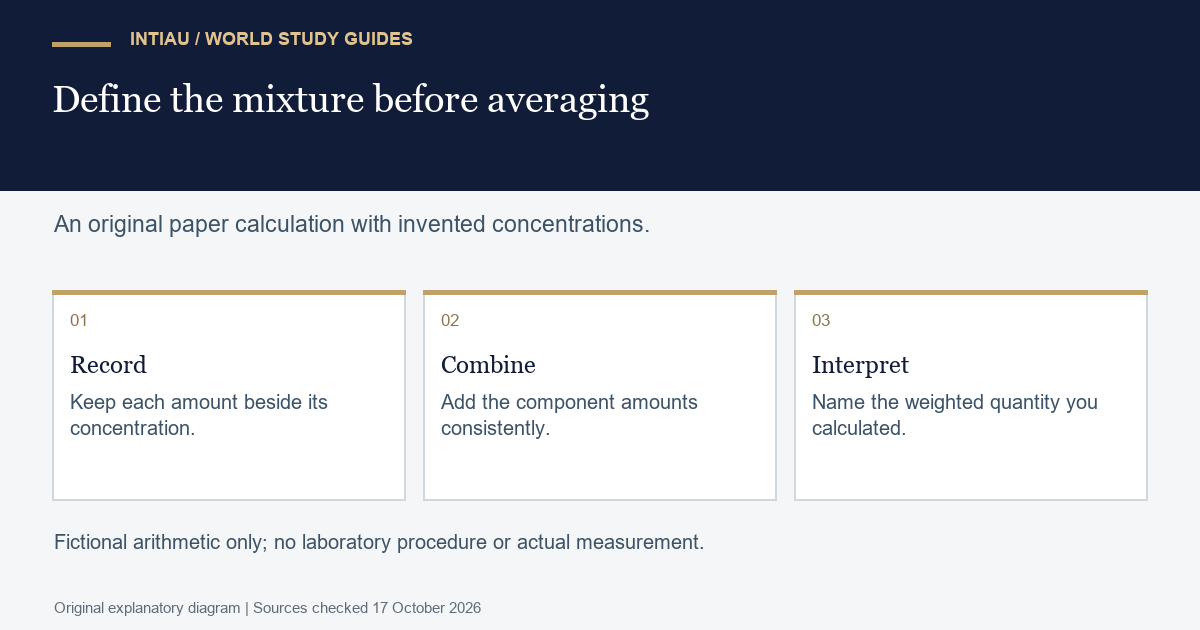
Suppose two fictional mixtures contain 20 units at concentration 2 and 80 units at concentration 7. Under the assumption that the stated units combine additively, the component quantity is 20×2+80×7=600 and the combined amount is 100. The weighted concentration is therefore six. The unweighted mean of two and seven is 4.5, which answers a different question: the mean of the two labels, not the concentration in the combined amount. If the amounts are reversed, the result becomes three. Explain which assumption makes the arithmetic possible, and why no real chemical compatibility or volume behaviour has been established. The task is invented paper reasoning, not a recommendation to mix substances or a report of actual measurements.
Three practical questions
Does the programme’s name fix the main field automatically?
No. The syllabus identifies Chemistry or Molecular Biology as the degree’s main field. programme syllabus
Is a course description the complete legal syllabus?
No. Use its linked syllabus and retain the effective date when checking detailed requirements.
Can the original average be used as a mixing instruction?
No. It is a fictional calculation under explicit assumptions and establishes no real material behaviour.
INTIAU’s own information is available through Courses and Contact.
Related guides
View the study diagram