Lund University in Sweden is independent of INTIAU. Its English-language Development Studies programme brings economic, political and social questions together through several departments. The Political Science department identifies terms three and six as points where students can study within that department. department guide
Which qualification and applicant cycle?
The programme awards a Degree of Bachelor of Science in Development Studies after three years and 180 credits. The advertised autumn 2027 offering is full-time in Lund, taught in English, with an application deadline of 15 January 2027. Applications follow the programme’s University Admissions link. General entry requirements apply, together with the stated English and Social Studies equivalents. Early international selection uses upper-secondary grades; the later national round has a different selection arrangement. programme details
For a useful initial comparison, decide whether you want development to be the shared problem around which you study several disciplines, or whether you want one discipline to supply almost the whole degree. Record that preference before comparing course titles: a familiar word such as poverty does not reveal whether the analytical approach is historical, spatial, political or sociological.
How the published sequence fits together
The structure begins with two broad courses, then permits disciplinary specialisation before returning to research methods and independent work. At least 30 credits in one major discipline are required during the second year. The linked structure and programme syllabus provide the full requirements; this table selects stages rather than reproducing every module. programme structure
| Stage | Published component | Comparison question |
|---|---|---|
| Year 1 | Multi-Disciplinary Perspectives I and II, 30 credits each | Which disciplinary lens changes your explanation? |
| Year 2 | 30-credit specialisation; 30 elective credits, exchange or relevant internship | Which major supports your intended research question? |
| Year 3 | Research Methods and Current Debates; 15-credit desk-study/fieldwork course; 15-credit thesis | Can your question be answered with accessible evidence? |
The participating disciplinary perspectives include economic history, human geography, political science and sociology. An interdisciplinary programme does not mean that every later choice is interchangeable: the department’s published course links distinguish the political science route’s development courses and its final research components. department guide
A real course example: politics and development
STVC02, The Politics of Development, is a 15-credit bachelor’s-level course listed for autumn 2026 in English. It examines development through power, governance and institutions, connecting national political processes with global structures. Published themes include rights-based approaches, democracy, state-building and the political dimensions of poverty, health, climate and gender. Teaching combines lectures, student-led seminars and an individual paper. The course page links its syllabus and warns that reading lists may change. A prospective student interested in climate could use this course to investigate who makes a decision, whose rights are represented and how an institution distributes authority. That is a more precise comparison than treating every climate-related course as the same kind of environmental training. These are selected teaching themes, not a promise that a later cohort will receive an identical reading list. course overview
Original worked comparison: a programme effect?
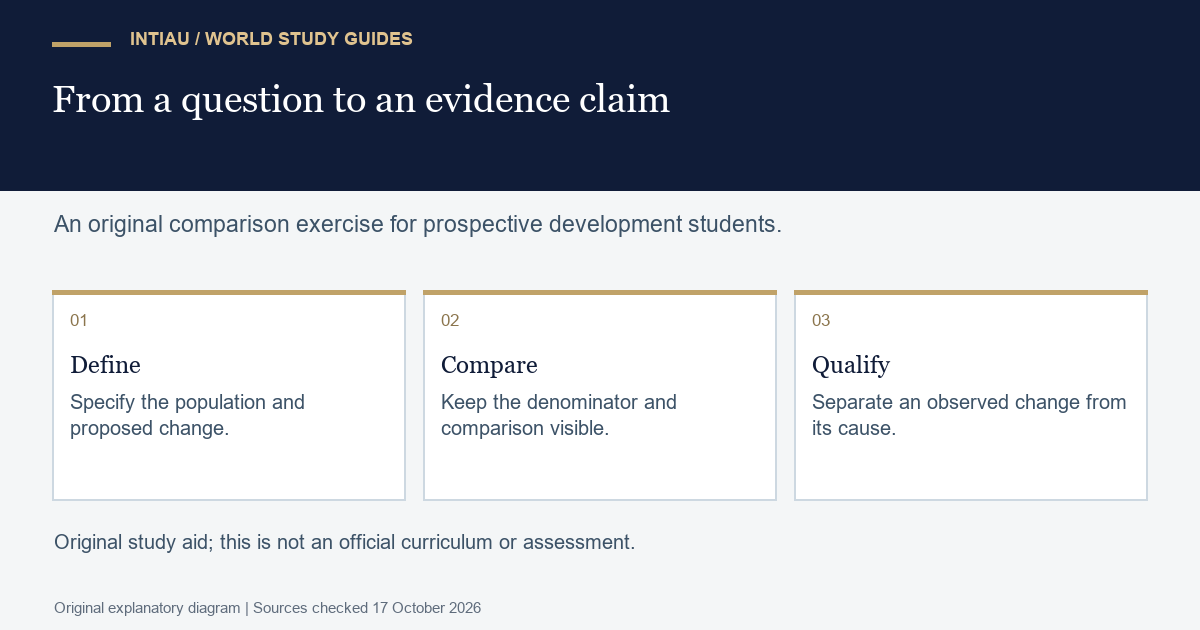
Imagine two fictional districts, each with 100 eligible households. In district A, 60 households use a new service before a project and 75 afterwards. In district B, use rises from 40 to 50 without that project. A rises 15 percentage points; B rises 10. Subtracting those changes gives 5 points. That calculation does not establish causation: perhaps the districts faced different transport changes or selected different households. Write the additional assumption needed for a causal interpretation, then propose one observable check that could challenge it. A clear answer names comparable underlying trends and checks earlier changes before implementation. Even matching earlier trends would support an argument rather than prove every assumption. Finally, state why the raw 25-household difference between the final counts answers a different question from the 5-point difference in changes.
Questions to settle before choosing
Does the major replace the development focus?
No. The published structure retains common development courses while the major supplies disciplinary specialisation. programme structure
Is the selected politics course a full programme syllabus?
No. It is one dated example. Use the linked programme structure and syllabus to check the complete pathway.
Does the worked subtraction prove a project succeeded?
No. It describes the stipulated numbers; a causal conclusion needs evidence and defensible assumptions about the comparison.
For INTIAU’s own information, see Courses and Contact.
Related guides
View the study diagram