The University of St Gallen in Switzerland is independent of INTIAU. Its computer-science bachelor combines technical computing with business-related and contextual study. The programme presents software, systems, theoretical and mathematical foundations, and data as connected areas rather than separate degree titles. official programme overview
Degree and language framework
The award is Bachelor of Science HSG (B.Sc. HSG), requiring 180 ECTS over three years or six semesters. German is the programme language, with some English courses. The factsheet gives an annual application period from 1 October to 30 April without a cycle year; this guide does not turn that recurring label into a confirmed 2027 admission schedule. degree factsheet
For comparison, identify whether you want a computing degree with a structured business component, or a programme whose optional space you can use in another way. Do not compare only the percentage labelled technical. Ask what the remaining study contributes and whether its requirements fit the questions you want to investigate.
Selected progression through the curriculum
The published framework assigns 75% to technical study, 15% to business subjects and 10% to contextual study. Contextual work includes a language course. Its computing sequence develops programming, software design, systems and data, while distinguishing collaborative project work from the individual thesis. curriculum and complete framework
| Stage or strand | Selected published component | Comparison question |
|---|---|---|
| Programming foundations | First-semester Python; second-semester Programming Methods using Java | Can you explain a design choice as well as write a working solution? |
| Developing technical study | Software design, computer systems, networks, databases and data analysis | Which assumptions cross the boundary between components? |
| Independent and collaborative work | Small-group Bachelor Project; individual 15-credit bachelor’s thesis | Which contribution must you demonstrate personally? |
The table selects stages and strands; it does not assign every topic to an invented semester. A programme comparison becomes more useful when it identifies how foundations support later work, and when group production is distinguished from an individual research argument.
A real teaching example: Programming Methods
Programming Methods develops the foundation through Java and more complex projects. Later software teaching addresses planning and teamwork. This programme-level account is not a verified full module syllabus or assessment breakdown. named-course context
One useful preparation task is to take a small solution you already understand and explain how its data representation, error handling and shared assumptions would change when several people extend it. That asks a different question from whether it produces the right output once. Record which part of your explanation relies on a language feature and which part is a general design decision.
Admission route and German preparation
The computer-science Assessment Year is offered in German. The admission page distinguishes Swiss and Liechtenstein qualifications from recognised foreign school certificates, with country-specific conditions. Foreign-applicant selection rules have stated exemptions, including relevant nationality or residence categories; they should not be reduced to one universal test rule. The university recommends C1 preparation for study, while its application guidance distinguishes that recommendation from a language certificate required at application. Additional examination conditions can apply to particular qualifications. Use the official route matching the actual certificate and status, and check its document instructions before applying. bachelor admission conditions
The overview connects technical foundations with applications and business contexts; it does not guarantee an outcome. programme context
Original exercise: two requests, one place
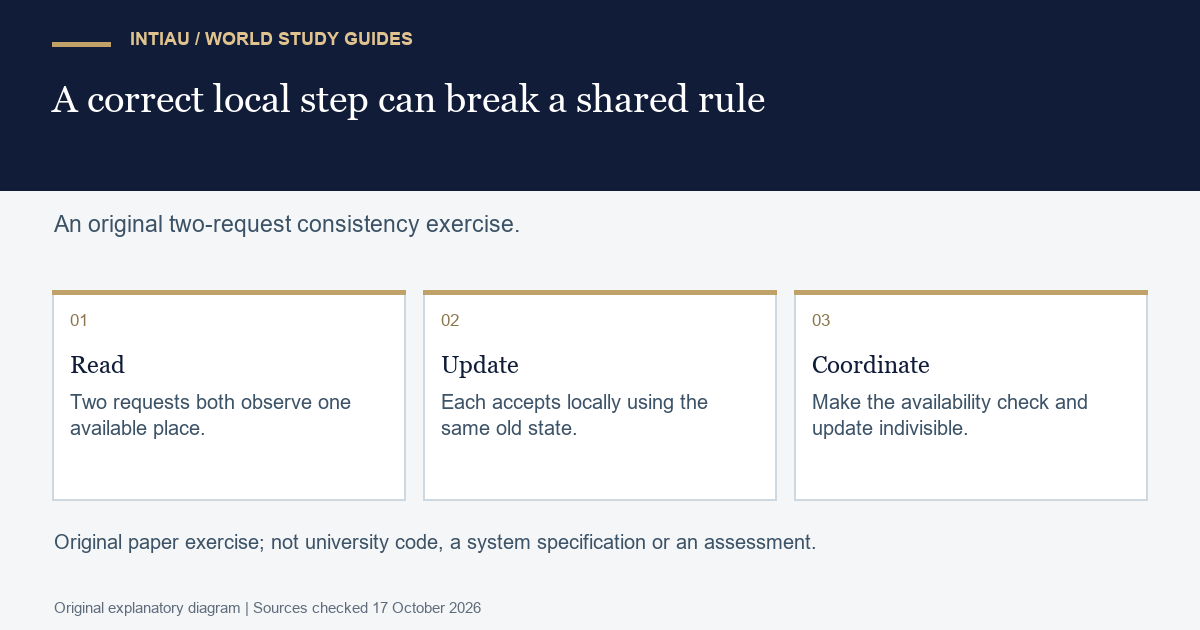
A fictional booking system has one place left. Requests A and B both read “one available.” Each then accepts its own booking and writes “zero available.” Every local subtraction appears correct, but two bookings have been accepted for one place. Explain why storing the final value zero does not establish that the capacity rule was preserved. Now stipulate an operation that checks availability and reserves a place as one indivisible action. If A succeeds first, B sees no availability and fails. State the rule being protected and one question that remains, such as how a failed payment releases a reservation. The exercise concerns an explicitly simplified model, not production software. Its point is to identify a shared-state assumption that a successful isolated test could miss.
Three practical questions
Are the Bachelor Project and thesis the same activity?
No. The curriculum distinguishes a group project from individual thesis work.
Is the entire programme English-taught?
No. The factsheet identifies German with some English courses.
Does a final stored value prove every booking rule held?
No. The fictional sequence shows why the accepted actions must also be checked.
For INTIAU’s own information, see Courses and Contact.
Related guides
View the study diagram