Stockholm University in Sweden is independent of INTIAU. Its new Statistics and Data Analysis bachelor’s programme starts in autumn 2026 and leads to a kandidatexamen in statistics. Teaching is mainly at Albano, with some courses at Frescati and Kista. The department combines statistics with contributions from mathematics, computing, philosophy, English and human geography. department guide
What the published programme actually contains
SODAK comprises 180 credits over six semesters. Its catalogue lists English, mathematics and social-studies entry equivalents, but the teaching-language field supplies no language. That absence cannot establish an English-taught degree. The table selects components from the current overview, rather than translating an entire legal syllabus. programme overview
| Stage | Selected published components | Planning question |
|---|---|---|
| Year 1 | Statistics and Data Analysis I/II; mathematics; academic writing; philosophy of science | Can you explain both a calculation and its assumptions? |
| Year 2 | Statistics III; databases; GIS; sampling; programming; generalised linear models; time series | Which data structure and dependence matter? |
| Year 3 | Elective semester; multivariate methods; selected statistical applications; 15-credit independent work | What question can your chosen method answer? |
There is a useful distinction between learning a tool and deciding when its answer is meaningful. A database exercise may establish that a query returns the intended rows. A statistical argument must also explain what those rows represent and whether the method matches the question. Compare programmes by looking for both kinds of work, rather than counting software names alone.
An actual introductory course
ST1101, Statistik och dataanalys I, is a 15-credit first-cycle course with autumn 2026 information. Its first component covers handling, visualising and summarising data in R, relationships and regression, prediction and introductory probability. The second develops random variables, distributions, inference and decisions under uncertainty. Teaching includes lectures and calculation/computer exercises; assessment includes written tests and group submissions. The course recommends reviewing relevant school mathematics before starting. This is a documented teaching recommendation, distinct from an additional admission condition. The page links the autumn 2026 course description and legal-syllabus archive. course outline
For preparation, choose a small, invented dataset and explain each column before applying a method. A result that is computationally reproducible can still answer the wrong substantive question. Write the target quantity in ordinary language first: the mean among recorded observations, a forecast for a new case, or a claim about a wider population. Keep those alternatives separate in your comparison notes.
Application and registration are different steps
The university’s current application guidance directs applications to Antagning.se. It distinguishes admission notifications, any required reply, and the department’s registration or roll-call instructions. Where a response is required, failing to reply by the specified date can remove a place. A subsequent admission notice does not remove the need to follow departmental registration instructions. This guide uses the 2026 programme launch and current guidance; it does not project a verified application window into 2027. application guide
Original task: a perfect fit is not every answer
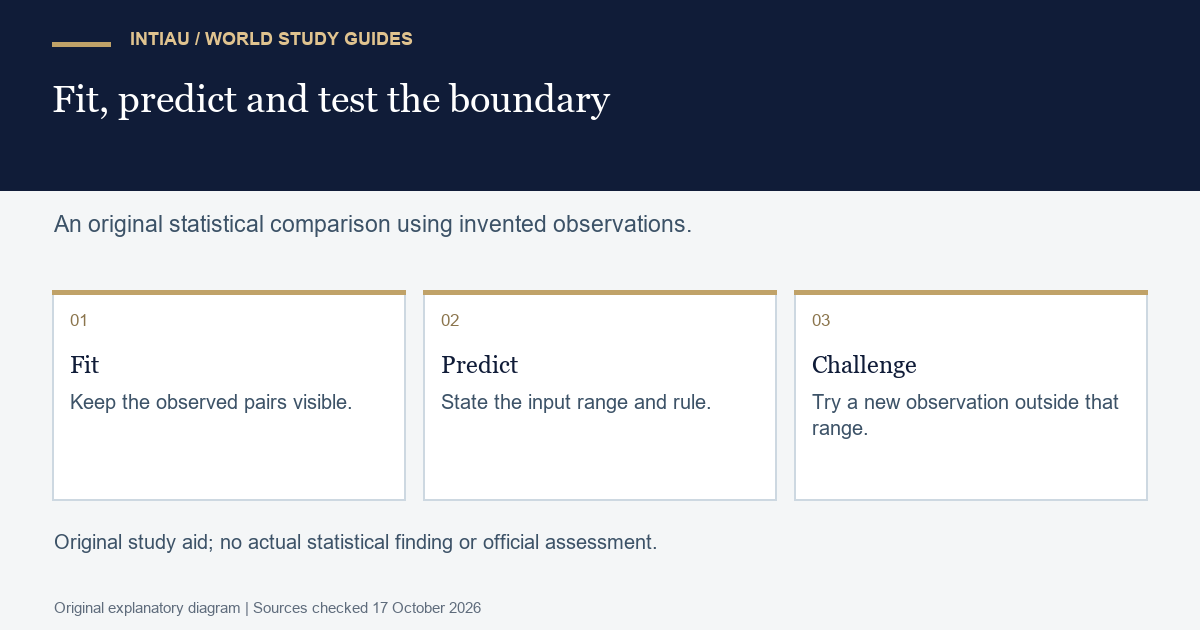
Take the invented observations (1,3), (2,5), (3,7). The rule y=1+2x fits every pair and predicts nine at x=4. A different rule, y=1+2x+(x−1)(x−2)(x−3), fits the same three observations but predicts 15 at four. Neither fit alone identifies how a real process behaves. Now suppose a new recorded pair is (4,9). The first rule agrees with it; the second does not. That supports a comparison between these two specified candidates on this new case, rather than proving that the first rule is universally correct. Write down whether your intended use concerns interpolation, extrapolation or explanation. Finally, describe one additional feature of the data collection that you would need before treating these fictional pairs as evidence about a population.
Three applicant questions
Is this the department’s earlier programme unchanged?
No. The department explicitly presents this programme as a new autumn 2026 offering. department guide
Does the catalogue confirm programme-wide English teaching?
No. Its language field is empty. Confirm the intended courses and groups directly before choosing. programme overview
Does exact fit establish a correct prediction?
No. Different rules can agree on observed points and disagree elsewhere, as the original task demonstrates.
See INTIAU’s Courses and Contact for its own information.
Related guides
View the study diagram