Uppsala University in Sweden is independent of INTIAU. Its Game Design and Graphics programme leads to a Bachelor of Arts with Game Design as the main field. The programme syllabus combines critical study of games with practical production, communication and consideration of games’ social and ethical dimensions. programme syllabus
Location, language and applicant route
The three-year, 180-credit programme is delivered in English at Campus Gotland in Visby. The advertised autumn 2027 offering specifies general first-cycle eligibility, intermediate mathematics equivalent to Swedish 2a/2b/2c, and English level 2/English 6. The programme page directs applicants to University Admissions and its document guidance. Its published teaching description includes lectures, workshops, group work and practical drawing, graphics and modelling. These are programme characteristics, rather than evidence that a particular applicant meets the requirements. programme details
When comparing this route with a computing degree, ask which work you want to practise: writing an engine, building visual assets, examining play, or coordinating production. Those activities can interact without being interchangeable. Make two lists: work you already enjoy doing and work you would need deliberate practice to perform. Use the course evidence below to identify that second list more precisely.
A selected map of the 2026 outline
The outline adopted in February 2026 specifies individual courses and their place in the sequence. The table selects examples from that outline; it is not a complete timetable or a replacement for checking the applicable cohort. programme outline
| Stage | Selected published component | What to compare |
|---|---|---|
| Semester 1 | Game Design 1: Introduction; Expression and 2D Graphics for Games 1 | Rules, artistic decisions and explanation |
| Semesters 2–4 | Arcade Games; System Design; 3D modelling and texturing; Vertical Slice | How a component becomes part of a larger production |
| Semester 5 | 30 elective credits; internship or study-abroad possibilities | Which opportunity requires a separate application? |
| Semester 6 | Theory and Method, 7.5 credits; 15-credit degree project; 7.5 elective credits | How a design claim will be investigated |
What an actual introductory syllabus adds
The autumn 2026 syllabus for 5SD065, Game Design 1: Introduction, describes a 15-credit course. It connects mechanics with play experience, considers different players, and develops documentation of a design study. One 7.5-credit module concerns prototyping, testing and study; another concerns digital games. Teams frame research questions and evaluate their working process, while digital games are also developed individually. The stated assessment includes written work, seminars and a digital game. This makes the distinction between making something playable and explaining a design decision visible in the actual teaching specification. course syllabus
Read a syllabus with three columns beside it: the artefact produced, the reasoning documented and the collaboration required. A portfolio image may illustrate the first column while revealing little about the other two. For your own comparison, choose one course outcome and describe what evidence would demonstrate it; avoid assuming that an attractive finished image establishes how the process was conducted.
Original paper task: change one rule
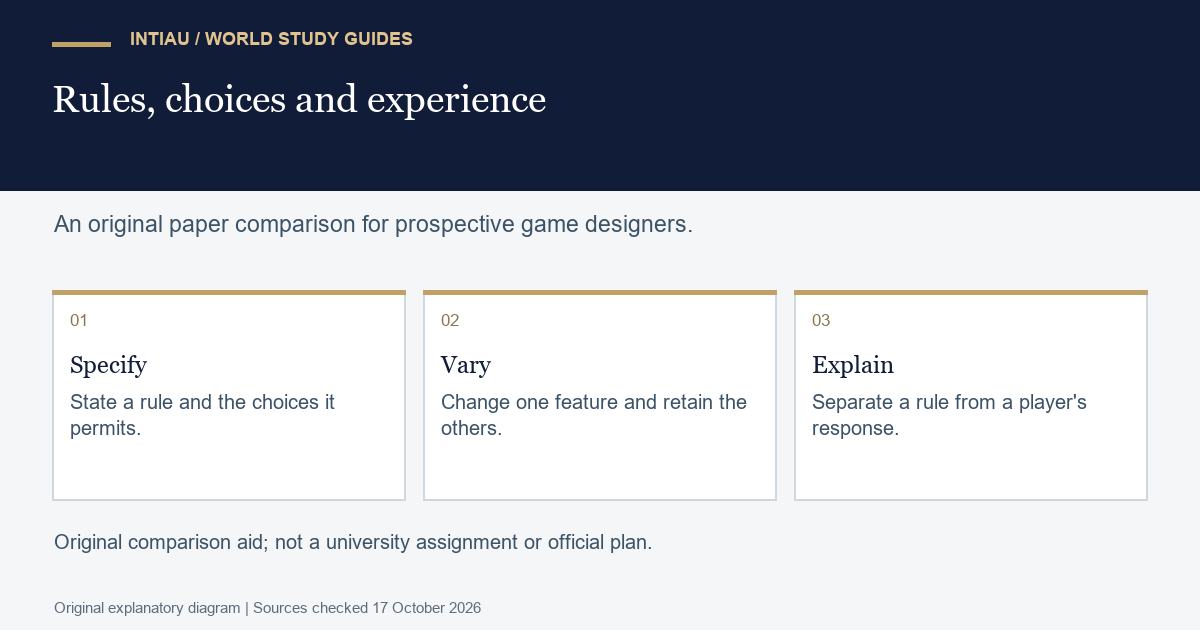
Invent a game with two routes. Route A takes two turns and awards four points. Route B takes three turns and awards six. Both offer two points per turn, but that does not make them identical: a player may prefer an earlier finish. Now change only A’s reward to five. Its rate becomes 2.5 points per turn, while B remains two. A score-maximising player with unlimited turns may respond differently from a player allowed exactly three turns and only one route. Under that latter rule, B still gives six rather than five. Write down the objective and stopping rule before announcing a better route. Finally, propose a visual cue that explains the changed reward without changing the scoring rule. This is an invented reasoning task, not evidence about real players or a university assessment.
Three practical questions
Is the fifth semester entirely prescribed?
No. The outline provides 30 elective credits and identifies internship or study-abroad possibilities. Check the applicable application and approval arrangements. programme outline
Does an English webpage alone establish teaching language?
No. Here the programme record explicitly states English. For another route, check its own teaching-language field.
Does the original task compare actual player behaviour?
No. It compares specified rules and objectives; real behaviour would require an appropriate study and evidence.
For INTIAU information, see Courses and Contact.
Related guides
View the study diagram