The Indian Institute of Technology Bombay in India is independent of INTIAU. IDC’s Bachelor of Design is a four-year, eight-semester programme taught in English. Its separate five-year BDes–MDes option is not the same award. The programme page states that BDes students cannot change branch into another IIT Bombay undergraduate programme. official BDes overview
Keep the curriculum cohort visible
IDC’s course-credit navigation links cohort-specific bulletins, including 2025–2029 and 2024–2028 documents. Those Google document bodies did not expose readable course content in this check. The detailed map below therefore uses the accessible 2023–2027 bulletin and does not claim to be the final plan for a 2027 entrant. cohort-specific curriculum links
That distinction matters because a design degree can retain the same award while changing studio names, options and credit arrangements. Use a dated map to understand the kind of work involved, then obtain the applicable cohort plan before making a registration decision. Do not combine attractive modules from several editions into an invented personal curriculum.
Selected progression from the 2023–2027 bulletin
| Published stage | Selected actual components | Comparison question |
|---|---|---|
| Semester 1 | Art and Design Fundamentals 2D; filmmaking; drawing; material exploration; Design Studio I | How do observation and representation affect a proposal? |
| Semester 5 | Applied Ergonomics; collaborative and summer projects; department electives | What must a team investigate before choosing a solution? |
| Semesters 7–8 | System Design Project; later BDes design project | How will a proposal be developed and communicated? |
For example, DE101 carries six credits in that bulletin, while Applied Ergonomics also appears as a six-credit course. Later department options include communication, film/video, interaction and service design. These are selected entries, not a full syllabus, a promise that every option runs, or proof that the newer cohorts use the same codes. The original PDF tables were read as text and inspected visually for the stages used here. dated bulletin
An actual teaching case: public-space wayfinding
IDC’s course documentation describes a BDes case involving Sir JJ Hospital and the Gateway of India jetties. The work began with site visits, observation and surveys to identify navigation problems. The documented proposals considered colour, visual cues and signs in relation to their users and settings. This supplies an actual learning example: the design problem was investigated before the communication system was proposed. The page is undated and describes an earlier newly introduced BDes course; it is not evidence that the same sites, assignment or implementation form a current compulsory module. No outcome or effectiveness claim is inferred from the account. official course documentation
2027 admission: examination and degree application differ
The official 2027 criteria require a UCEED2027 rank, the relevant age condition and Class XII or equivalent passed in 2026 or 2027. IIT Bombay accepts eligible applicants from all streams under this route; requirements differ at other participating institutes. The criteria also apply to foreign applicants, with separate nationality/OCI provisions that must be checked in full. This is admission eligibility, which should not be replaced by a summary of eligibility merely to sit the examination. 2027 admission eligibility
Qualifying candidates must separately apply for BDes admission through the common application process. The published 2027/28 page says that portal opens on 15 March 2027. Applicants give institute preferences, and seat allocation depends on rank, applicable category and available seats. A UCEED rank is therefore not an admission offer. BDes application process
Original exercise: a correct route can be a poor direction
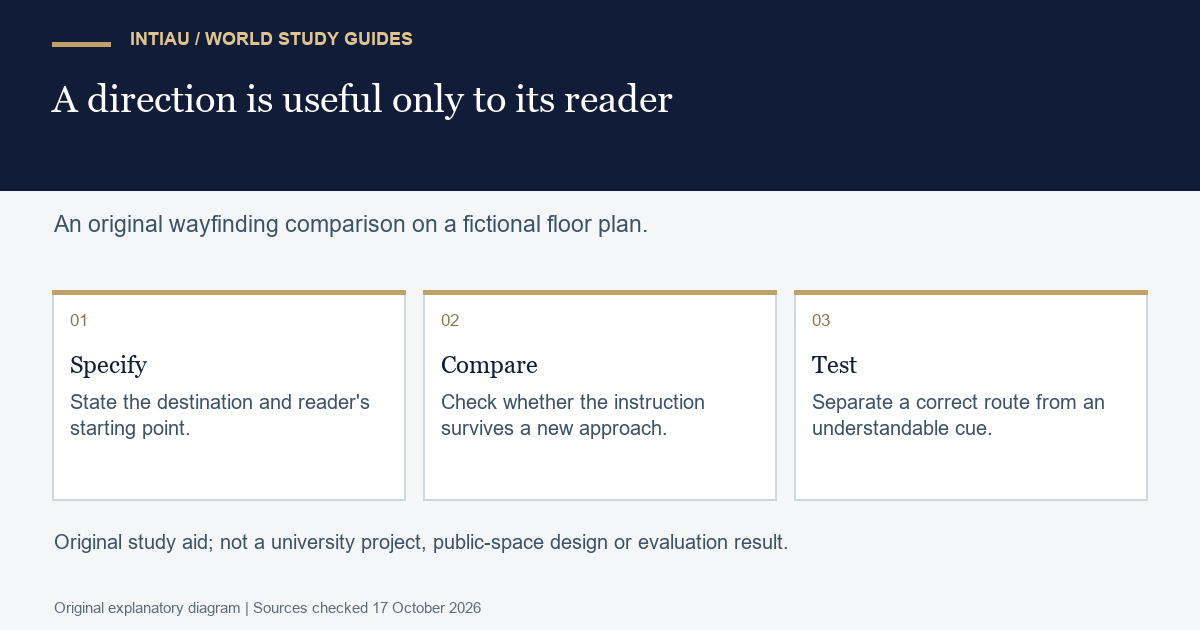
On a fictional floor plan, a corridor runs east–west with a north branch to room N. A person approaching from the west reaches the branch by turning left; a person approaching from the east reaches it by turning right. A sign saying “turn left for N” is correct for one approach and wrong for the other. Rewrite the direction using a fixed landmark or an orientation-aware sign, then explain what additional information your revision assumes. Next distinguish two tests: whether following the instruction reaches N, and whether a first-time reader understands the cue. A correct route on paper does not establish the second. This is a comparison exercise, not a proposal for a real hospital or a claim about actual users.
Three practical questions
Is the table a confirmed 2027-entry curriculum?
No. Its cohort is explicitly 2023–2027; newer official links are provided separately.
Does a UCEED rank itself secure the degree place?
No. A separate BDes application and the official allocation process are required.
Does the fictional route test establish user comprehension?
No. Route correctness and understanding require different evidence.
For INTIAU’s own information, see Courses and Contact.
Related guides
View the study diagram