Instituto Politécnico Nacional lists Ingeniería Aeronáutica at ESIME Unidad Ticomán in Mexico City and at UPIIG in Guanajuato. This independent guide focuses on the published Ticomán material; it is not an INTIAU programme or partnership.
Know which engineering map you are reading
The linked Ticomán map is explicitly effective from August 2003. Its Design and Construction option shows eight semesters and a headline 432 credits, with a note that totals vary with selected curricular-completion routes and options. It is a published plan, not confirmation that an entering 2027 cohort follows an unchanged audit. Read the actual map and its footnote.
| Map stage | Selected courses, translated |
|---|---|
| Semesters I–II | Calculus; Classical Physics; Programming; Applied Chemistry |
| Semesters III–IV | Solid Mechanics; Thermodynamics; Fluid Dynamics; Computer-aided Design |
| Semesters V–VI | Aerodynamics; Structural Matrix Analysis; Flight Mechanics |
| Semesters VII–VIII | Flight Dynamics; Composite Materials; Aircraft Control Systems; selected options |
Read the columns as carefully as the course names. Theory hours, practical hours and credits are different quantities. Likewise, a total printed above a qualification footnote is not necessarily the only valid total for every option. When comparing curricula, keep the map edition and the option name beside every number you copy.
The programme’s entry profile emphasises mathematics and physics, reading English and working with specialised instruments. The English version of an institutional webpage does not itself establish an English-taught degree. Applicants should confirm teaching arrangements for the actual school and intake, rather than infer them from the language selector.
Aerodynamics: actual laboratory context and its limit
The school’s laboratory listing describes aerodynamic measurement, including forces and moments, pressure and flow visualisation. These are concrete learning themes to investigate alongside the named Aerodynamics course. The listing describes facilities and services; it does not verify a complete undergraduate syllabus, a particular student’s access or a future laboratory timetable. Inspect the school laboratory descriptions.
As a preparation task, explain the difference between a force reading and a visual pattern. A balance might provide a numerical comparison, while a flow image can help formulate an explanation. Neither removes the need to state the test conditions. In your course comparison, ask how observations are recorded, how instruments are checked and how a written engineering argument connects those results to a model.
Admission is governed by the applicable call
The school-mode call reviewed here applies to August 2026–January 2027 entry and describes a process ending on 24 August 2026, already past on 17 October. It requires completed upper-secondary study, an admission examination and subsequent document verification; satisfying school completion alone does not allocate a place. The call specifies an online examination in Spanish except its English section. It cannot establish a new 2027 application window. Read the dated call.
Build your application notes around the named academic unit, the programme choice and the call’s mode of study. Keep exam participation, selection and final registration as separate checkpoints. A document deadline also needs its stated purpose: submitting a record is different from completing the qualification that record must prove.
Original exercise: interpret a force comparison
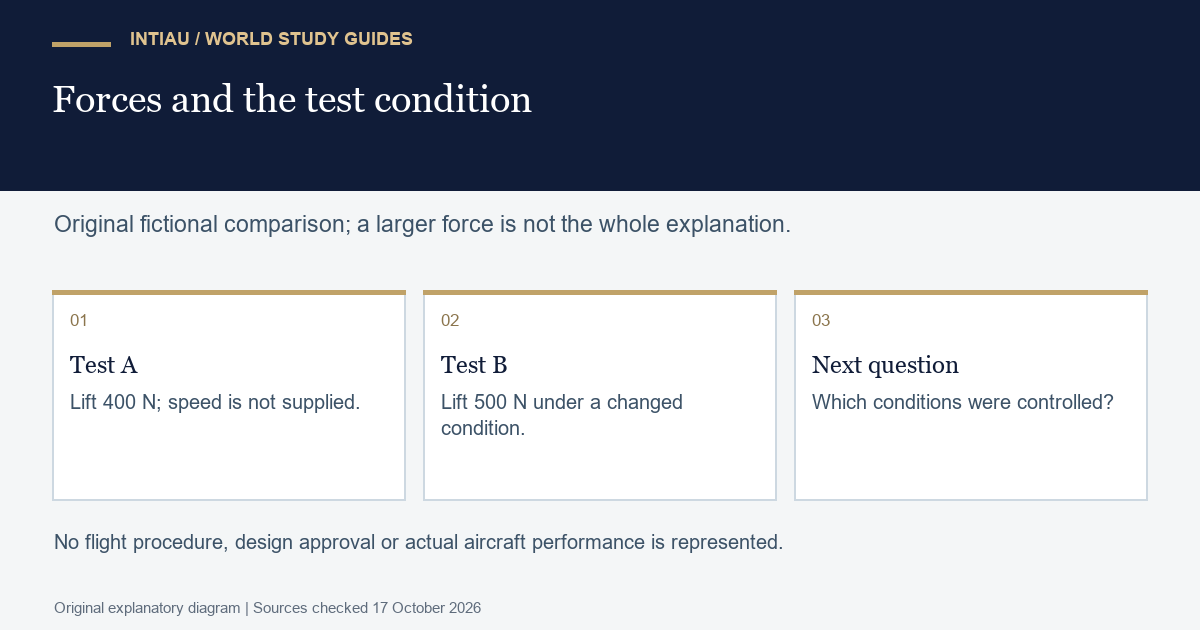
Imagine two fictional wind-tunnel readings. Test A records lift of 400 newtons; Test B records 500 newtons. The increase is 100 newtons, or 25 percent relative to A. That arithmetic does not establish why lift increased. Suppose the angle setting changed at the same time as speed: two conditions changed together.
Make a two-column test log listing speed, angle setting, model geometry and instrument zero. Mark unknown values rather than filling them with plausible guesses. A stronger next comparison changes one selected condition while holding the others fixed and repeats the observation. Your conclusion should distinguish the measured difference from the explanation you still need to test. This is an original reasoning exercise, not an aircraft design calculation, operating instruction or IPN examination question.
Questions to settle
Does this cover every IPN campus?
No. It focuses on ESIME Ticomán; the programme listing also names UPIIG.
Is the map a newly issued 2026 syllabus?
No. The reviewed map explicitly carries an August 2003 effective date.
Do laboratory descriptions prove my class schedule?
No. They establish laboratory themes, not individual access or a future teaching allocation.
Official reading
- Programme entry (published listing)
- Ticomán curriculum map (effective August 2003)
- School laboratories (published listing)
- School-mode admission call (2026-27)
For other study topics, browse INTIAU Courses; use Contact for questions about INTIAU services. University applications belong with the institution named above.
Related guides
View the study diagram