The University of Southern Denmark is separate from INTIAU. Its Mechatronics BSc in Engineering is taught in English at Sønderborg. It combines mechanics, electronics and software in integrated systems. This guide concerns the BSc route, not the separately advertised Mechatronics BEng.
Read the project progression
The published structure specifies six semesters and 180 ECTS. Each semester links theory with a main project theme. The following is a selection, not a complete module list.
| Semesters | Selected progression |
|---|---|
| 1–2 | Small mechatronic product; then a product capable of motion. |
| 3–4 | Sensors, actuators and dynamics; profile study and Control Engineering. |
| 5–6 | Experts in Transformative Teams; bachelor project. |
The progression matters because a component can behave correctly on its own while the complete system fails to meet a requirement. In a degree comparison, look for opportunities to connect a mechanical requirement to a sensor reading, a computation and an actuator response. A list containing all four words does not show how they are brought together. Read the project descriptions alongside the subject names and ask which decisions a student must explain.
The programme describes developing systems that sense, process and act, rather than studying each technical domain in isolation. Its undergraduate duration is three years; the separately described master’s stage takes a further two years.
A named project with a published learning context
SDU describes the fifth-semester Experts in Transformative Teams project through a virtual company: students develop an idea into a working prototype while considering economic issues and external suppliers. The same structure identifies mechanics, electronics, embedded systems and multidisciplinary profile options. These are programme-level descriptions, not a retrieved full unit syllabus.
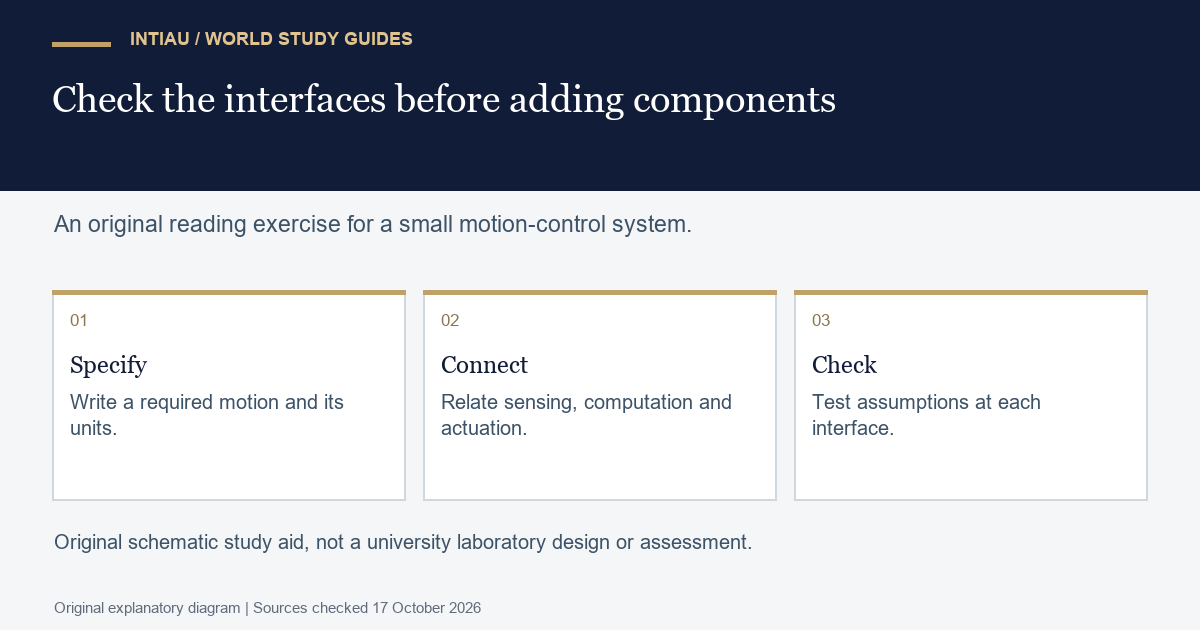
For a prospective student, the useful distinction is between building an object and explaining a development decision. An explanation might compare two sensing arrangements, specify which assumption makes one preferable and identify a test that could overturn the choice. In a team, write the interface assumptions where everyone can see them. “The motor receives a command” is incomplete unless the command’s units, timing and expected range are also clear.
Check the actual subject requirements
The entry page requires a qualifying upper-secondary education and English B, Mathematics A, plus Physics B or Geoscience A. These are Danish subject levels. It describes quota-based selection and directs applications through Optagelse.dk. Foreign-examination applications have a stated annual 15 March noon deadline; no unverified 2027 calendar is inferred here.
The same page offers qualification pre-assessment from 1 October to 15 November in the year before applying. As checked on 17 October 2026, that is a useful route for asking about subject-level equivalence. A pre-assessment enquiry is different from admission itself.
When organising that enquiry, give the qualification title, awarding country and evidence of the subjects studied. Keep a curriculum question, such as the difference between two profiles, in a separate paragraph. This lets the university distinguish your academic interests from the documentary question it must assess.
Try an original interface calculation
Assume a fictional wheel travels 0.5 metres per revolution and a sensor produces 100 counts per revolution. At 200 counts per second, the calculated speed is two revolutions per second, or one metre per second. The calculation assumes that each count is interpreted correctly and that the stated travel per revolution applies.
Now imagine a controller requests two metres per second but the measured count rate stays at 200. The evidence shows a mismatch between the requested speed and the computed speed. It does not identify the cause. A wrong scale factor, an unsuitable command, a sensing problem or a mechanical limitation could produce different explanations. A sound answer states the one-metre-per-second result and proposes a discriminating check before assigning blame. This is an original paper exercise, not guidance to operate a machine.
Questions about the route
Where is this BSc taught?
The published location is Sønderborg and the teaching language is English.
Is the bachelor a 180-ECTS route?
Yes. The structure specifies three years, six semesters and 180 ECTS.
Is Physics B the only stated science option?
No. The page also lists Geoscience A as the alternative.
Compare subjects through INTIAU Courses, or use Contact for INTIAU information-service enquiries.
Related guides
View the study diagram