Universidad Nacional Autónoma de México offers Ciencias Ambientales at ENES Mérida in Yucatán. This independent guide concerns that campus route, not an INTIAU qualification or partnership. UNAM also lists Morelia; its plan is separate.
A specific plan, rather than a generic environmental degree
The DGAE record identifies Mérida plan 2206, first generation 2022, as valid for first entry and re-enrolment. It specifies eight semesters and 350 credits: 312 compulsory and 38 optional. The selected progression below comes from that record. Use the full official plan.
| Stage | Selected actual entries, translated |
|---|---|
| Semester 1 | Environmental Physics and Chemistry; Ecology Foundations; Introduction to Statistics |
| Semesters 2–3 | Environmental Ethics; Physical Geography; Mathematical Modelling; Human Geography |
| Semester 4 | Ecological Agriculture; Ecosystem Biogeochemistry; Statistical Modelling |
| Semesters 6–8 | Project Development I and II; Integration Exercise; optional subjects |
Mérida’s published areas include socioecological systems, society and environment, and ecotechnologies. The Spanish award is Licenciatura en Ciencias Ambientales; translated names here do not establish English-medium teaching.
For comparison, ask what kind of argument you want to learn to make. A physical measurement, a model of change and an account of how people use a territory require different kinds of evidence. A useful study notebook puts these beside one another without treating an interview as a chemical measurement or a model output as an observation. This is a better preparation question than simply asking whether a course sounds “green.”
A real teaching resource: recording laboratory work
UNAM’s environmental-quality laboratory repository explicitly connects its materials with Environmental Physics and Chemistry at ENES Mérida. Its laboratory-notebook and report manual teaches recording observations, organising experimental work, preparing a report and using flow diagrams. The repository is a teaching resource updated in September 2024, not a verified complete 2026 module syllabus. Read the actual reporting resource.
Use that theme when inspecting any proposed laboratory experience. Ask what students must produce: a measured result, a reproducible procedure, an uncertainty statement or an explanation of a discrepancy. Those outputs reveal more than a photograph of equipment. A neat final report also needs a traceable route back to the original record; rewriting inconvenient observations after seeing the result defeats that purpose.
The entrance competition has its own calendar
The official 2026 competition listing gives an initial registration period from 23 January to 3 February and examination dates from 23 May to 10 June. Those dates are past on 17 October 2026. They establish a dated admission process, not a newly open 2027 window. Check subsequent category-specific notices through DGAE rather than treating an archived timetable as an invitation to apply now.
Prepare the application comparison around your actual route: campus, qualification sought, school record and the current competition document. Save the plan number separately from the admission-year label. A valid curriculum record does not establish that the entrance system is accepting a new application on the day you read it.
Original exercise: keep the record behind the average
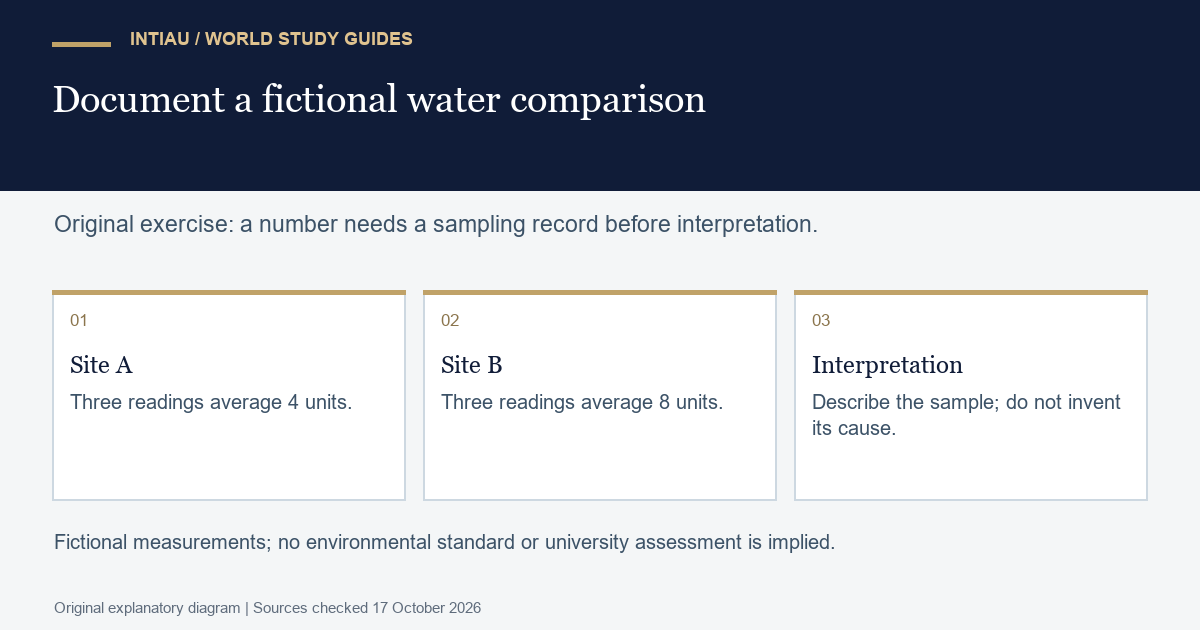
Use fictional readings from two sites. Site A has values 3, 4 and 5; Site B has 7, 8 and 9. Their means are 4 and 8. The second mean is twice the first, but that calculation alone identifies neither the substance measured nor its environmental significance.
Write a sample record giving a fictional unit, collection time and measurement method. Then suppose A was sampled in the morning and B after rain. Your defensible conclusion is that the recorded samples differ; you cannot isolate a site effect from a timing effect. Propose matched sampling times and repeated visits before making that stronger comparison. Keep the original six readings beside the means so another reader can check the arithmetic. This is a reasoning exercise, not a real sampling instruction or a UNAM assessment.
Questions to settle
Is this the Morelia plan?
No. This guide follows ENES Mérida and keeps the other campus separate.
Does the reviewed record use 350 credits?
Yes. Plan 2206 lists 350 total credits.
Is the laboratory manual a whole current syllabus?
No. It supports particular laboratory skills; its scope does not establish every current course requirement.
Official reading
- Programme overview (published listing)
- Mérida study plan (2206; first entry 2022)
- Laboratory reporting manual (updated September 2024)
- Entrance competition (2026)
For other study topics, browse INTIAU Courses; use Contact for questions about INTIAU services. University applications belong with the institution named above.
Related guides
View the study diagram