The University of Helsinki is separate from INTIAU. Its Bachelor’s Programme in Science leads to a Bachelor of Science. The English-language programme is based at Kumpula in Helsinki and has a target duration of three years.
Understand the common foundation and later choices
The published structure totals 180 credits. Students begin with mathematics and programming, then select chemistry, computer and data science, mathematics and statistics, physics, or a combination. The following map summarises components rather than assigning an invented semester timetable.
| Component | Published allocation |
|---|---|
| Common quantitative studies | 15–30 credits |
| Basic and intermediate studies | 60–105 credits |
| Transferable skills and languages | 15 and 10 credits |
| Final seminar and thesis | 4 and 6 credits |
The ranges should be read as alternatives within a personal plan. Adding all the upper limits would describe no actual degree. When comparing tracks, first identify which methods support the questions you want to ask. A probability course might support an analysis of noisy measurements; programming might allow the same calculation to be repeated consistently. These uses overlap, but that does not make the disciplines interchangeable.
The programme describes its bachelor’s thesis as a short literature study. Other courses occupy 35–50 credits according to the track and personal study plan. At least 75% of the degree, including the thesis, must be completed in English.
Inspect a real introductory course
Helsinki’s public Python Programming MOOC 2026 identifies Introduction to Programming, BSCS1001, as a five-credit course covering parts 1–7. Its completion involves exercises and an examination. This is a concrete university course example, rather than a promise that every Science track has the same required module.
The opening lesson has explicit learning aims: execute a first Python program, use the print command and perform arithmetic operations. It distinguishes displaying text from calculating an expression.
That distinction is a useful bridge between mathematics and computation. A program that displays a plausible sentence has not necessarily performed the intended calculation. In reviewing a solution, separate the model, the numeric operation and the displayed result. Write the expected units beside the answer. A correct operation on an incorrectly chosen quantity is still the wrong scientific answer.
Use the application period for your qualification
For autumn 2027, the admissions page distinguishes two groups. Applicants without the listed Finnish matriculation, IB, EB or Finnish RP/DIA qualifications use Group 1: 5–19 January 2027, selected through SAT or ACT scores. Holders of those listed qualifications use Group 2: 9–23 March 2027, based on examination results. Both periods close at 15:00 UTC+2.
Applicants cannot choose their preferred period or apply in both. General higher-education eligibility and language requirements also apply; full criteria are linked through Studyinfo.
Begin with the name and country of your qualification, rather than assuming that citizenship determines the group. Put the correct deadline in a document checklist alongside the required evidence. A curriculum interest, such as combining chemistry and data analysis, does not replace the eligibility or selection rules.
Try a short original scientific comparison
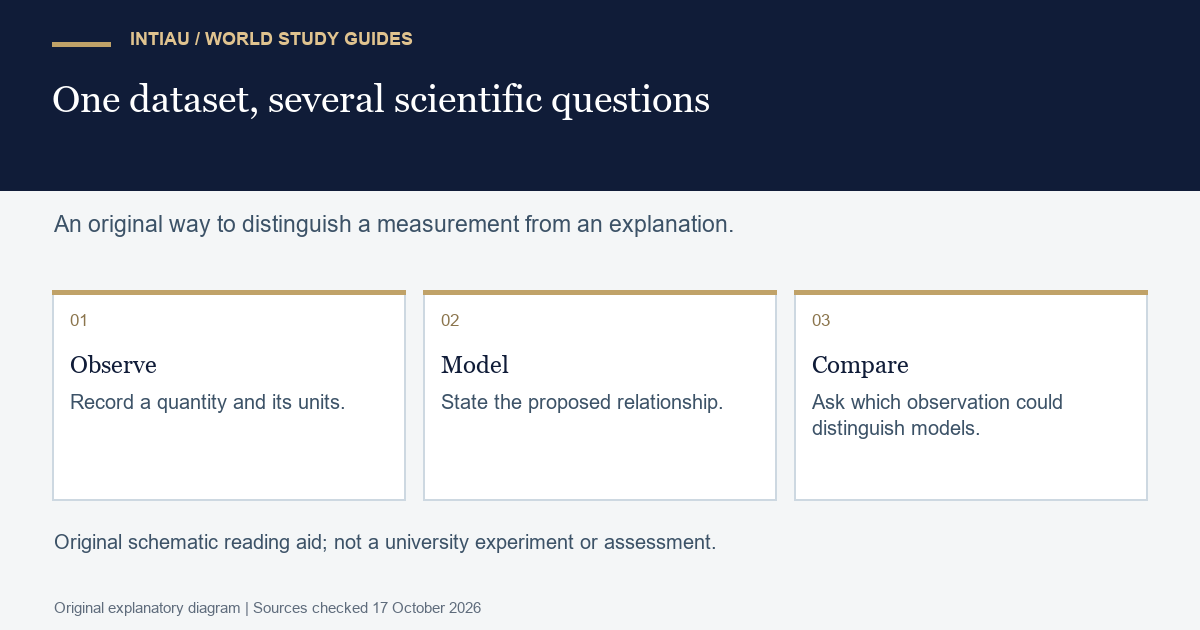
Imagine two fictional instruments report a length. Instrument A gives 10, 10 and 10 centimetres; instrument B gives 9, 10 and 11. Both averages are 10 centimetres. B has greater spread in these observations, but the equal averages do not establish that either instrument is accurate. Both could share an unknown offset.
A useful next question is what independent reference could reveal that offset. Repeating the measurements provides information about variation under the chosen conditions; it does not automatically supply a true value. This paper example shows why a numerical summary, an uncertainty question and a causal explanation should remain distinct.
Questions about the programme
Must a student choose only one scientific field?
No. The published structure allows combinations across the study tracks.
Can an applicant use both 2027 application periods?
No. The previous qualification determines the appropriate admission group.
Does the introductory programming example have a course code?
Yes. The MOOC identifies Introduction to Programming as BSCS1001.
Compare subject areas through INTIAU Courses, or use Contact for INTIAU information-service enquiries.
Related guides
View the study diagram