The University of Innsbruck is separate from INTIAU. Its Atmospheric Sciences bachelor awards a Bachelor of Science after six semesters and 180 ECTS. The programme combines physical, chemical, mathematical and computational approaches to the atmosphere, with particular attention to mountain processes.
Read a recommended sequence as a planning aid
The university identifies curriculum 2025W as currently applicable. Its example sequence is recommended, not compulsory. Selected stages are:
| Recommended stage | Selected actual components |
|---|---|
| Semesters 1–2 | Mathematics and physics; atmospheric chemistry; radiation; programming |
| Semesters 3–4 | Statistical Data Analysis; atmospheric dynamics; forecasting; climate |
| Semesters 5–6 | Observation methods; Weather Briefing; bachelor’s thesis and seminar |
The initial orientation stage requires Introduction to Atmospheric Sciences and the Physics 1 lecture in mechanics and thermodynamics. Passing that stage is relevant to further study; the curriculum also specifies what may be completed beforehand.
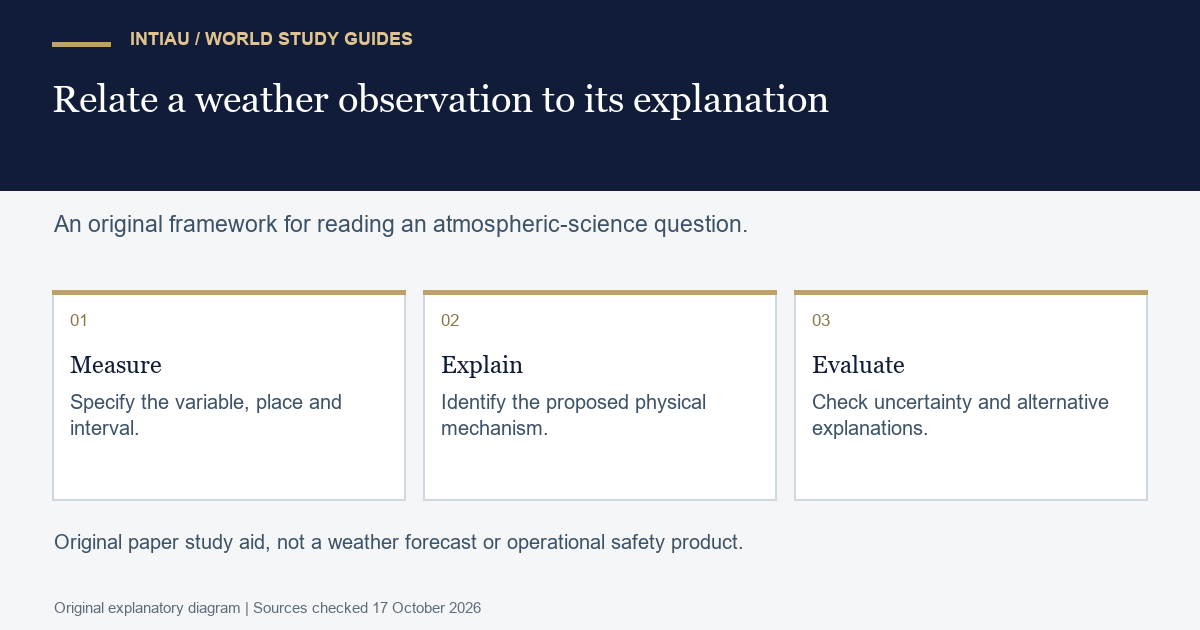
The sequence helps show why an atmospheric question can require several kinds of preparation. A measurement provides a value under particular conditions. A physical model explains a mechanism. Statistical analysis addresses variation and the information in a dataset. These roles support each other, but a sophisticated calculation cannot compensate for an unclear variable or an unsuitable observation.
When comparing programmes, choose one phenomenon and trace the methods needed to study it. For instance, distinguish the instrument’s output from the physical quantity being inferred and the period over which it is summarised. This produces a more useful comparison than simply counting references to climate or computing.
A real module specifies statistical interpretation
The linked full curriculum defines Statistical Data Analysis and Programming as a 12.5-ECTS compulsory module. It combines statistical lecture and practical work with programming. Themes include probability, descriptive statistics, hypothesis tests and regression. Outcomes require choosing suitable methods, interpreting results and using statistical software, alongside reading and writing scientific programs.
A useful distinction is between obtaining an output and explaining why it answers the question. Before selecting a statistical method, state the observational unit and the comparison being attempted. Several measurements from one instrument are not automatically equivalent to independent measurements from several places. In study notes, record assumptions next to the result, so they remain visible when the interpretation is discussed.
For a course comparison, look for verbs such as select, interpret and explain. They describe demands beyond recognising a method’s name. The full curriculum supplies the formal detail; this article summarises one module rather than reproducing its complete syllabus.
Check both German and English study demands
The department’s guidance says Atmospheric Science courses are taught in English, while mathematics, physics and some electives are taught in German. That clarification matters alongside the main programme’s German-and-English language listing.
Admission requires a secondary-school completion certificate or equivalent and the specified German-language evidence. The main page links online application and the university’s admission dates. Rules were checked on 17 October 2026; this guide supplies no unverified 2027 deadline.
An international applicant should therefore assess the whole study plan’s language demands, not just the language used in specialist lectures. Keep the qualification assessment, language evidence and curriculum questions separate when contacting the university. Permission to study one English course does not establish eligibility for the complete degree.
Try an original temperature-summary comparison
Imagine two fictional locations observed on two days. A records 10 and 14 degrees Celsius; B records 11 and 13. Both two-day means are 12 degrees. Their daily values differ, and neither two-day mean establishes a long-term climate trend.
Now suppose one location was measured in shade and the other in direct sunlight using an unsuitable exposure. More arithmetic cannot remove that comparability problem. A useful report states the measurement conditions, interval and intended comparison before interpreting the mean. This original paper example is not a weather forecast or an account of real Innsbruck observations.
Questions about the bachelor
Is the example semester sequence compulsory?
No. The university explicitly describes it as recommended.
Does the statistics module include interpretation?
Yes. Selecting methods and interpreting their results are explicit outcomes.
Are all supporting courses taught in English?
No. Department guidance identifies German-language mathematics, physics and some electives.
Compare subjects through INTIAU Courses, or use Contact for INTIAU information-service enquiries.
Related guides
View the study diagram