The Norwegian University of Science and Technology, NTNU, is separate from INTIAU. Its Chemistry and Materials Engineering bachelor is a three-year Norwegian-language engineering degree in Trondheim. The official award is Bachelor i ingeniørfag; students choose chemistry or materials engineering after the shared first year.
Compare two routes from the same foundation
The published structure specifies 180 credits, normally 30 each semester. Selected units show the relationship between common foundations and later specialisation:
| Stage | Selected actual study |
|---|---|
| Shared first year | Engineering mathematics; General Chemistry for Engineers; physics; chemical thermodynamics |
| Chemistry route | Analytical chemistry; chemical engineering; organic chemistry |
| Materials route | Material testing and characterisation; material and process selection; surface chemistry and corrosion |
| Final semester | Engineering systems thinking and the route-specific bachelor project |
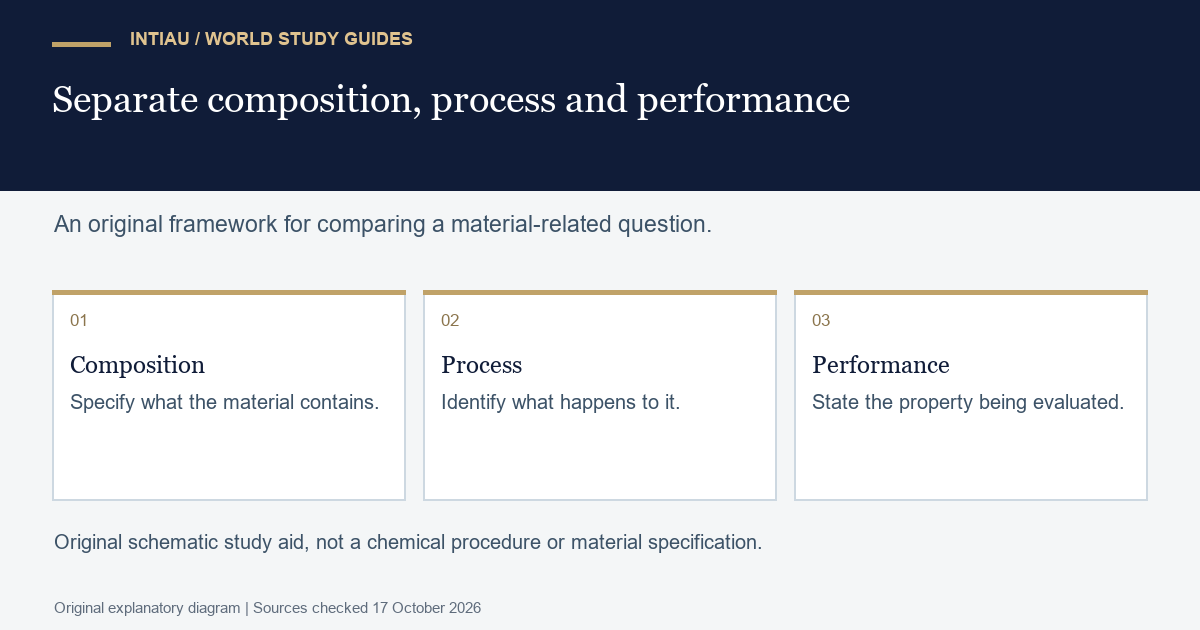
The distinction is useful when deciding what kind of explanation interests you. A chemistry question may concern how substances react or how a mixture can be analysed. A material-selection question may concern how a property relates to composition, processing and service conditions. These questions can overlap, but their evidence and constraints need to be stated.
A meaningful degree comparison should therefore follow one problem through several courses. Ask which foundation supports the calculation, which unit develops an investigative method and where a design choice has to be justified. A long list of laboratory terms does not show that progression on its own.
The programme combines lectures, exercises, laboratory work and projects.
A current module has explicit learning outcomes
The autumn 2026 IMAK1001 description, General Chemistry for Engineers, specifies 7.5 credits in Norwegian at Trondheim. It covers amount of substance, concentration, stoichiometry, gases, equilibrium and thermodynamics. Outcomes include balancing reactions, calculating equilibrium relationships and documenting experimental results. It also requires students to read safety data sheets and handle chemicals according to regulations.
Approved laboratory and calculation work are required for access to the final examination. The description is evidence of a real module’s scope; it is not a complete laboratory manual.
This combination of calculation and reporting helps a prospective student distinguish a numerical answer from an engineering explanation. A concentration value needs a clearly defined amount and volume. A reported result also needs a record of how it was obtained and what limits the interpretation. Being able to repeat a formula is only part of the learning demand described by the course.
Check the actual science and mathematics entry route
The admissions page directs applications through Samordna opptak and gives an annual 15 April deadline. Alongside general university-entry eligibility, its HING requirement specifies Mathematics R1, or S1 and S2, plus R2 and Physics 1. It also lists accepted preparatory routes. These are Norwegian qualification categories, not an automatic equivalence decision for a foreign certificate.
As checked on 17 October 2026, this guide does not assign the annual date an unverified 2027 cycle. Check the instructions applicable to your qualification and intended intake before assembling documents. A stated prerequisite is different from a historical admission score, and neither is a promise of a place.
Try an original mass-balance comparison
A fictional feed contains 100 kilograms of material, including 20 kilograms of a target substance. A separation produces 25 kilograms of product containing 15 kilograms of that substance. Product purity is 15 divided by 25, or 60%. Recovery is 15 divided by 20, or 75%.
The two percentages answer different questions. A higher-purity product could still lose more of the target substance into another stream. Before comparing two processes, identify the quantity being optimised and account for the remaining material. This original paper calculation supplies no instructions for a chemical operation and says nothing about whether a real process would be feasible or safe.
Questions about the route
Are both specialisations chosen before the first year?
No. The programme describes choosing after the shared first year.
Is this a 180-credit bachelor?
Yes. The published structure spans three years.
Does IMAK1001 require approved practical work?
Yes. Laboratory and calculation requirements apply before the final examination.
Compare subjects through INTIAU Courses, or use Contact for INTIAU information-service enquiries.
Related guides
View the study diagram