The University of Turku is separate from INTIAU. Its ICT bachelor awards a Bachelor of Science (Technology): 180 ECTS, three years, English-language contact teaching in Turku.
Read the component map as a degree structure
The official 2024–2027 study-guide text, available through its indexed primary record, divides this route into the following blocks. The dynamic page did not return a readable body during this check.
| Block | Credits |
|---|---|
| ICT major | 88 |
| Minor | 25 |
| Polytechnic studies | 55 |
| Languages | 12 |
The associated programme record links technical study with mathematics, physics and communication. These are edition-specific components, not an independently verified semester schedule for the 2027 intake.
The four blocks add to 180, but that arithmetic alone does not explain their relationships. For a useful comparison, take one software problem and ask which mathematical concept supports the model, which programming technique expresses it and which communication task explains the result to someone else. A minor offers a further direction; it should be evaluated alongside the major’s required work.
Keep the programme’s general structure separate from a course’s implementation. The first tells you what kinds of study belong in the degree. The second should tell you how a specific unit is taught and assessed on a particular occasion. A catalogue edition spanning several years is evidence of a published plan, rather than a guarantee that every listed course runs at every time.
Inspect an actual programming description
The indexed official description for Basics of Object Oriented Programming, TKO_2326, specifies five ECTS. It concerns Java, classes, inheritance, exceptions, genericity, class libraries and text files, with writing, compiling and testing programs. Prior introductory programming or equivalent knowledge is required. The direct catalogue was blank, so this is a qualified reading of its published indexed description.
These themes suggest a more useful question than whether a course “uses Java.” Ask what a learner must represent, what behaviour belongs to each representation and how incorrect inputs are handled. A language name does not specify the difficulty of those tasks. Likewise, recognising the word inheritance does not show that a student can justify when one class should inherit from another.
For your comparison notes, choose one concept and write a small explanation in ordinary language before thinking about syntax. Then identify an example that fits the explanation and one that does not. This makes a gap in understanding easier to locate than simply rereading a list of technologies.
Use the dated admissions route
For 2027, applications use Studyinfo from 7–21 January, closing at 15:00 Finnish time. Selection uses SAT or the listed certificate qualifications; consult the linked full criteria for your qualification.
The application process and curriculum edition answer different questions. Save the criteria applicable to the intake you intend to enter, and check both academic eligibility and English evidence before organising documents. Do not assume that an attractive course combination changes the selection route. Where a published page contains inconsistent administrative dates, ask the university to clarify the relevant instruction rather than silently substituting a year.
Try an original object-model comparison
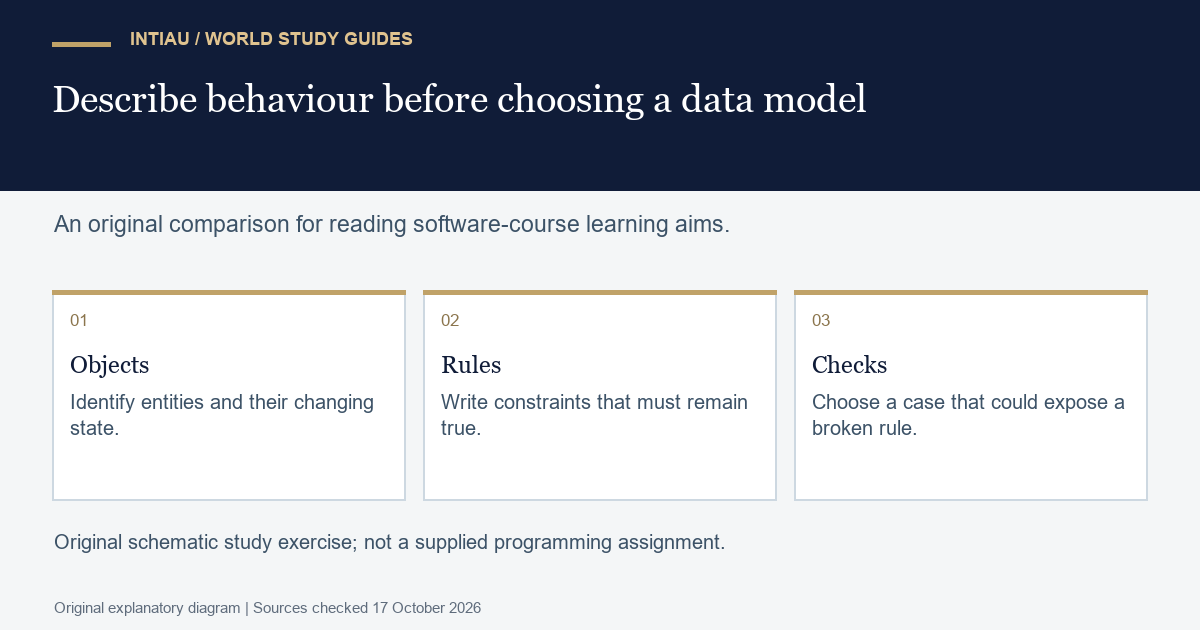
Consider a fictional equipment register. A camera has an identifier and a current borrower. A loan has a start date and a return date. Proposal A stores the borrower’s name directly inside every camera record. Proposal B records each loan separately and connects it to the camera and borrower.
If the question is only “Who has the camera now?”, either model might answer under suitable assumptions. If the question becomes “Who borrowed it last month?”, A has discarded information when it replaces the borrower. B can preserve history, but must prevent incompatible overlapping loans. The better model depends on the required behaviour and its constraints. This paper exercise is original and is not a university assessment answer.
Questions about interpreting the plan
Do the four component figures total 180?
Yes: 88 + 25 + 55 + 12 equals 180 credits.
Is TKO_2326 an introductory course with no prior programming?
No. Its published description requires introductory programming or equivalent knowledge.
Is the linked guide a confirmed 2027 semester timetable?
No. It is a 2024–2027 programme record.
Explore subject comparisons through INTIAU Courses, or use Contact for INTIAU information-service enquiries.
Related guides
View the study diagram