National Tsing Hua University’s Department of Engineering and System Science in Hsinchu, Taiwan, publishes an undergraduate programme spanning electronics, mechanics, materials and physics. This independent guide concerns that university route, not an INTIAU qualification or partnership.
The posted directions and the historical map are different records
The high-school FAQ describes two directions: Low-carbon Green Energy Technology and Smart Nanosystems. Examples include energy systems, radiation applications, photovoltaics and storage on one side, and electronic circuits, sensing, fabrication and characterisation on the other. The page contains mixed-age explanatory material; its route descriptions should not be mistaken for a newly dated complete graduation audit. Read the actual departmental FAQ.
A separate detailed Engineering Physics map explicitly applies to entry years 99–101, corresponding to 2010–2012. It shows scientific and engineering foundations, a selected specialism and later application areas. The table below is a selected reading of that historical map, not a 2026 requirement list. Inspect its edition label.
| Historical map component | Selected actual examples, translated |
|---|---|
| Foundations | Physics; Calculus; Programming; Engineering Mechanics; Thermodynamics |
| Specialist choices | Electronics; Materials; Thermal Fluids; Physics |
| Second-year applications | Principles of Nuclear Engineering; Engineering Drawing |
| Later applications | Control Systems; Measurement Systems Laboratory; Fuel Cells; Microsystems |
Use such a map to understand relationships between fields, then obtain the actual entering-cohort requirements before constructing a schedule. For example, a device can involve material behaviour, an electronic signal and a heat problem at the same time. Comparing how a programme joins those questions is more useful than assuming that every course containing “systems” has the same purpose.
A real named teaching outline: ESS2410
The posted Engineering Thermodynamics outline, ESS2410, requires Thermodynamics I. Its themes include exergy analysis, vapour and gas power systems, refrigeration and heat pumps, gas mixtures and psychrometrics, and reacting mixtures and combustion. It is a real departmental outline, but its Chinese note refers to much older academic years. It does not establish current offering, assessment or teaching language for a future cohort. Read the actual course themes.
For preparation, separate a system’s useful output from the ratio of output to input. Then ask what boundary defines the system and which quantities are being compared. A numerical result is difficult to interpret if one calculation counts an input that another excludes. State those choices before ranking alternatives; a larger device output and a better ratio need not identify the same option.
Admission evidence is route-specific
The department’s 115-cycle notice, dated May 2026, concerns the domestic university-application route and second-stage selection. It links preparation guidance, a written-test and interactive-discussion grouping notice, and selection instructions. The attached instructions redirected rather than yielding a readable guide during review. This evidence does not establish an international application route, a current language threshold or a newly open registration period on 17 October 2026.
A separate first-semester 115 timetable notice labels its PDF as reference material. That attachment also redirected, so no timetable rows or current full credit total are claimed here. Use the actual course notice and request the applicable plan when making an enrolment decision.
Keep applicant category, programme direction and cohort edition together. A domestic selection notice cannot answer all questions about an overseas school record. Similarly, a bilingual course webpage is not evidence that the complete undergraduate programme can be taken in English.
Original exercise: compare two outputs and two ratios
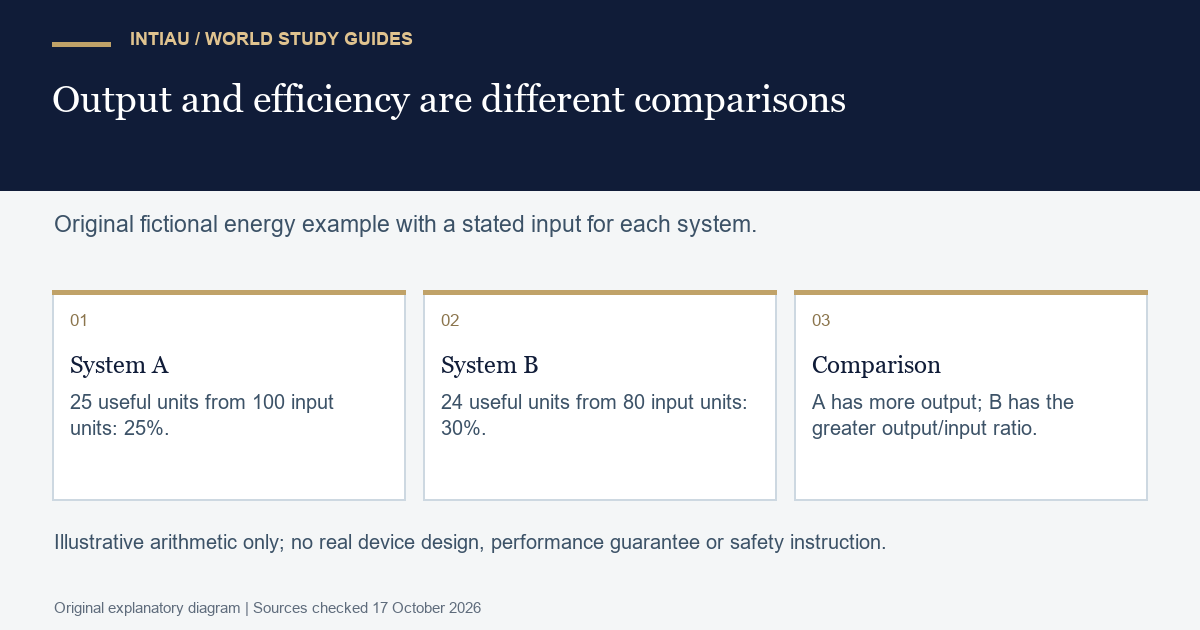
Imagine System A receives 100 energy units and provides 25 useful units. B receives 80 and provides 24. Their output-to-input ratios are 25 percent and 30 percent. A provides slightly more useful output, while B has the greater ratio. Neither statement contradicts the other.
Write a conclusion for someone needing at least 25 useful units, then a separate conclusion for someone comparing ratios. Under the first constraint B does not meet the stated output need, despite its higher ratio. Before choosing a real system, additional operating and design information would be needed. This original exercise uses invented quantities; it is not an ESS2410 assessment, an actual device calculation or a performance guarantee.
Questions to settle
Is the Engineering Physics map a current 2026 plan?
No. It explicitly applies to 2010–2012 entry years.
Does ESS2410 identify a preceding subject?
Yes. Its posted outline requires Thermodynamics I.
Does the May notice establish international admission rules?
No. Its stated scope is the domestic application and second-stage selection route.
Official reading
- Undergraduate route FAQ (posted, mixed-age content)
- Engineering-physics course map (99–101 entry years; 2010–2012)
- Engineering Thermodynamics (legacy ESS2410 outline)
- Domestic application notice (115 cycle; May 2026)
- First-semester course notice (115 academic year; reference only)
For other study topics, browse INTIAU Courses; use Contact for questions about INTIAU services. University applications belong with the institution named above.
Related guides
View the study diagram