The University of Vienna is separate from INTIAU. Its Sociology BA comprises 180 ECTS over six semesters, with German as an admission requirement. Thirty credits are allocated to extension curricula.
Read the current version and the dated course directory
The faculty’s start-of-study guidance identifies curriculum version 2024 as current and distinguishes the older 2011 version. Students plan their semester through a recommended study path rather than receiving a fixed individual timetable.
The linked u:find directory rendered the 2025 winter semester during this check. Its selected module structure is useful evidence of that edition, not a claim about every 2026 course offering.
| Area | Selected published modules |
|---|---|
| Entry and orientation | Social-science methodology, 6 ECTS; subject-specific introduction, 10 ECTS |
| Theory | Foundations, 12 ECTS; advanced theory, 8 ECTS |
| Methods | Quantitative foundations, 20 ECTS; qualitative research, 16 ECTS |
| Research application | Sociological research practical, 12 ECTS |
This selection helps distinguish theoretical vocabulary from the evidence needed to examine a claim. A theory may suggest which relationship matters; a research method determines how that relationship can be investigated. The ability to name both does not show that the proposed method actually answers the question.
For a useful comparison, choose one social concern and write three separate notes: the concept used to describe it, the evidence you would need and the limits of that evidence. This makes it easier to see how theory and methods can support each other without reducing either to a decorative label.
A real introductory course explains its purpose
The 2025W Introduction to Sociology lecture, course 230002, is five ECTS and taught in German. Its published aims introduce sociological thinking and research, basic concepts and examples of investigation. It asks students to understand the discipline’s central questions and methodological principles, using introductory reading and discussion.
The distinction between an everyday impression and a sociological question is useful here. “People seem less connected” leaves the population, meaning of connection and evidence unspecified. A more answerable question might define a particular relationship, group and period, while acknowledging that one indicator may miss other forms of contact.
When reading an introductory outline, look for what you will have to explain rather than only what you will encounter. A reading list establishes material to engage with; it does not turn the author’s conclusion into a fact you can repeat without evaluating the reasoning. Keep a short record of how a concept changes the way you formulate the question.
Keep the admissions year explicit
The admissions page lists registration from 2 March to 4 May 2026, now past, and states that the written test did not take place. It does not establish a 2027 schedule.
The faculty explains the general sequence: registration, online self-assessment and a test when registrations exceed available places, followed by completion of admission. That general rule should be read alongside the cycle-specific announcement.
For a foreign qualification, follow the university’s relevant certificate and German-language instructions. A general explanation of a selection process should not be mistaken for an announcement that a test will occur in a particular future year. Keep the current intake notice and the curriculum version in separate parts of your planning notes.
Try an original survey comparison
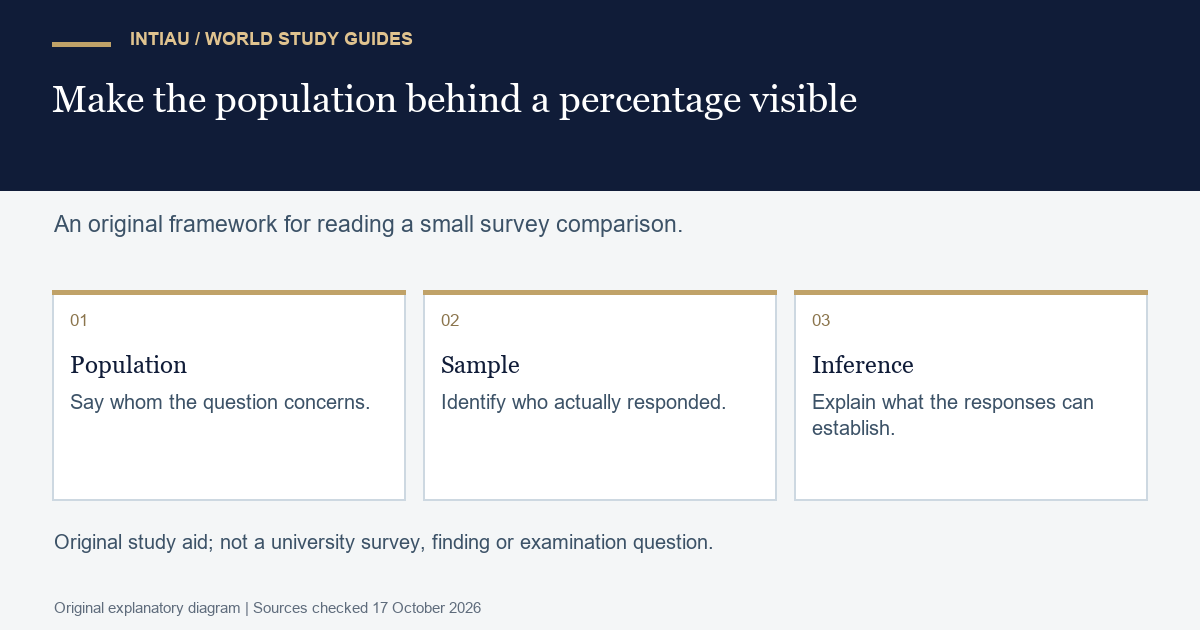
A fictional university society asks whether members want evening meetings. Forty of fifty respondents say yes. That is 80% of respondents. If the society has 200 members, it is not evidence that 80% of all members support the proposal: 150 people did not respond.
The response pattern may still be useful. Ask whether the invitation reached everyone and whether people unable to attend evenings were less likely to answer. A stronger report gives the question, number invited, number responding and limitations, then explains what decision the evidence can support. This is an original paper example, not a finding about Vienna students.
Questions about the BA
Did the published 2026 written entrance test take place?
No. The admissions page says it did not.
Is curriculum version 2011 treated as the current route?
No. Current guidance distinguishes version 2024 from the older route.
Is the introductory course example explicitly dated?
Yes. It is the 2025W course record.
Compare subjects through INTIAU Courses, or use Contact for INTIAU information-service enquiries.
Related guides
View the study diagram