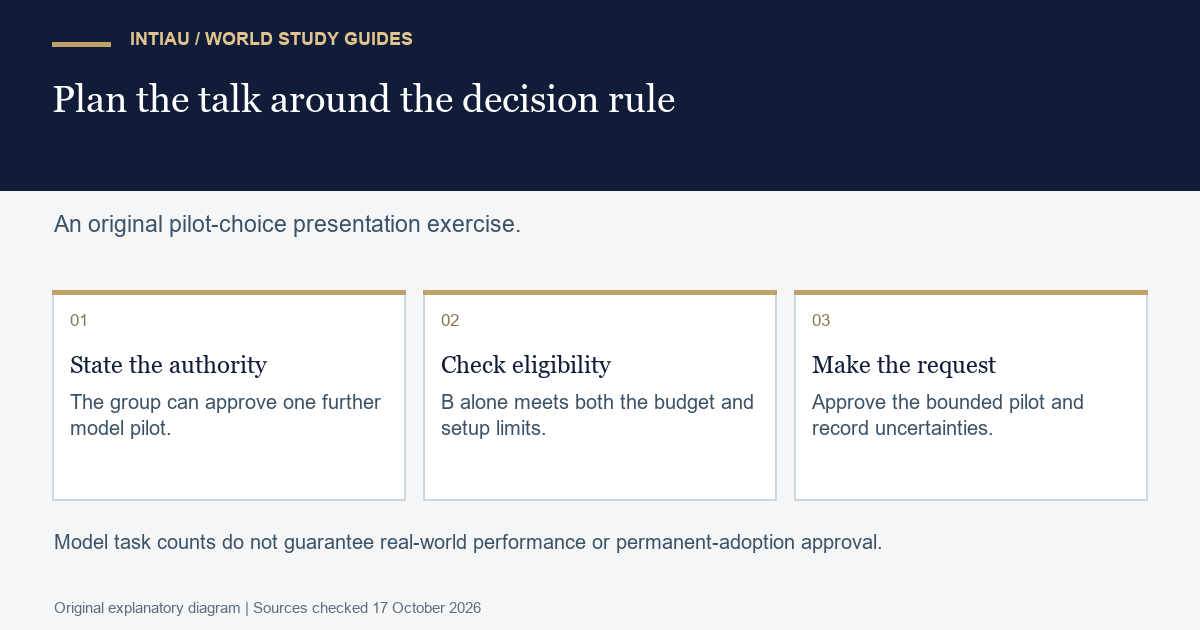
This self-study workshop plans a presentation around one decision the audience can actually make. You will separate eligibility rules from preferences, compare three fictional options and write a concise request supported by the supplied evidence. The output is a three-slide paper storyboard with a complete decision statement.
Specify the audience’s job
The MIT EECS guide to slide presentations connects presentation structure to the speaker’s purpose and audience. It recommends a clear message for each slide and enough context for listeners to understand the evidence and its relevance.
The original fictional audience is a model-workshop planning group. It can approve one further tray-labelling pilot, defer the choice or ask for missing information. It cannot authorise an institution-wide purchase. Its rules are a pilot budget no greater than 60 tokens and setup time no greater than twelve minutes. Among eligible options, it prefers fewer placement errors in the supplied model tasks.
Read the decision sheet
| Option | Pilot cost | Setup time | Errors in 20 model tasks | Eligibility |
|---|---|---|---|---|
| A: paper sleeves | 30 tokens | 20 minutes | 6 | Fails the setup-time rule |
| B: reusable cards | 55 tokens | 10 minutes | 3 | Meets both rules |
| C: illuminated labels | 90 tokens | 8 minutes | 2 | Fails the budget rule |
First apply the two rules. A is affordable but too slow to set up. C is quick enough but exceeds the budget by 30 tokens. B is the only option satisfying both. Its cost leaves five tokens of the pilot budget and its setup time leaves two minutes of the permitted maximum. Do not treat a strong score on one measure as permission to ignore a compulsory condition.
Build the three-slide storyboard
Slide 1 is titled “Choose one eligible pilot within 60 tokens and twelve minutes.” Its content is the audience’s decision and the two rules. The speaker note is: “Today we are choosing a further model pilot, not a permanent purchase. Please assess the options against both limits before comparing their error counts.”
Slide 2 is titled “Only reusable cards meet both pilot rules.” Show the three rows with cost and time, retaining the units. The speaker note is: “Paper sleeves miss the setup requirement; illuminated labels exceed the budget. Reusable cards cost 55 tokens and take ten minutes, so they meet both conditions. Their supplied model result is three errors in twenty tasks.”
Slide 3 is titled “Approve a further B pilot and record the remaining uncertainties.” The speaker note is: “I recommend approving the reusable-card pilot within the stated limits. The model sheet does not establish durability or performance in real operations. The next pilot should record those questions explicitly before a wider decision.” These three notes form a complete worked answer for this paper storyboard.
Anticipate the relevant questions
Question one is “Why not choose C, which has fewer errors?” The answer is that C is ineligible under the stated budget. If the group wants to change that rule, it must make a separate budget decision rather than treating C as compliant. Question two is “Does B’s three-error result guarantee future performance?” No; the number describes the supplied model task set.
Question three is “What happens if B’s cost rises to 65 tokens?” Under the unchanged rules, no option is eligible. The correct decision becomes defer or revise the constraints openly. It is not to recommend B while hiding the changed cost. This variation tests whether the presentation follows the decision logic rather than defending a favourite option at any price.
Cut facts that do not support the decision
A draft slide describing the history of illuminated displays would not help apply these rules. Remove it unless the audience needs that information to evaluate a stated uncertainty. Keep the model-task denominator, however, because “three errors” without “twenty tasks” invites an incomplete comparison.
Score one point each for naming the decision authority, stating both rules, applying them consistently, making a specific request and retaining the model-to-reality boundary. The worked storyboard earns five. A polished pitch for C earns no eligibility point, even if its visual design is persuasive.
Is the cheapest option automatically the answer?
No. A is cheapest but fails the setup-time rule. The worked decision applies compulsory conditions before considering preferences.
Can the audience approve permanent adoption?
Not in this fictional scenario. Its authority extends to one further pilot. The presentation’s request must stay within that decision.
What should change if the budget rule changes?
Recalculate eligibility and revise the recommendation. Keep the original and revised rules visible so the audience can see why the answer changed.
This is original INTIAU editorial self-study practice; no qualification is awarded. Browse Courses or use Contact for editorial enquiries.
Related guides
View the study diagram