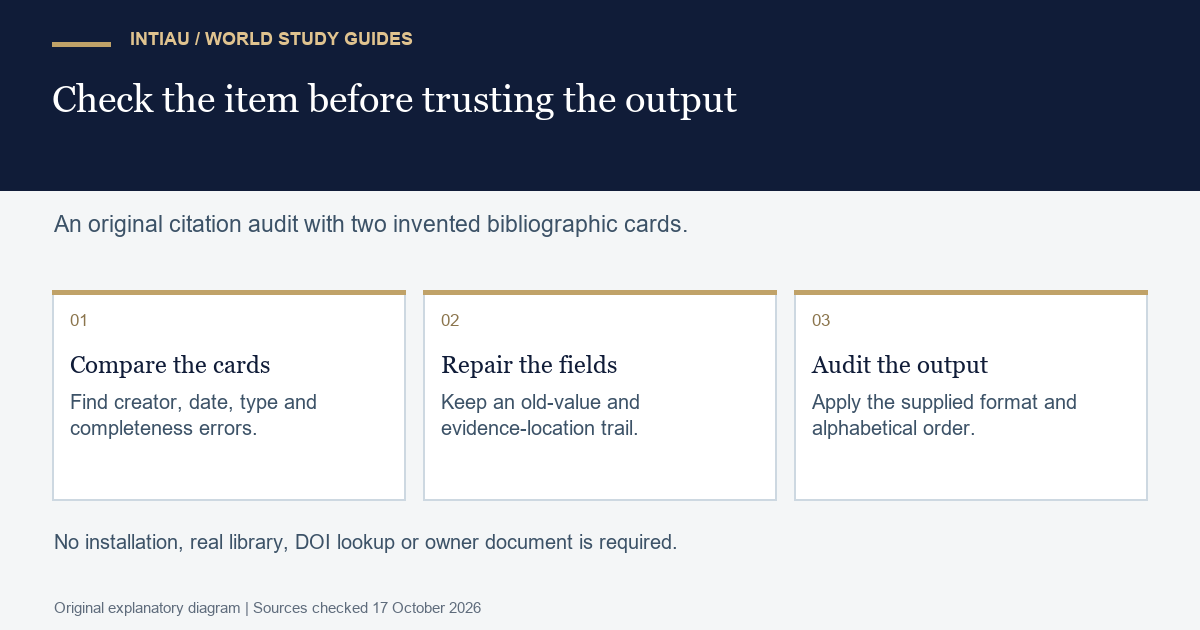
This self-study workshop audits the information behind a generated reference list. You will compare two fictional source cards with a mock citation-manager export, repair the item data and produce a checked bibliography in an explicitly supplied training format. No software installation, account or real document is needed.
Separate item data from output style
The official Zotero guidance on adding and verifying items says imported metadata can be incomplete or incorrect and should be checked. It also distinguishes institutional creators from personal names and describes editing item information.
The official Zotero bibliography guidance describes creating citations or bibliographies from selected items using a chosen style. A formatted export is therefore a separate object to inspect after checking the underlying records.
The fictional cards use practice identifiers F1 and F2, not real DOIs or publications. F1 is a report by “North Quay Methods Unit,” published in 2024, titled “Checking shelf descriptions,” version 2, published by “North Quay Studio.” F2 is an article by the fictional author “Ira Sen,” published in 2025, titled “Route labels in model archives,” in “Practice Records,” volume 3, issue 1, pages 8 to 14. Every named entity in these cards is invented.
Find errors before changing punctuation
| Field | Mock imported value | Correct value from the card |
|---|---|---|
| F1 creator | Unit, North Quay Methods | North Quay Methods Unit, corporate creator |
| F1 date | 2025 | 2024 |
| F1 item type | Journal article | Report |
| F1 version | Missing | 2 |
| F2 creator | Sen, I. | Sen, Ira |
| F2 pages | 8 | 8 to 14 |
| F2 issue | Missing | 1 |
Mark each error as an identity, date, type or completeness problem. Correct the seven values in a paper copy of the records. Do not start by making the bibliography look attractive: perfect punctuation would not repair the wrong report year or a corporate creator split into a surname and forenames.
Apply the supplied training format
Use these local exercise rules. A report entry is “Creator. Year. Title. Version. Publisher.” An article entry is “Surname, Given name. Year. Title. Journal, volume(issue), pages.” Put entries in alphabetical order by their displayed creator. These are invented training rules, not an assertion about APA, Chicago or a university’s required citation style.
The complete worked bibliography is: “North Quay Methods Unit. 2024. Checking shelf descriptions. Version 2. North Quay Studio.” The second entry is: “Sen, Ira. 2025. Route labels in model archives. Practice Records, 3(1), 8 to 14.” North precedes Sen, so this order follows the supplied rule.
Now compare the bibliography with the corrected cards. The report creator remains intact; the year is 2024; the version is present; and F2 includes both the issue and the full page span. The entries contain no invented identifiers or links. Adding a plausible-looking DOI would introduce information absent from the source cards.
Keep an audit trail that can be repeated
For each correction, record the item identifier, field, old value, new value and evidence location. For example: “F1; date; 2025; 2024; supplied report card.” A second reader can then distinguish a verified correction from a preference about formatting. If the card does not supply a missing field, record it as unresolved rather than filling it from memory.
In an actual citation workflow, inspect both the item record and the rendered output after a correction. For this workshop, the paper comparison is sufficient. You can demonstrate the skill using the supplied fictional cards without opening a real document, accessing a private library or importing records. The observable result is the corrected set of records and its matching two-entry bibliography.
Score accuracy before appearance
Award one point for each of the seven field corrections and one for applying the stated alphabetical order. The answer earns eight. An entry with the right commas but the wrong corporate identity does not earn the creator point. Keep formatting changes separate from evidence corrections so an audit can identify why each alteration was made.
Does a successful import prove the reference is accurate?
No. Zotero’s documentation explicitly recommends checking saved items because supplied metadata can be incomplete or incorrect. This exercise illustrates that distinction with deliberately flawed fictional records.
Should I invent a DOI for either practice card?
No. Neither card supplies one. The correct output contains no DOI, and the practice identifiers F1 and F2 are not resolvable publication identifiers.
Must I use Zotero to complete the task?
No. The mock import and training format are fully supplied. A paper audit demonstrates the required corrections without installing software or accessing a real library.
This is original INTIAU editorial self-study practice; no qualification is awarded. Use Courses for general study navigation and Contact for editorial enquiries.
Related guides
View the study diagram