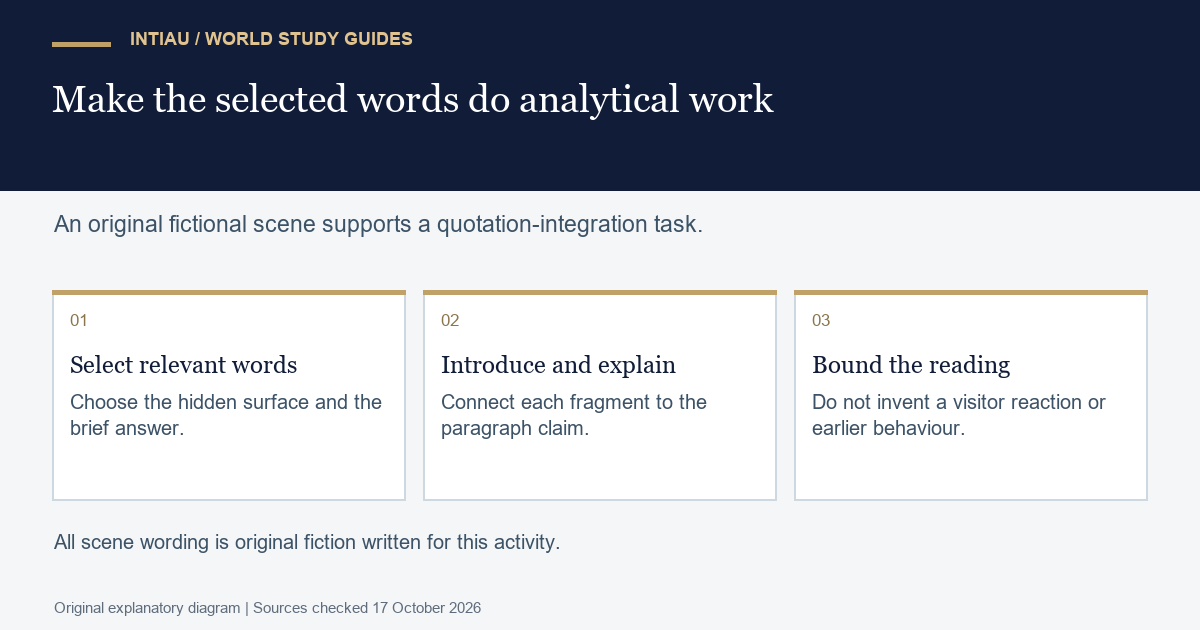
This self-study workshop teaches you to make a quotation do a precise analytical job. You will select a few words from an original fictional passage, introduce them and explain what they support. The finished output is a complete paragraph in which quoted language is evidence for a bounded interpretation.
Give the quotation a purpose
The University of Wisconsin–Madison guide to literary quotations recommends selecting relevant language, introducing it and discussing how it supports an argument. It cautions against filling space with quotations or placing them together without the writer’s own explanation.
The passage below was written for this activity. It is not taken from a novel, an interview or a real person’s account. The practice identifier is Scene Q, paragraph 1. You may quote from it within the exercise without confusing it with the university guidance linked above.
Original fictional Scene Q: “The repair desk bell rang twice. Nera left the unfinished model on the bench and opened the door. When the visitor asked whether it was ready, she turned the model so its unpainted side faced the wall. ‘Nearly,’ she said, keeping one hand on the handle.”
Choose evidence for one interpretation
Consider this claim: “The scene presents Nera as managing what the visitor can see rather than openly acknowledging the unfinished work.” Find two short textual details that help support it. Do not try to prove that Nera is dishonest in every situation, that the visitor is angry or that the model is broken. None of those claims follows from this short passage.
| Selected wording | What is directly described | What the analysis may suggest |
|---|---|---|
| “its unpainted side faced the wall” | The model is turned so one surface is hidden. | Nera controls which evidence of incompletion is visible. |
| “Nearly” | A brief answer is given to the readiness question. | The answer avoids specifying the remaining work. |
| “one hand on the handle” | Nera keeps contact with the door handle. | The doorway remains part of the encounter’s staging. |
The final row is weaker support for concealment than the first. It could fit several interpretations. Keep it available, but do not let an interesting detail replace the clearest evidence for your chosen claim. Selection is part of the analysis.
Write the full worked paragraph
A complete answer is: “The scene presents Nera as managing what the visitor can see rather than openly acknowledging the unfinished work. Before answering, she turns the model until ‘its unpainted side faced the wall’ (Scene Q, paragraph 1). The movement hides the specific surface that reveals unfinished painting, so the visitor’s view is deliberately narrowed. Her answer, ‘Nearly,’ offers an approximation rather than an account of what remains. Read together, the physical adjustment and the brief reply suggest controlled disclosure in this encounter. They do not establish a general character trait: the passage gives no earlier behaviour, and the visitor’s reaction is not reported.”
The quotation is introduced by an action from the scene, then followed by an explanation of its relevance. The second quotation is only one word because its brevity is the point being analysed. The paragraph does not retell every event. It also keeps the interpretation distinct from the directly described movement.
Repair two common draft problems
A quotation-only draft says: “The bell ‘rang twice.’ The model’s ‘unpainted side faced the wall.’ Nera said ‘Nearly.’” Each fragment comes from the passage, but the writer has not explained the relationship between them. Repair it by choosing the concealment claim, removing the bell unless its repetition becomes relevant, and adding the reasoning about visibility.
An overextended draft says: “Nera hides the paint because she intends to deceive every customer.” The passage supplies neither a customer history nor an account of intention. Repair it to “the movement restricts the visitor’s view of the unfinished surface.” You can then propose the narrower interpretation while acknowledging that it remains an interpretation of this scene.
For an additional paper check, cover each quotation in the model paragraph. The surrounding prose should still tell you why a quotation belongs there. Then restore it and ask whether the exact selected wording is necessary. If only the sequence of actions matters to your claim, a paraphrase may be more economical.
Use a six-point review
Award one point for a clear claim, relevant selection, grammatical integration, a practice source locator, analysis after the quotation and an explicit inference boundary. The model earns six. A different interpretation can also score well if its evidence is present in Scene Q and the analysis does not invent a motive or an unseen event.
Must I quote the entire fictional passage?
No. The model selects only the language needed for its interpretation. Copying the whole scene would make the reader search for the evidence you should have identified.
Can I say the visitor was disappointed?
Not from this passage. It records the visitor’s question but supplies no reaction. Keep that possibility separate from what Scene Q actually describes.
Is the university guide the source of Scene Q?
No. Scene Q and the worked analysis are original fictional teaching material. The university page supports the quotation-integration method, not the scene or its interpretation.
This is original INTIAU editorial self-study practice; no qualification is awarded. Browse Courses for study navigation or Contact for editorial enquiries.
Related guides
View the study diagram