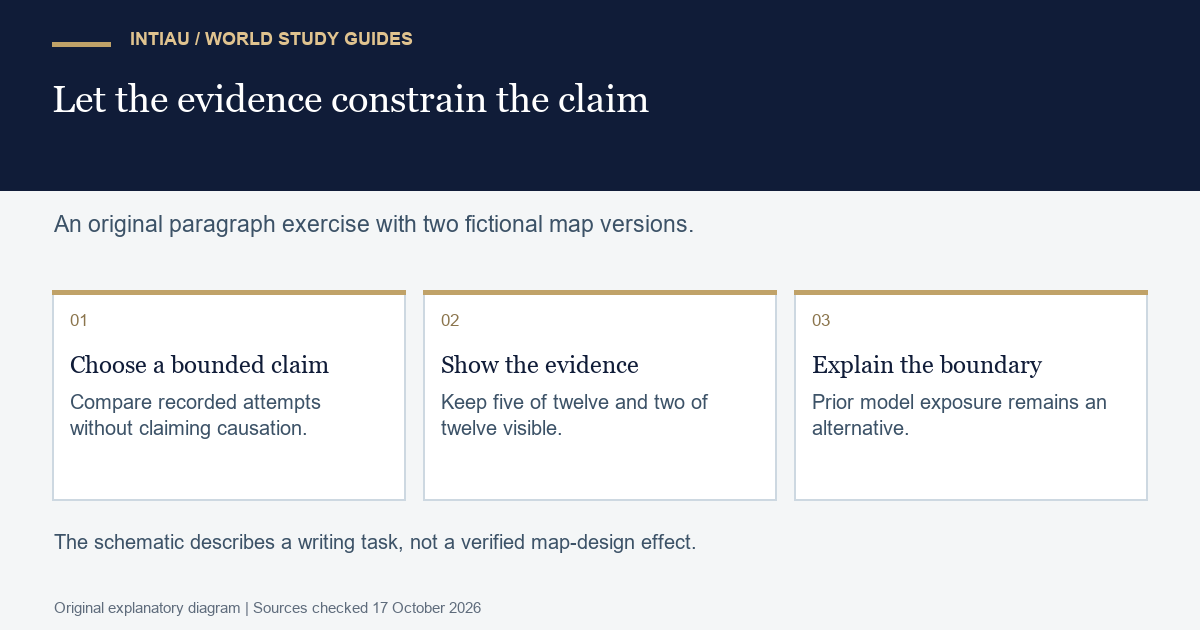
This self-study workshop builds one paragraph whose central claim can survive an evidence check. You will choose a claim, select the relevant observations and explain the connection between them. The output is a complete paragraph with an identifiable inference, rather than a list of facts followed by a confident final sentence.
Separate the paragraph’s jobs
The Harvard College Writing Center guide to body paragraphs distinguishes a topic sentence, supporting evidence and analysis. Its central point is that providing evidence does not remove the writer’s responsibility to explain how that evidence supports the paragraph’s claim.
The following case and all its wording are original fiction. A mock walking map has two versions. Version A labels every doorway with a number; version B adds a destination name. In twelve simulated route attempts using A, five ended at the wrong doorway. In twelve different attempts using B, two ended at the wrong doorway. The groups were not randomly allocated, and the second group had already seen the building model.
Choose the claim the records can carry
| Candidate claim | Evidence demand | Decision |
|---|---|---|
| Destination names always prevent route errors. | No errors and a much broader evidential scope | Reject: B still had two errors. |
| Adding destination names caused the reduction. | A design separating labels from prior exposure | Reject: the groups differ in exposure. |
| Version B was associated with fewer errors in these attempts. | The two supplied counts and their context | Retain with the comparison’s boundary. |
| The model had twelve rooms. | A room inventory | Reject: twelve refers to attempts. |
Write the retained claim in your own words. Underline the phrase that restricts it to this case. Then select the two numbers a reader must see. Do not add facts about map readability, participant confidence or route duration; none appear in the dossier.
Draft and annotate the worked paragraph
Here is a complete model: “The destination-name map was associated with fewer wrong-doorway endings in these simulated attempts. Five of twelve attempts using number-only labels ended at the wrong doorway, compared with two of twelve using labels that also named the destination. The difference is three errors across equally sized sets of attempts, which supports describing B as the better-performing version in this record. However, the B group had already seen the model, so the comparison does not isolate the effect of naming destinations. A subsequent comparison would need to address that exposure difference before attributing the improvement to the labels.”
The opening contains the claim. The next sentence supplies the observations. The third explains why the counts are relevant: the denominators are equal, and the recorded error total is lower. The fourth identifies an alternative explanation from the dossier. The final sentence states the specific question left open. It does not introduce an unrelated conclusion about building design.
Check the arithmetic separately from the argument. Five minus two is three. It is not a three-percent improvement. The proportions are five-twelfths and two-twelfths, and their difference is three-twelfths, or twenty-five percentage points. You do not need those percentages in the paragraph; keeping the original counts may make the tiny comparison easier to inspect.
Repair a paragraph that only lists evidence
A weaker draft says: “A had five errors. B had two errors. B used destination names. Maps matter.” Its facts are relevant, but the reader must reconstruct the claim and the exposure problem. Add an opening that names the bounded comparison, connect the counts explicitly, and replace “Maps matter” with the unresolved attribution issue.
Another weak draft says: “Because B is clearly superior, the remaining numbers confirm its success.” That opening assumes the conclusion and invites selective reading. In the worked model, the evidence constrains the claim; the error-free claim was rejected before drafting. Retaining the two B errors makes the comparison more informative, not less persuasive.
Apply the five-point rubric
Award one point each for a bounded opening claim, exact counts with denominators, an explanation of relevance, the prior-exposure boundary and a final sentence that follows from the paragraph. A paragraph can earn all five with different wording. It cannot earn the attribution point by adding the word “may” to an otherwise causal assertion without explaining the actual design problem.
Must every paragraph follow the model’s sentence order?
No. This exercise uses a visible sequence so each job can be audited. A different order is acceptable if the reader can still identify the claim, its evidence, the reasoning and the boundary.
Can I describe B as error-free?
No. The fictional record contains two wrong-doorway endings for B. That sentence would contradict the evidence even if the rest of the paragraph were carefully written.
Is the three-error difference a causal effect?
The model does not establish that. It reports the recorded difference and names the groups’ unequal exposure to the building model as an unresolved explanation.
This is original INTIAU editorial self-study practice; no qualification is awarded. Browse Courses or use Contact for general editorial enquiries.
Related guides
View the study diagram