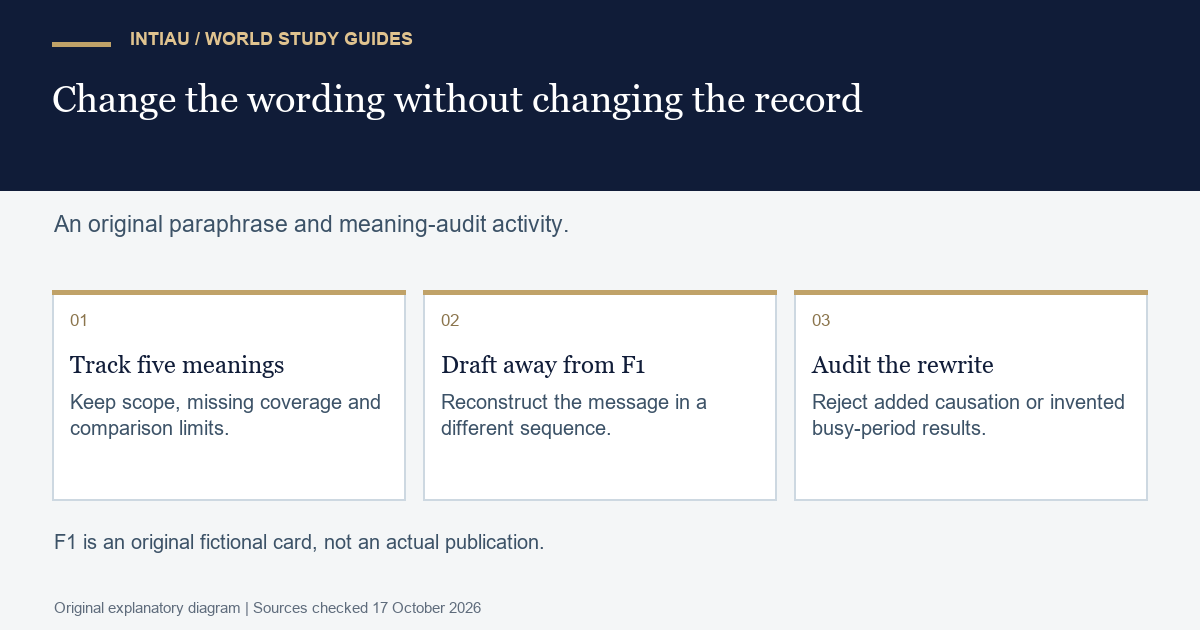
This self-study workshop practises a paraphrase that changes the wording and structure while retaining the original statement’s boundaries. You will track quantities, conditions and uncertainty through two flawed rewrites and one complete answer. The output is a short paraphrase with a meaning audit, not a synonym-by-synonym replacement exercise.
Understand before rewriting
The University of Wisconsin–Madison guidance on quoting and paraphrasing recommends understanding the passage, writing away from it and reconsidering its structure. It also makes clear that ideas obtained from a source still require acknowledgment when expressed in new wording.
For this activity, use only the original fictional source card below. Its identifier, F1, is a practice label rather than a real publication. You do not need to find an article, enter a citation system or copy someone else’s research. Read the card twice, then cover it while drafting.
Fictional card F1: “In a model store, blue shelf markers were associated with fewer sorting errors during six quiet sessions. The busiest two sessions were not observed. The exercise did not compare blue with other marker colours, so the records cannot show whether colour itself explained the difference.”
List the meanings that must survive
| Element | F1 establishes | A rewrite must not imply |
|---|---|---|
| Setting | A model store | A real retailer’s operations |
| Observation | An association with fewer sorting errors | Proof of a colour effect |
| Scope | Six quiet sessions | All eight sessions were observed |
| Missing coverage | The busiest two were absent | The pattern held under heavy demand |
| Comparison | No other marker colours were compared | Blue outperformed red or green |
These five rows are the answer key for meaning, not a compulsory sentence template. Your rewrite can begin with the missing coverage, the observation or the comparison boundary, provided it preserves all the relationships. Keep the fictional source identifier beside the paraphrase so its origin remains visible.
Diagnose two failed rewrites
Rewrite A says: “Blue markers improved accuracy in eight store sessions and would help at busy times.” It turns association into causation, changes six observed sessions into eight and extends the finding precisely to the period that was not observed. Replacing “improved” with “enhanced” would repair none of these errors.
Rewrite B says: “In a model shop, blue shelf indicators were linked with fewer classification mistakes during six calm meetings.” This retains part of the meaning but follows the original sentence’s structure closely and drops both limitations. “Meetings” is also a poor substitution for sorting sessions. New vocabulary is not useful when it changes the activity being described.
Before drafting your answer, make a brief note in ordinary language: “quiet periods only; fewer mistakes recorded; no busy-period coverage; no colour comparison.” Set that note beside the covered source. Use it to construct a different sequence of ideas rather than walking through the original one word at a time.
Compare the complete worked answer
A suitable paraphrase is: “F1 reports lower sorting-error counts alongside blue shelf markers in six low-demand model-store sessions. Because the two busiest sessions were missing and no alternative colours were tested, the record neither establishes performance under heavy demand nor identifies colour as the explanation.”
This answer begins with the recorded relationship and places the two missing comparisons together. It keeps the number of observed sessions, the artificial setting and the cautious inference. It does not add a recommendation to adopt blue markers. It also does not claim that an alternative colour was ineffective; that question was never tested.
Now uncover F1 and compare your own answer row by row. Mark each preserved meaning once. If a sentence seems broader than a row allows, replace the relevant clause rather than appending a vague disclaimer at the end. A final “more research is needed” does not undo an earlier statement that blue caused an improvement.
Use a repair-focused rubric
Score one point for each table row preserved accurately. Then check two separate writing conditions: the structure is genuinely reworked, and the source identifier is retained. The model meets all seven checks. Your answer need not use the same words, but it should let another reader reconstruct the same limited observation without consulting an explanation of what you meant.
May a paraphrase be shorter than its source?
Yes. The worked answer compresses the card while retaining its key limits. In this task, a shorter answer fails only when it loses a required meaning or adds an unsupported conclusion.
Do I need to replace the number six?
No. A quantity is part of the meaning being preserved. Changing it to eight would be a factual error; retaining it is not a failure to paraphrase.
Does adding F1 make any rewrite acceptable?
No. Attribution identifies the source of an idea. It does not repair distorted meaning or wording that follows the source too closely.
This is original INTIAU editorial self-study practice; no qualification is awarded. Use Courses for study navigation and Contact for editorial enquiries.
Related guides
View the study diagram