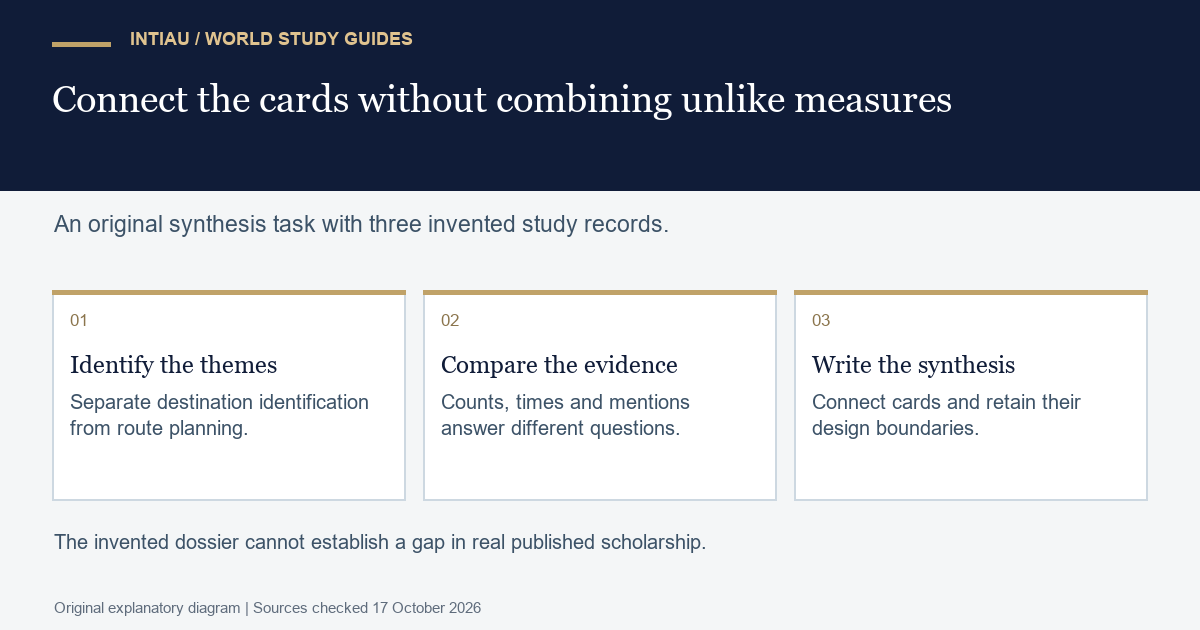
This self-study workshop turns three source summaries into a thematic synthesis. You will identify a shared question, compare what the records actually measure and write a paragraph that connects them without manufacturing agreement. The output is a small evidence grid and a complete synthesis using fictional study cards.
Organise by a question, not a reading list
The George Mason University guide to literature reviews describes synthesis as identifying connections among sources. It recommends organising around themes or questions instead of writing a sequence of separate summaries.
Our original fictional review question is: “What information helps someone find an item in a model library?” The three cards below are invented teaching records, not actual publications. They have different outcomes and cannot be pooled into a single effect estimate. Their identifiers are sufficient for this paper exercise.
| Card | Design and outcome | Result supplied | Boundary |
|---|---|---|---|
| A: Shelf names | Twenty-four route attempts; correct shelf on first arrival | Named shelves: 10 of 12; numbered shelves: 7 of 12 | Different groups used each version. |
| B: Route preview | Ten paired model routes; seconds to reach shelf | Median time 38 seconds with preview, 47 without | Every preview route was attempted second. |
| C: Catalogue notes | Eight fictional explanations of locating an item | Five mention shelf wording; three mention route layout | Mentions are not completion or timing results. |
Start by writing one sentence for each card. Then place those sentences under two provisional themes: identifying a destination and planning a route. A source may contribute to more than one theme, but explain the connection instead of repeating its entire summary.
Make the comparison explicit
Card A most directly concerns identifying the destination: the outcome is first arrival at the correct shelf. Card B concerns route duration, although its fixed order leaves practice as an alternative explanation. Card C concerns what the invented explanations mention. It may help frame a question about wording and layout, but it does not show that either feature improved performance.
Write a sentence that joins A and C, then another that distinguishes B. Avoid “all studies prove clear labels are faster.” A does not measure time, B changes route preview rather than shelf names, and C measures neither speed nor accuracy. The shared topic does not make their variables interchangeable.
Compare the complete worked synthesis
A suitable paragraph is: “The fictional cards suggest that destination identification and route planning should be examined separately. Card A records more correct first arrivals with named shelves than with numbered shelves, while Card C’s explanations frequently mention shelf wording. Their connection is the information used to identify a destination, although mentions in C are not evidence of improved accuracy. Card B addresses a different outcome: routes with a preview had a lower median completion time. Because preview trials always came second, that comparison cannot separate preview from practice. Together, the cards motivate a study that varies destination wording and route preview independently while recording both arrival accuracy and duration.”
The opening names the thematic distinction. The middle compares two kinds of evidence without equating them. The final sentence proposes a question generated by the comparison; it does not claim that no real researcher has studied it. These invented cards cannot establish a gap in the actual published literature.
Repair the source-by-source version
A weak draft begins, “A studied shelves. B studied previews. C studied explanations.” It preserves the reading order but gives the reader no reason to consider the cards together. Keep those summaries as working notes, then move the destination-identification point to the beginning and group the relevant observations underneath it.
Check every connector. “Similarly” should name a real similarity; “however” should identify a difference that matters to the review question. In the model, “while” joins the topic of wording but the next sentence explains the unequal evidence. If you remove that boundary, the smooth prose becomes misleading even though each individual number remains correct.
Score the synthesis as a comparison
Use five checks: the paragraph answers the stated question; at least two cards are related directly; outcomes remain distinct; design boundaries are retained; and the proposed next step follows from the comparison. Give one point for each. The model scores five. A paragraph that includes all three cards but never compares them earns no point for synthesis.
Can I average the three results?
No. The cards report correct arrivals, completion time and mentions. Those are different quantities with different denominators; the exercise provides no model that would make one combined average meaningful.
Must every source receive its own paragraph?
For this task, that would obscure the intended thematic comparison. You may organise notes by card, but the final worked paragraph is organised around destination identification and route planning.
Does the model establish a real research gap?
No. It proposes a follow-up within a fictional dossier. Establishing a gap in actual scholarship would require a justified search and critical reading beyond these invented cards.
This is original INTIAU editorial self-study practice; no qualification is awarded. Use Courses for study navigation and Contact for editorial enquiries.
Related guides
View the study diagram