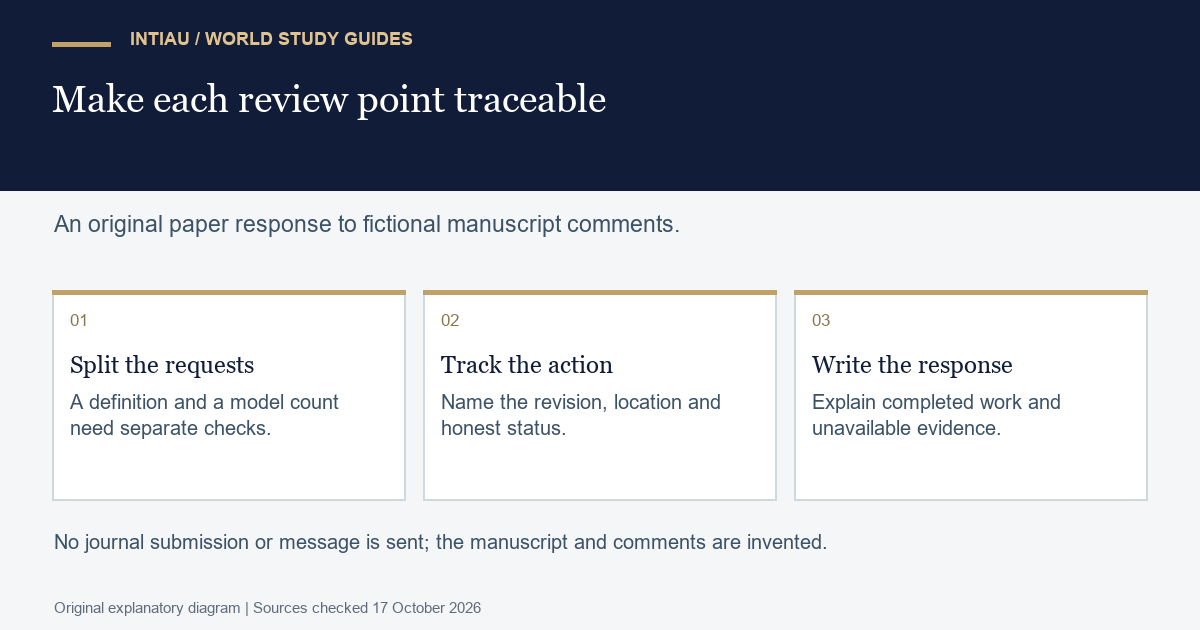
This self-study workshop converts a fictional review letter into a traceable revision matrix and a complete response. You will split compound requests, distinguish a text correction from a request for new evidence and explain a reasoned boundary without pretending an unperformed analysis exists. No manuscript submission or message is sent.
Make every response findable
William Stafford Noble’s PLOS guidance on responding to reviewers recommends addressing each point and making the response sufficiently self-contained, including the changes and their locations. This supports a response a reviewer can inspect rather than a vague assurance that revisions were made.
The original fictional manuscript compares three cardboard bridge shapes under model weights. It records deflection after one minute, with four models per shape. It contains no material-cost records and no outdoor exposure test. The old conclusion says “Shape C is best for every setting.” All reviewer comments, manuscript labels and response text below are invented for practice.
Split the comments into actions
Reviewer comment 1 asks: “Define deflection and give the number of models.” Comment 2 asks: “Explain why Shape C is best everywhere.” Comment 3 asks: “Add a cost analysis.” Comment 4 says: “The graph label says millimetres but the table says centimetres.” The supplied original measurement sheet uses millimetres in both the heading and entries.
| Point | Action | Worked revision and location | Status |
|---|---|---|---|
| 1a: definition | Clarify | Methods, paragraph 2: define deflection as the recorded vertical displacement. | Revised |
| 1b: model count | Clarify | Methods, paragraph 2: four cardboard models per shape. | Revised |
| 2: universal conclusion | Narrow claim | Conclusion, paragraph 1: restrict comparison to the supplied one-minute model test. | Revised |
| 3: cost | Explain unavailable evidence | Discussion, paragraph 3: state cost was not recorded and no cost comparison was performed. | Not performed; boundary added |
| 4: unit mismatch | Correct transcription | Table 1 heading: centimetres changed to millimetres using the supplied sheet. | Corrected |
The first comment produces two rows because a definition and a count are independently checkable. The cost request is not marked complete merely because a sentence was added. The matrix records that the analysis itself was not performed.
Read the complete worked response
“Thank you for identifying points needing clarification. We have revised the definition, model count, conclusion and table heading. We have also stated the limits of the available cost evidence.”
“Point 1: Methods, paragraph 2 now defines deflection as the recorded vertical displacement and states that four cardboard models were tested for each shape. Point 2: We removed the claim about every setting. Conclusion, paragraph 1 now restricts the comparison to the one-minute model test. Point 3: We cannot calculate a cost comparison from the supplied records because material costs were not collected. Discussion, paragraph 3 now states that cost was not assessed; no cost analysis is presented. Point 4: We checked the original sheet and corrected the Table 1 heading to millimetres. The recorded numerical values were not rescaled.”
This response is concise but specific. It tells the reviewer which work was done, where to find it and which requested analysis remains unavailable. It does not claim that declining the cost analysis guarantees acceptance; that decision is outside this fictional exercise.
Audit the unit correction carefully
The dossier says the original entries were already in millimetres. Correcting the heading therefore does not require multiplying the values by ten. If you instead changed a genuine centimetre measurement into millimetres, the numerical conversion would be necessary. Identify whether the error lies in a label, value or measurement before making a blanket change.
Compare a weak reply, “We disagree about cost,” with the worked response. The weak reply provides neither evidence nor a location. The worked reply identifies the absent records and the explicit manuscript boundary. A reasoned response can leave a request unfulfilled while still addressing it directly and honestly.
Use a completion rubric
Award one point for splitting comment 1, one for a precise revision location, one for removing the universal conclusion, one for distinguishing a boundary sentence from an unperformed analysis and one for the justified unit correction. The worked matrix and response earn five. A “done” status without a corresponding change or explanation earns no point.
Does every reviewer request have to be marked accepted?
Not in this exercise. The cost request is addressed with an evidence-based explanation and a manuscript boundary. It is not falsely labelled as an analysis that was performed.
Why split one comment into two rows?
The definition and model count can be checked separately. Splitting them prevents a corrected definition from concealing an omitted count.
Should I send the worked response to a journal?
No. The manuscript and comments are fictional. This is a paper exercise in traceability, not a publication submission or correspondence service.
This is original INTIAU editorial self-study practice; no qualification is awarded. Browse Courses or use Contact for editorial enquiries.
Related guides
View the study diagram