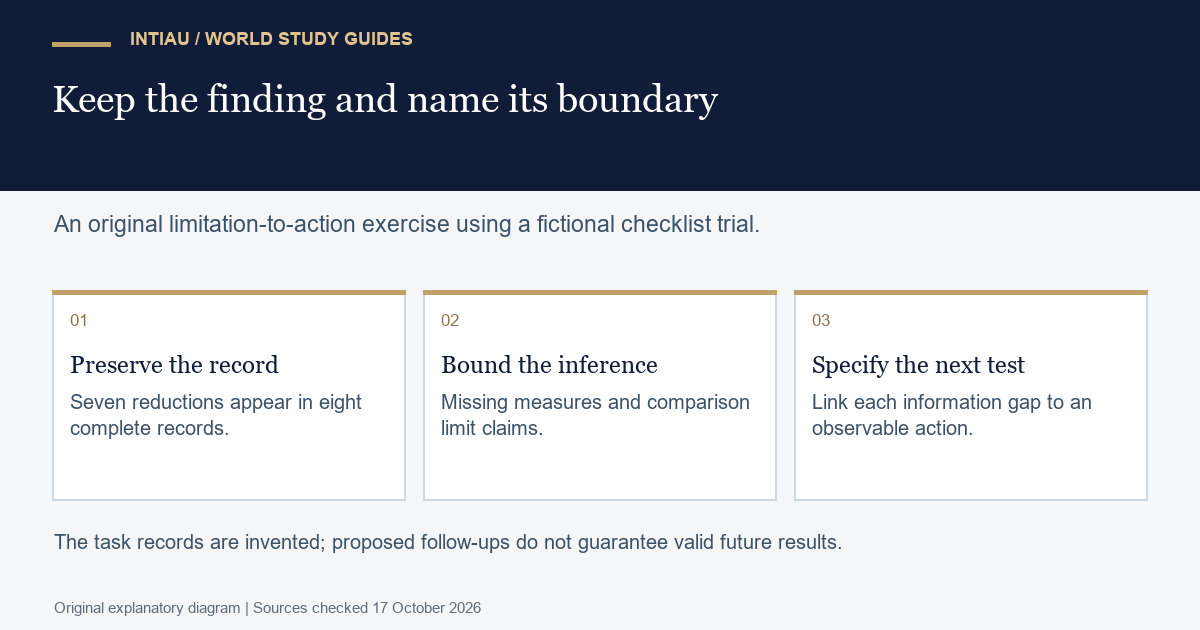
This self-study workshop helps you write a limitation that changes the scope of a conclusion without erasing a valid observation. You will separate what a small fictional trial recorded, what it could not answer and what a better follow-up would need to measure. The finished output is a bounded findings paragraph and a limitation-to-action table.
Connect each limitation to a claim
The USC Libraries guide to study limitations advises explaining how a constraint affects findings and conclusions, rather than merely listing problems. It also distinguishes an unexpected or negative result from a limitation of the study’s design or evidence.
All observations below are invented. A mock archive tested a shelf-photo checklist on twelve cardboard storage tasks. Eight task cards have both a starting and finishing timestamp; four have no starting timestamp. Seven of the eight complete records show fewer misplaced cards after checking. The eighth complete record was unchanged. No task used a comparison procedure, and nobody recorded staff time or cost. Treat these as the whole dossier.
Audit the tempting conclusions
| Proposed statement | What the dossier supports | Required correction |
|---|---|---|
| The checklist reduced misplacements in seven tasks. | Seven of eight complete records show a reduction. | Name the complete-record denominator. |
| The checklist is faster. | Four starting times are absent; no comparator exists. | Do not claim a comparative speed benefit. |
| The checklist saves money. | No cost information was recorded. | Remove the financial claim. |
| The trial failed because one task did not improve. | One complete record shows no reduction. | Report the exception; do not label it a design flaw. |
Before looking at the answer, draft three sentences: one observation, one boundary and one next-step requirement. Avoid the phrases “proves the system works” and “the sample is too small to say anything.” Neither expression tells a reader precisely which claim survives.
Write the complete worked paragraph
A defensible version is: “Seven of the eight task records with complete timestamps showed fewer misplaced cards after the shelf-photo check. Four other task cards lacked a starting timestamp, and the trial used no comparison procedure, so these records do not establish a comparative time saving or isolate the checklist’s contribution. A follow-up should define the same recording procedure for both checklist and comparison tasks and capture the missing time and cost measures before evaluating those benefits.”
The first sentence preserves the observed direction while naming the subset. The second does not assert that missing timestamps caused biased results; the dossier cannot establish that. It explains why particular benefits were not demonstrated. The final sentence specifies information needed for two claims instead of offering an unfocused instruction to collect more data.
Notice that a timestamp is not itself a count of misplaced cards. The fictional dossier says the complete records also contain placement observations. Missing a start time makes duration unavailable; it does not automatically mean every other observation on that card is unusable. Our model paragraph reports the supplied eight-record analysis and does not silently invent placement results for the other four.
Make a limitation-to-action map
Create three rows in your own notes. For missing starting times, write “duration cannot be calculated for four tasks” and propose a check that both timestamps exist before a task record is closed. For no comparison procedure, write “the observed change cannot be attributed solely to the checklist” and propose comparable tasks with an explicitly documented allocation procedure. For absent cost measures, write “financial savings were not assessed” and specify which costs a future evaluation would need.
Do not claim that these suggestions guarantee an unbiased future study. They are repairs to identified information gaps. The selection of tasks, implementation differences and the meaning of a misplaced card would still need consideration. A useful plan states what changes and which inference that change is intended to support.
Use a four-part review rubric
Give one point for an exact denominator, one for linking each constraint to a named inference, one for retaining the non-improving result and one for a measurable next step. Deduct no point merely because the paragraph sounds cautious. Deduct a point if caution becomes vague: “there were several issues” is less useful than naming the missing measure. The model earns four because another reader can trace every boundary to a dossier item.
Does one unchanged task invalidate the other seven observations?
No. In this fictional dossier it is an observed exception. Report it alongside the seven reductions rather than hiding it or treating it as a reason to discard every record.
Can I turn seven out of eight into a population success rate?
No. You can describe that subset as seven of eight. The dossier supplies no basis for a population estimate or for assuming the four incomplete records had the same outcome.
Should a limitation paragraph apologise for the whole project?
The worked answer explains the surviving observation and the exact boundaries. An apology would add no information about the task records or the proposed follow-up.
This is original INTIAU editorial self-study practice; no qualification is awarded. Use Courses for general study navigation and Contact for editorial enquiries.
Related guides
View the study diagram