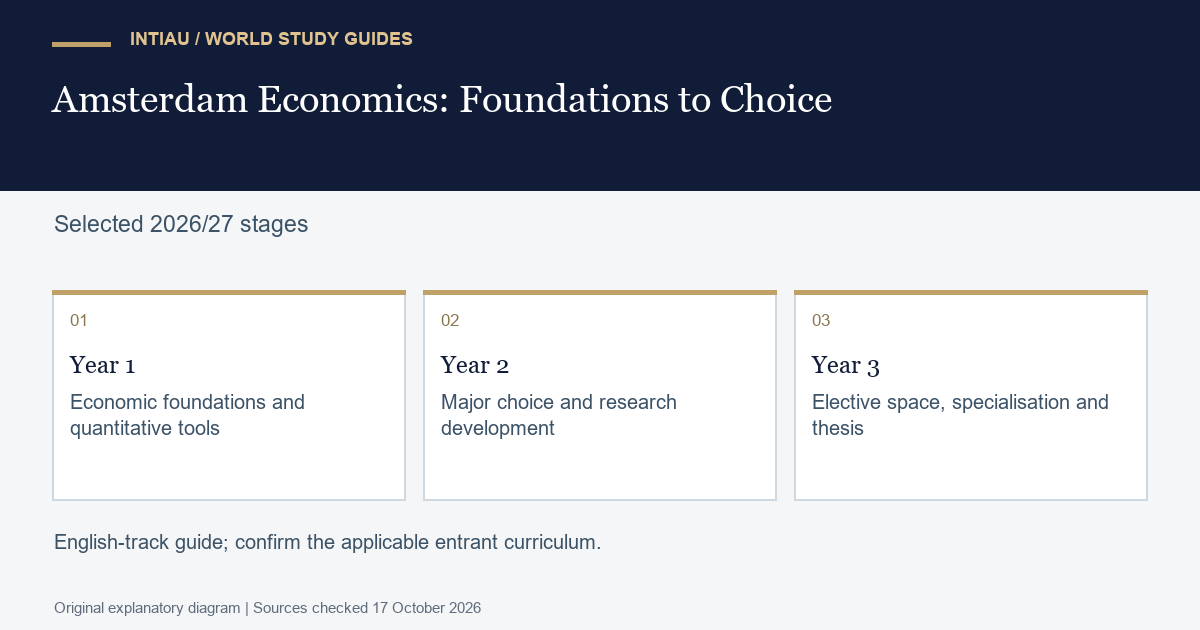
The University of Amsterdam is separate from INTIAU; its BSc Economics and Business Economics is a three-year, 180-ECTS degree. This guide concerns the English track at Roeterseiland campus, Amsterdam.
An economics comparison becomes more useful when you distinguish a question about an individual decision from a question about an entire economy. Ask what is being explained, which choices are possible and what information is missing. A numerical answer can be precise while the model supporting it remains too narrow for the decision at hand.
Read the curriculum edition before planning a route
| Year | Published structure |
|---|---|
| 1 | Economic foundations, mathematics, statistics and a research project. |
| 2 | Further methods; Economics or Business Economics major; research laboratory. |
| 3 | Elective space, specialised study and thesis. |
Compare the sequence with the kind of reasoning you want to develop. Identifying a pattern, explaining an incentive and recommending a policy are related activities, but they require different evidence. In your own notes, distinguish required study from a possible elective and an appealing topic from a confirmed course offering.
A real quantitative course example
The study-programme page describes Mathematics 1 for Economics through selecting, applying and interpreting mathematical methods. It explicitly dates the curriculum to 2026/27 and warns that the following year may change. This is a selected example, not a complete syllabus.
Read that description as a prompt to connect calculation and interpretation. After obtaining a result, write what it measures, which assumptions it needs and what it cannot establish. A comparison sheet that records those boundaries will tell you more than a list of software packages or familiar school topics.
Original worked exercise: price and quantity
This exercise is created for this guide, not assigned by Amsterdam. Imagine a fictional café selling 120 drinks at a price of 8 units each. Its daily sales revenue is 960 units. After a price change to 9 units, it sells 100 drinks and receives 900 units. The higher price coincides with lower revenue in this invented example.
Calculate the changes carefully: price rises by 12.5 percent, quantity falls by about 16.7 percent and revenue falls by 6.25 percent. Write the baseline beside each calculation so that a reader can reproduce it. These percentages describe the simulated observations; they do not explain why demand changed.
Now add a possible confounder: the second day had shorter opening hours. Identify what information would help separate a price response from a change in opportunity to buy. You might want comparable hours, repeated observations or information about another relevant change. State why your proposed comparison improves the question rather than simply producing more numbers.
Next ask whether the café’s profit increased or decreased. The revenue figures alone cannot answer. Create two fictional cost scenarios that would lead to different conclusions. Keep fixed and per-drink costs clearly labelled. Your purpose is to expose the missing information, not to recommend an actual pricing decision or claim a universal rule about businesses.
Finish with a one-page note containing the calculations, a small assumption table and two competing explanations. Ask a reader which sentence is a description and which is an inference. Revise any sentence that presents a possible cause as established fact. This turns a simple arithmetic task into a useful comparison of modelling, evidence and judgement.
Keep the applicant route distinct from the curriculum
The international-prior-education instructions identify the English track as numerus fixus. For September 2027, the application deadline is 15 January 2027. Begin through Studielink, then follow the university’s document and selection instructions.
The January date was future when checked on 17 October 2026. Build a checklist for your exact qualification, mathematics preparation and English evidence; do not assume that registering an interest completes selection. Keep questions about the major you might choose later on a separate sheet from the conditions for entering the bachelor.
Before relying on any future study plan, reopen the current curriculum and course catalogue. A degree title can remain stable while individual options change. Record the academic year beside each saved description and ask the university to resolve any difference that would affect a required combination.
Frequently asked questions
Is the degree based at Roeterseiland?
Yes. That is the listed campus.
Is this a guaranteed 2027 module list?
No. The cited curriculum is 2026/27.
Does the English track have selection?
Yes. The application guidance identifies a numerus-fixus route.
INTIAU’s separate information is available through Courses and Contact. Amsterdam controls its own admission and academic requirements.
Related guides
View the study diagram