
The University of California, Berkeley offers the Bachelor of Science in Environmental Economics and Policy through Rausser College; this independent guide describes that university programme, not an INTIAU award or partnership. Official programme record.
An environmental preference becomes a more demanding question when someone must explain its costs, incentives and consequences. Use this guide to investigate whether you enjoy that kind of reasoning. A strong comparison makes its assumptions visible, keeps a calculation separate from a value judgement, and records whose experience might be absent from the available evidence.
Identify the route and the record
College advising describes lower-division preparation in microeconomics, calculus and statistics, followed by upper-division environmental and resource economics. Its current guidance locates the major in Rausser rather than Letters and Science. College guidance.
The catalogue distinguishes applying directly to the major from the Rausser undeclared route; existing Berkeley students have separate change-of-major or college procedures. Admission-to-major section.
Sources were checked on 17 October 2026. A current developmental map is not a guaranteed semester timetable or a future admission offer. Before selecting a course, place the applicable catalogue, your entry classification and the actual teaching term beside one another. Keep unresolved differences as questions for the university rather than silently choosing the most convenient version.
A condensed progression map
| Stage | Selected published study | Question for your notebook |
|---|---|---|
| Foundations | Microeconomics, calculus and statistics | Can I explain a marginal change? |
| Developing analysis | Intermediate microeconomics, then upper-division quantitative methods | Which assumption can I test? |
| Advanced choices | Environmental or natural-resource economics and ENVECON electives | Which resource problem interests me? |
| Optional investigation | ENVECON 195 for students undertaking the EEP senior thesis | What evidence would answer my question? |
The major map presents the thesis as a choice, not a universal final-year requirement.
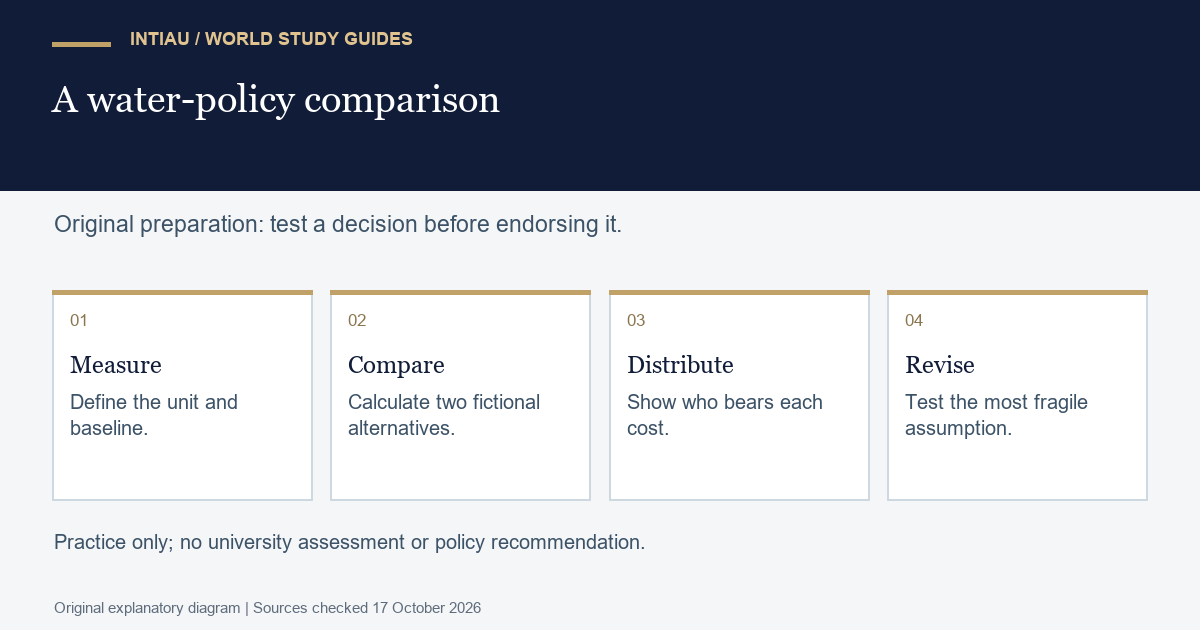
Worked exercise: two water-saving proposals
This invented exercise is independent preparation, not Berkeley coursework. Imagine a small community using 1,000 units of water each month. Proposal A costs 600 fictional currency units and saves 100 water units; proposal B costs 960 and saves 160. Both therefore cost six currency units per water unit saved. Write the denominator explicitly: comparing total expenditure alone would conceal this initial similarity.
Now add a distribution question. Under A, each of twenty households pays thirty currency units. Under B, eight high-use households pay ninety and twelve others pay twenty. Check that the contributions total 960. The average cost-effectiveness remains the same, but the allocation of payments changes. Explain why a statement that one proposal is simply cheaper does not yet answer whether its burden is acceptable.
Test the weakest assumption next. Suppose B saves only 120 units because participation is lower than expected. Its cost per saved unit becomes eight. Record that this is a scenario, not an observed forecast. Identify the missing evidence: baseline measurement quality, participation, maintenance, and whether savings persist. Do not invent a household survey to close the gap.
Finally, write a short decision memo with four sentences: the initial comparison, the distribution concern, the sensitivity result, and the next observation needed. A cautious conclusion can prefer a trial or further measurement. The useful achievement is a traceable argument that another person can inspect and challenge.
Turn the exercise into a study question
Annotate your memo using three colours for arithmetic, empirical evidence and ethical judgement. If a sentence mixes all three, divide it. Then choose one skill to practise: graphing a relationship, explaining an incentive, or checking the uncertainty behind a numerical claim. Keep the worked calculation and a corrected version; the revision usually reveals more about your preparation than an unsupported declaration of enthusiasm.
For an application plan, create separate rows for applicant category, academic preparation, documents and questions requiring an official answer. Add a date only after reading the relevant cycle page. This keeps a curriculum comparison from becoming an unreliable deadline checklist.
Frequently asked questions
Is this the same as the Economics major?
This record is specifically Environmental Economics and Policy in Rausser College. Use its own requirements rather than substituting another major’s checklist.
Does every student complete the thesis?
The published map describes ENVECON 195 for students choosing the EEP senior thesis; it does not make that choice universal.
What should I prepare before seeking advice?
Bring your applicant category, the dated source, a short mathematical example and one precise unresolved question. Avoid sending private records through an unrelated public contact route.
View the study diagram
Official sources
For other independent study comparisons, see INTIAU Courses; general enquiries can use Contact. The named university decides its own admissions and academic requirements.